Research identifies new way to treat common hospital-acquired infection
August 21, 2011 in Diseases, Conditions, Syndromes
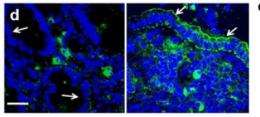
The right image shows abundant S-nitrosylation (green) in human colitis compared with much less found in the left image of a normal colon. Credit: UCLA/University of Texas Medical Branch at Galveston
Researchers at the David Geffen School of Medicine at UCLA and the University of Texas Medical Branch at Galveston have discovered a molecular process by which the body can defend against the effects of Clostridium difficile infection (CDI), pointing the way to a promising new approach for treating an intestinal disease that has become more common, more severe and harder to cure in recent years.
In the U.S., several million people are infected each year, approximately double the incidence of a decade ago, mainly due to the emergence of a new, highly virulent strain of the bacteria that causes CDI.
As a result of the study findings, published in the Aug. 21 online edition of the journal Nature Medicine, the researchers are preparing to launch clinical trials using their discovery as a new CDI therapeutic approach. The team also included researchers from Case Western Reserve University, Tufts University and the Commonwealth Medical College.
CDI is a bacterial infection that can cause diarrhea and more serious intestinal conditions, such as colitis, the inflammation of the colon. In the most severe cases, CDI can be fatal. It is most commonly acquired in hospitals by patients, particularly the elderly, who are being treated with antibiotics for another infection.
Currently, one of two potent antibiotics is used to treat the infection, but up to 20 percent of patients experience a relapse and a return of symptoms within a few weeks.
"We are treating a disease caused by antibiotics with yet another antibiotic, which creates the conditions for re-infection from the same bacteria," said study co-author Dr. Charalabos Pothoulakis, director of UCLA's Inflammatory Bowel Disease Center and a professor of medicine in the division of digestive diseases. "Identification of new treatment modalities to treat this infection would be a major advance."
Clostridium difficile causes diarrhea and colitis by releasing two potent toxins into the gut lumen that bind to intestinal epithelial cells, initiating an inflammatory response. These toxins are released only when the Clostridium difficile bacteria are multiplying. When antibiotics are used to treat another infection, it changes the bacterial landscape in the gut and, in the process, may kill bacteria that under normal conditions would compete with Clostridium difficile for energy. Scientists believe this may be what provides the opportunity for Clostridium difficile to grow and release its toxins.
The UCLA and University of Texas researchers found in laboratory studies that upon infection with Clostridium difficile, human cells in the gut are capable of releasing molecules that will neutralize these toxins, rendering them harmless. In animal studies, the researchers showed that using a drug to induce this process, known as protein s-nitrosylation, inhibited Clostridium difficile toxins from destroying intestinal cells. Forthcoming clinical trials will test this approach in humans.
"Our study suggests a novel therapeutic approach for treating Clostridium difficile infection by exploiting a newly discovered defense mechanism that has evolved in humans to inactivate microbial toxins," said Tor C. Savidge, an associate professor in the division of gastroenterology and hepatology at the University of Texas Medical Branch at Galveston and the paper's lead author.
Along with its potential to provide a much-needed new approach to treating CDI, the discovery could be applied to developing new treatments for other forms of diarrhea, as well as non-diarrheal diseases caused by bacteria.
"We already know through gene-sequencing analysis that hundreds of microbial proteins can be regulated by s-nitrosylation," Pothoulakis said. "If we are successful with this approach, we may be able to treat other bacterial diseases in a similar way."
Provided by University of California - Los Angeles
-
Thuricin CD tested as specific antibiotic for Clostridium difficile
May 03, 2010 |
not rated yet |
0
-
New guidelines for diagnosing, managing and treating Clostridium difficile
Mar 22, 2010 |
not rated yet |
0
-
Deadly stomach infection rising in community settings, study finds
Oct 26, 2009 |
not rated yet |
0
-
New treatment shown to reduce recurrence of debilitating diarrhea
Jan 20, 2010 |
not rated yet |
0
-
The balance shifts
May 27, 2008 |
not rated yet |
0
-
Motion perception revisited: High Phi effect challenges established motion perception assumptions
Apr 23, 2013 |
3 / 5 (2) |
2
-
Anything you can do I can do better: Neuromolecular foundations of the superiority illusion (Update)
Apr 02, 2013 |
4.5 / 5 (11) |
5
-
The visual system as economist: Neural resource allocation in visual adaptation
Mar 30, 2013 |
5 / 5 (2) |
9
-
Separate lives: Neuronal and organismal lifespans decoupled
Mar 27, 2013 |
4.9 / 5 (8) |
0
-
Sizing things up: The evolutionary neurobiology of scale invariance
Feb 28, 2013 |
4.8 / 5 (10) |
14
-
Classical and Quantum Mechanics via Lie algebras
Apr 15, 2011
- More from Physics Forums - Independent Research
More news stories
WHO voices deep concern over spread of SARS-like virus
The World Health Organization voiced deep concern Thursday over the SARS-like virus that has killed 22 people in less than a year, saying it might potentially spread more widely between humans.
Diseases, Conditions, Syndromes
3 hours ago |
5 / 5 (1) |
0
WHO: Scientific red tape mars efforts vs. virus
International efforts to combat a new pneumonia-like virus that has now killed 22 people are being slowed by unclear rules and competition for the potentially profitable rights to disease samples, the head ...
Diseases, Conditions, Syndromes
15 hours ago |
not rated yet |
0
Shortage of key drug hampering U.S. efforts to control TB, report says
(HealthDay)—A shortage of a critical tuberculosis drug has hampered the efforts of health departments across the United States to contain the spread of the highly infectious lung disease, federal officials ...
Diseases, Conditions, Syndromes
16 hours ago |
not rated yet |
0
Heart healthy lifestyle may cut kidney disease patients' risk of kidney failure
Maintaining a heart healthy lifestyle may also help protect chronic kidney disease patients from developing kidney failure and dying prematurely, according to a study appearing in an upcoming issue of the Journal of the Am ...
Diseases, Conditions, Syndromes
16 hours ago |
not rated yet |
0
Flu vaccine also linked to narcolepsy in adults, study reports
Finnish researchers unveiled new data Thursday to link the Pandemrix flu vaccine to a higher risk of the sleeping disorder narcolepsy in adults.
Diseases, Conditions, Syndromes
17 hours ago |
not rated yet |
0
Engineered cytomegalovirus protects monkeys from HIV equivalent
(Medical Xpress)—A new study by researchers in the US has shown that an ancient virus can be modified to help in the fight against the simian immunodeficiency virus SIV, which is the equivalent in monkeys ...
Help at hand for people with schizophrenia
How can healthy people who hear voices help schizophrenics? Finding the answer for this is at the centre of research conducted at the University of Bergen.
Scientists put bowel cancer under the microscope
Researchers from London's Kingston University have begun a two-year study which could help prolong the lives of people with colorectal tumours.
New neuron formation could increase capacity for new learning, at the expense of old memories
New research presented today shows that formation of new neurons in the hippocampus - a brain region known for its importance in learning and remembering - could cause forgetting of old memories by causing a reorganization ...
Are there atheists in foxholes? Study says they're the minority
Ernie Pyle – an iconic war correspondent in World War II – reportedly said "There are no atheists in foxholes." A new joint study between two brothers at Cornell and Virginia Wesleyan found that only ...
Breathing exercises help veterans find peace after war, scholar says
(Medical Xpress)—Research by Stanford scholar Emma Seppala at the Center for Compassion and Altruism Research and Education found that post-traumatic stress disorder decreased in veterans who participated ...
Aug 22, 2011
Rank: not rated yet
If side effects are near nil, use it now! Why allow compromised patients to continue to suffer, weaken, and worse!
It took over a Decade for the World's Medical Community to accept an Australian Physician's discovery of 'Helocobactor pylori', as the cause of most Stomach/intestinal Ulcers . . . a lot of suffering and death during those years of denial!
Roy J Stewart,
Phoenix AZ
P.S. Working together, We can 'Greatly' reduce the Distance between the Laboratory and the Factory Floor/Clinical application!