Holograms reveal brain's inner workings
August 16, 2011 in Neuroscience
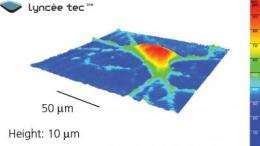
This is a 3-D image of living neuron taken by DHM technology. Credit: Courtesy of Lyncée Tec
Like far away galaxies, powerful tools are required to bring the minute inner workings of neurons into focus. Borrowing a technique from materials science, a team of neurobiologists, psychiatrists, and advanced imaging specialists from Switzerland's EPLF and CHUV report in The Journal of Neuroscience how Digital Holographic Microscopy (DHM) can now be used to observe neuronal activity in real-time and in three dimensionswith up to 50 times greater resolution than ever before. The application has immense potential for testing out new drugs to fight neurodegenerative diseases such as Alzheimer's and Parkinson's.
Neurons come in various shapes and are transparent. To observe them in a Petri dish, scientists use florescent dyes that change the chemical composition and can skew results. Additionally, this technique is time consuming, often damages the cells, and only allows researchers to examine a few neurons at a time. But these newly published results show how DHM can bypass the limitations of existing techniques.
"DHM is a fundamentally novel application for studying neurons with a slew of advantages over traditional microscopes," explains Pierre Magistretti of EPFL's Brain Mind Institute and a lead author of the paper. "It is non-invasive, allowing for extended observation of neural processes without the need for electrodes or dyes that damage cells."
This video is not supported by your browser at this time.
This is an interview with Pierre Magistretti of EPFL's Brain Mind Institute on using DHM to render neurons. Credit: Courtesy of EPFL
Senior team member Pierre Marquet adds, "DHM gives precious information not only about the shape of neurons, but also about their dynamics and activity, and the technique creates 3D navigable images and increases the precision from 500 nanometers in traditional microscopes to a scale of 10 nanometers."A good way to understand how DHM works is to imagine a large rock in an ocean of perfectly regular waves. As the waves deform around the rock and come out the other side, they carry information about the rock's shape. This information can be extracted by comparing it to waves that did not smash up against the rock, and an image of the rock can be reconstructed. DHM does this with a laser beam by pointing a single wavelength at an object, collecting the distorted wave on the other side, and comparing it to a reference beam. A computer then numerically reconstructs a 3D image of the objectin this case neuronsusing an algorithm developed by the authors. In addition, the laser beam travels through the transparent cells and important information about their internal composition is obtained.
Normally applied to detect minute defects in materials, Magistretti, along with DHM pioneer and EPFL professor in the Advanced Photonics Laboratory, Christian Depeursinge, decided to use DHM for neurobiological applications. In the study, their group induced an electric charge in a culture of neurons using glutamate, the main neurotransmitter in the brain. This charge transfer carries water inside the neurons and changes their optical properties in a way that can be detected only by DHM. Thus, the technique accurately visualizes the electrical activities of hundreds of neurons simultaneously, in real-time, without damaging them with electrodes, which can only record activity from a few neurons at a time.
A major advance for pharmaceutical research
Without the need to introduce dyes or electrodes, DHM can be applied to High Content Screeningthe screening of thousands of new pharmacological molecules. This advance has important ramifications for the discovery of new drugs that combat or prevent neurodegenerative diseases such as Parkinson's and Alzheimer's, since new molecules can be tested more quickly and in greater numbers.
"Due to the technique's precision, speed, and lack of invasiveness, it is possible to track minute changes in neuron properties in relation to an applied test drug and allow for a better understanding of what is happening, especially in predicting neuronal death," Magistretti says. "What normally would take 12 hours in the lab can now be done in 15 to 30 minutes, greatly decreasing the time it takes for researchers to know if a drug is effective or not."
More information: Determination of Transmembrane Water Fluxes in Neurons Elicited by Glutamate Ionotropic Receptors and by the Cotransporters KCC2 and NKCC1: A Digital Holographic Microscopy Study, The Journal of Neuroscience, August 17, 2011 31(33):11846
Provided by Ecole Polytechnique Federale de Lausanne
-
New microscope records firing of thousands of individual neurons in 3-D
Jan 12, 2011 |
not rated yet |
0
-
Light-controlled neo-neurons in the brain
Dec 15, 2010 |
not rated yet |
0
-
Microchip technology rapidly identifies compounds for regrowing nerves in live animals
Oct 11, 2010 |
not rated yet |
0
-
Protecting neurons could halt Alzheimer's, Parkinson's diseases
Nov 13, 2008 |
not rated yet |
0
-
'Noisiest' neurons persist in the adult brain
Jan 13, 2010 |
not rated yet |
0
-
Of mice and mental models: Neuroscientific implications of risk-optimized behavior in the mouse
13 hours ago |
not rated yet |
0
-
Limits to growth: Scientists identify key metastasis-enabling enzyme
May 22, 2012 |
5 / 5 (4) |
0
-
Seeing is as seeing does: Spatially-structured retinal input in early development of cortical maps
Apr 26, 2012 |
5 / 5 (4) |
1
-
Dreamless nights: Brain activity during nonrapid eye movement sleep
Apr 09, 2012 |
4.4 / 5 (12) |
0
-
Take your time: Neurobiology sheds light on the superiority of spaced vs. massed learning
Mar 28, 2012 |
4.5 / 5 (21) |
3
-
A question about drug tolerance
May 23, 2012
-
Poor nutrition leading to overeating?
May 23, 2012
-
Math and dyslexia?
May 21, 2012
-
portable metabolism meter?
May 21, 2012
-
Rare medical conditions on 20/20 tonight
May 18, 2012
-
"Good" Cholesterol in Doubt
May 17, 2012
- More from Physics Forums - Medical Sciences
More news stories
Of mice and mental models: Neuroscientific implications of risk-optimized behavior in the mouse
(Medical Xpress) -- Regardless of an organism’s biological complexity, every encephalized animal continuously makes under-informed behavioral choices that can have serious consequences. Despite its ubiquity, ...
Neuroscience
13 hours ago |
not rated yet |
0
|
Persistent sensory experience is good for aging brain
Despite a long-held scientific belief that much of the wiring of the brain is fixed by the time of adolescence, a new study shows that changes in sensory experience can cause massive rewiring of the brain, even as one ages. ...
Neuroscience
May 24, 2012 |
not rated yet |
0
Boundary stops molecule right where it needs to be
A molecule responsible for the proper formation of a key portion of the nervous system finds its way to the proper place not because it is actively recruited, but instead because it can't go anywhere else.
Neuroscience
May 24, 2012 |
not rated yet |
0
|
Locating ground zero: How the brain's emergency workers find the disaster area
Like emergency workers rushing to a disaster scene, cells called microglia speed to places where the brain has been injured, to contain the damage by 'eating up' any cellular debris and dead or dying neurons. ...
Neuroscience
May 24, 2012 |
5 / 5 (2) |
0
|
Genetic 'reset switch' enables signaling pathway to induce multiple developmental outcomes for olfactory neurons
Within the nervous system, a handful of signaling pathways modulate development of a cornucopia of different neuronal subtypes. Even small alterations in neuron differentiation pathways can disrupt subsequent ...
Neuroscience
May 24, 2012 |
not rated yet |
0
Tongue analysis software uses ancient Chinese medicine to warn of disease
For 5,000 years, the Chinese have used a system of medicine based on the flow and balance of positive and negative energies in the body. In this system, the appearance of the tongue is one of the measures used to classify ...
Cancer may require simpler genetic mutations than previously thought
Chromosomal deletions in DNA often involve just one of two gene copies inherited from either parent. But scientists haven't known how a deletion in one gene from one parent, called a "hemizygous" deletion, can contribute ...
Inherited DNA change explains overactive leukemia gene
A small inherited change in DNA is largely responsible for overactivating a gene linked to poor treatment response in people with acute leukemia.
Skp2 activates cancer-promoting, glucose-processing Akt
HER2 and its epidermal growth factor receptor cousins mobilize a specialized protein to activate a major player in cancer development and sugar metabolism, scientists report in the May 25 issue of Cell.
Early physical therapist treatment associated with reduced risk of healthcare utilization and reduced overall healthcare
A new study published in Spine shows that early treatment by a physical therapist for low back pain (LBP), as compared to delayed treatment, was associated with reduced risk of subsequent healthcare utilization and lower ...
New device allows pacemaker patients to safely undergo MRIs
For many, it's a medical conundrum: The very pacemaker keeping their heart in rhythm prevents them from undergoing an MRI to diagnose other ailments, because interaction between the two devices could prove deadly.