Computational method predicts new uses for existing medicines
August 17, 2011 in Medical research
Computational method predicts new uses for existing medicines

Enlarge

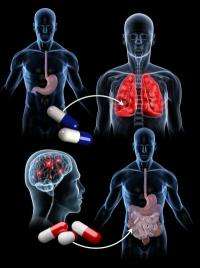
The researchers found that an anti-ulcer medicine might treat lung cancer and an anticonvulsant might alleviate inflammatory bowel diseases, Credit: Copyright Marina Sirota

For the first time ever, scientists are using computers and genomic information to predict new uses for existing medicines.

A National Institutes of Health-funded computational study analyzed genomic and drug data to predict new uses for medicines that are already on the market. A team led by Atul J. Butte, M.D., Ph.D., of Stanford University, Palo Alto, Calif., reports its results in two articles in the Aug. 17 online issue of Science Translational Medicine.

"Bringing a new drug to market typically takes about $1 billion, and many years of research and development," said Rochelle M. Long, Ph.D., who directs the NIH Pharmacogenomics Research Network. "If we can find ways to repurpose drugs that are already approved, we could improve treatments and save both time and money."

The scientists drew their data from the NIH National Center for Biotechnology Information Gene Expression Omnibus, a publicly available database that contains the results of thousands of on a wide range of topics, submitted by researchers across the globe. The resource catalogs changes in under various conditions, such as in diseased tissues or in response to medications.

Butte's group focused on 100 diseases and 164 drugs. They created a to search through the thousands of possible drug-disease combinations to find drugs and diseases whose essentially cancelled each other out. For example, if a disease increased the activity of certain genes, the program tried to match it with one or more drugs that decreased the activity of those .

Many of the drug-disease matches were known, and are already in clinical use, supporting the validity of the approach. For example, the analysis correctly predicted that prednisolone could treat Crohn's disease, a condition for which it is a standard therapy.

Other matches were surprises. Butte's team chose to further investigate two such drug-disease combinations: an anti-ulcer medicine (cimetidine) that matched with lung cancer, and an anticonvulsant (topiramate) that matched with inflammatory bowel disease, which includes Crohn's disease.

To confirm the cimetidine-lung cancer link, the team tested cimetidine on human lung cancer cells in lab dishes and implanted in mice. In both cases, the drug slowed the growth of the cancer cells compared to the control group (cells or mice) that had not received cimetidine.

To test whether the anticonvulsant topiramate had an effect on inflammatory bowel diseases, the researchers administered the drug to rats that had bowel disease symptoms—diarrhea and inflammation, ulcers and microscopic damage in the colon. The decreased all of these symptoms, sometimes even better than .

The work also has more fundamental value. The scientists noticed that diseases with similar molecular processes (for example, those that affect the immune system) clustered together in the analysis. So did drugs with similar effects (for example, those that slow cell division). The researchers believe that, by studying unexpected members of these clusters, they could learn more about how certain diseases progress and how some drugs work at the molecular level.

"This work is still at an early stage, but it is a promising proof of principle for a creative, fast and affordable approach to discovering new uses for drugs we already have in our therapeutic arsenal," Long said.

More information: Sirota M, Dudley JT, Kim J, Chiang AP, Morgan AA, Sweet-Cordero A, Sage J, Butte AJ. Discovery and Preclinical Validation of Drug Indications Using Compendia of Public Gene Expression Data. Sci Transl Med. 2011 Aug 17.

Dudley JT, Sirota M, Shenoy M, Pai R, Roedder S, Chiang AP, Morgan AA, Sarwal M, Pasricha PJ, Butte AJ. Computational Repositioning of the Anticonvulsant Topiramate for Inflammatory Bowel Disease. Sci Transl Med. 2011 Aug 17.

Provided by National Institutes of Health

5 /5 (14 votes)  

Filter


Move the slider to adjust rank threshold, so that you can hide some of the comments.


Display comments: newest first

Nanobanano
Aug 17, 2011

Rank: not rated yet
This research deserves all the funding they can get.

Also, turn it around:

They should also try this with the negative side-effects of drugs and gene or disease combinations, to see if the side-effects are being caused by other relationships which can be predicted. This may be useful in finding cures for diseases similar to the illnesses created by known drug side-effects.

If they could use these models to predict negative side-effects, it would add further support to the technique, and it would allow potentially understanding the "natural" versions of illnesses similar to those side effects. If you understand the molecular chemistry of the negative side-effects of a drug, it may allow you to understand the pathogenic nature of viruses and bacteria which make symptoms similar to those drugs' side effects.
rabrav
Aug 18, 2011

Rank: not rated yet
@Nanobanano
There was an article on exactly that on the website "eurekaalert" titled:

"Dangerous side effect of common drug combination discovered by Stanford data mining" (Public release date: 25-May-2011; Stanford University Medical Center )

I would have posted the link but the spam filter didn't let it through
`
Rank 5 /5 (14 votes)
Relevant PhysicsForums posts
  • A question about drug tolerance
    createdMay 23, 2012
  • Poor nutrition leading to overeating?
    createdMay 23, 2012
  • Math and dyslexia?
    createdMay 21, 2012
  • portable metabolism meter?
    createdMay 21, 2012
  • Rare medical conditions on 20/20 tonight
    createdMay 18, 2012
  • "Good" Cholesterol in Doubt
    createdMay 17, 2012
  • More from Physics Forums - Medical Sciences

More news stories

Implantable pain disk may help those with cancer

An estimated 3.5 million cancer patients around the globe are in severe pain from their disease, but many get no relief.

Medical research created 12 hours ago | popularity not rated yet | comments 0 | with audio podcast

Energy levels link sleep control mechanisms

Sleep, or lack of it, can determine level of cognitive performance which is linked with accidents as well as increased risk of serious health problems. Links between cell energy levels, gene transcription ...

Medical research created 14 hours ago | popularity not rated yet | comments 0

Researchers identify key brain cell in antidepressant action

(Medical Xpress) -- Antidepressant medications such as Prozac have helped improve mood and lessen anxiety in millions of people with major depression. But scientists know surprisingly little about how these drugs work.

Medical research created 15 hours ago | popularity 4 / 5 (1) | comments 0 | with audio podcast

Rockefeller scientists pioneer new method to determine mechanisms of drug action

(Medical Xpress) -- Knowing that a drug works is great. Knowing how it works is a luxury. And until now, determining a drug’s mechanism of action has been a tedious and difficult process for scientists.

Medical research created 15 hours ago | popularity not rated yet | comments 0 | with audio podcast

Like curry? New biological role identified for compound used in ancient medicine

Scientists have just identified a new reason why some curry dishes, made with spices humans have used for thousands of years, might be good for you.

Medical research created 22 hours ago | popularity 4.3 / 5 (9) | comments 2 | with audio podcast


Of mice and mental models: Neuroscientific implications of risk-optimized behavior in the mouse

(Medical Xpress) -- Regardless of an organism’s biological complexity, every encephalized animal continuously makes under-informed behavioral choices that can have serious consequences. Despite its ubiquity, ...

Tongue analysis software uses ancient Chinese medicine to warn of disease

For 5,000 years, the Chinese have used a system of medicine based on the flow and balance of positive and negative energies in the body. In this system, the appearance of the tongue is one of the measures used to classify ...

Cancer may require simpler genetic mutations than previously thought

Chromosomal deletions in DNA often involve just one of two gene copies inherited from either parent. But scientists haven't known how a deletion in one gene from one parent, called a "hemizygous" deletion, can contribute ...

Inherited DNA change explains overactive leukemia gene

A small inherited change in DNA is largely responsible for overactivating a gene linked to poor treatment response in people with acute leukemia.

Skp2 activates cancer-promoting, glucose-processing Akt

HER2 and its epidermal growth factor receptor cousins mobilize a specialized protein to activate a major player in cancer development and sugar metabolism, scientists report in the May 25 issue of Cell.

Early physical therapist treatment associated with reduced risk of healthcare utilization and reduced overall healthcare

A new study published in Spine shows that early treatment by a physical therapist for low back pain (LBP), as compared to delayed treatment, was associated with reduced risk of subsequent healthcare utilization and lower ...