The universe in your skull
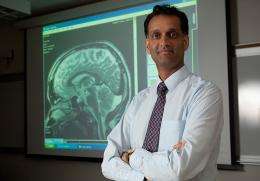
In the mid-1990s, Pradeep Ramanathan was working at the technology company Intel in California’s Silicon Valley. With a background in physics and engineering, he was successful in his job, but he had an insistent feeling that he was “caught in a rat race,” as he says.
On a whim, he took a career test, which told him he should be a speech pathologist.
Now, almost 15 years later, he is an assistant professor of communication sciences in the College of Liberal Arts and Sciences, conducting research on memory and traumatic brain injuries. Despite twists and turns along the way, like taking coursework in Southeast Asian studies and his native language Tamil at Berkeley, singing in operas, and becoming an advanced meditation practitioner, Ramanathan has gone from engineer to speech pathologist to college professor—and never looked back.
“I just kind of fell into this,” he says. “I love the brain, and that’s what brought me here.”
After leaving his job at Intel, Ramanathan enrolled in the speech pathology graduate program at the University of Minnesota and then began working in a stroke center at a local hospital. Seeing so many patients with brain injuries convinced him he wanted to help these people in a substantive way.
Today, Ramanathan studies traumatic brain injuries, which occur when some physical impact affects the brain’s normal function. No matter how or where a person is hit in the head—whether a soldier who is harmed in battle or a person who slips on ice—certain parts of the brain are more frequently injured than others, he says.
“When you get hit in the head, the frontal lobes are very often affected, and that’s where much of the self-regulation of behavior and sociobehavioral interactions takes place,” Ramanathan says.
Among the problems that can arise from these injuries are changes in what is called metamemory, which involves the awareness and control of one’s own memory processes.
“People with traumatic brain injuries are often not as aware of how bad their memory has become,” says Ramanathan. “The ability to encode and retrieve information is often impaired in these patients. And on top of that, they may have reduced awareness of this memory impairment, which in turn means they may be less inclined to do something about it.”
Issues with metamemory can become serious problems: for example, a person may be so sure of their memory that they don’t think they need a reminder to take their medications, and then they forget to do so.
Ramanathan’s work examines aspects of this phenomenon using experiments in his laboratory. Subjects with and without brain injuries are asked to remember a series of pairs of words, and then asked how confident they are that they will remember them for a test. These metamemory judgments provide a window into individuals’ awareness of their memory performance.
To determine whether or not metamemory is related to skills like planning, reasoning, and problem solving, Ramanathan compares subjects’ ratings of their confidence in their memory to standardized tests of these functions. He has recently found that certain types of planning skills seem to be correlated with the ability to make metamemory judgments. But interestingly, individuals with traumatic brain injury seem to have difficulty applying these planning skills when they attempt to make such metamemory judgments.
“We want to figure out how people with traumatic brain injuries could get better and more realistic in their assessments of their own memory,” Ramanathan says.
He is also interested in what makes us remember things more or less easily. For example, scientists know that seeing, say, an upright piano will make you more quickly identify the piano subsequently. But Ramanathan and his colleagues found in 2010 that if you had instead first seen a desk of similar appearance, it would make you slightly slower or less accurate in identifying the piano.
The more similar two objects are—without being identical—the more they interfere with each other in our brains. The phenomenon is called antipriming—the opposite of its predecessor, priming, and Ramanathan wants to know how it works in people with traumatic brain injuries. Currently, he is creating neural network computer models to simulate what happens in the brain during each of these experiences.
“Priming functions are surprisingly intact in many traumatic brain injury survivors,” he says. “But is their antipriming intact?”
Sometime down the road, Ramanathan would like to bring his personal passion for meditation into his work. The type of meditation he practices, called Vipassana meditation, trains the mind to focus in ways that are often disrupted in people who have brain injuries and impaired judgment. He speculates that this type of meditation could also have a positive effect on people in prisons who display impaired judgment and escalated aggression, since many of them have suffered brain injuries.
But all that’s in the future. For now, Ramanathan is happy to be out of his Silicon Valley cubicle and into a career that he says marshals all of his skills: engineering, physics, speech pathology, and even meditation.
“Everything has to do with how the brain processes information,” he says. “It’s like an entire universe in your skull.”


