Crippling condition associated with diabetes is often misdiagnosed and misunderstood
September 1, 2011 in Diseases, Conditions, Syndromes
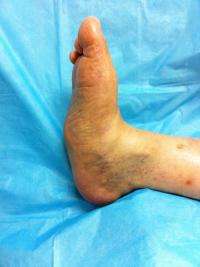
Photo of patient with Charcot foot, a syndrome described in a new journal article by Dr. Lee C. Rogers at Valley Presbyterian Hospital in Van Nuys, CA. Charcot foot syndrome causes the bones in the foot to soften and break, often resulting in amputation. Credit: Dr. Lee C. Rogers, Valley Presbyterian Hospital, Van Nuys, CA
Robert Winkler says he limped around on his painful left foot for six months, suffering unnecessarily from a misdiagnosis by a physician who didn't know about the symptoms and treatments for Charcot foot, a form of localized osteoporosis linked to diabetes that causes the bones to soften and break, often resulting in amputation.
When his primary care physician finally agreed to Mr. Winkler's request for an x-ray, they discovered the metatarsal bones in Mr. Winkler's left foot were all brokena common symptom of this serious and potentially limb-threatening lower-extremity complication.
A new article in the September issue of the journal, Diabetes Care, describes Charcot foot and its treatment with a goal of educating medical professionals about this painful inflammation of the foot. The article is the product of an international task force of experts convened by the American Diabetes Association and the American Podiatric Medical Association in January to summarize available evidence on the pathophysiology, natural history, presentations and treatment recommendations for Charcot foot syndrome.
"Even though it was first described in 1883, the diagnosis and successful treatment of Charcot foot continue to be a challenge because this syndrome is not widely known or understood by the broader medical profession," said Lee C. Rogers, D.P.M., co-director of the Amputation Prevent Center at Valley Presbyterian Hospital in Van Nuys, CA, and lead author of the Diabetes Care article. "Charcot foot is now considered to be an inflammatory syndrome most often seen in patients with diabetes which can be successfully treated in its early stages."
The article describes Charcot foot as a condition affecting the bones, joints and soft tissues of the foot and ankle, which is characterized by inflammation in the earliest phase and is associated with diabetes and neuropathy. The report finds offloading, or removing weight from the foot, is the most important initial treatment recommendation. Surgery can be helpful in early stages involving acute fractures of the foot or ankle or in later stages when offloading is ineffective, according to the article.
In Mr. Winkler's case, he was first diagnosed with Charcot foot in 2004 and had already undergone one surgery that relieved the problem for several years. By 2010, though, he was facing the potential amputation of the foot because of complications associated with Charcot foot syndrome.
His podiatrist referred him to Dr. Rogers at Valley Presbyterian Hospital's Amputation Prevention Center, an integrated limb salvage center that is one of only a handful in the nation. Since its December 2009 opening, the Amputation Prevention Center's specialized multidisciplinary team of highly skilled professionals has treated patients from all over the country and around the world with leading-edge technology, achieving a limb salvage rate of 96 percent.
George Andros, M.D., the Center's Medical Director, performed vascular surgery to restore circulation to Mr. Winkler's left foot so that it would heal. Then, Dr. Rogers performed surgery to rebuild the bones in Mr. Winkler's foot. Dr. Rogers also implanted a bone stimulator that acts like a pacemaker for bones which encourages Mr. Winkler's body to rebuild and fuse the broken bones in his left foot. As a result, Mr. Winkler is expected to be able to recover the use of his left foot.
"I'm very pleased because I had gone to another doctor and he wanted to amputate my foot," Mr. Winkler said. "When I found Dr. Rogers and Valley Presbyterian Hospital's Amputation Prevention Center, it's like I found a blessing and an angel in disguise. I have tears running down my face as I describe to you how I will be able to get up out of my chair and walk because of the care I received at Valley Presbyterian Hospital. All the people there are superb. They treat me like a king."
Provided by Valley Presbyterian Hospital
-
New treatment for crippling diabetic Charcot foot
Jul 14, 2010 |
not rated yet |
0
-
Team approach to foot care lowers risk of amputation in diabetes
Aug 19, 2010 |
not rated yet |
0
-
Cautionary tale for people with diabetes: Dog consumed part of a sleeping patient's toe
Jun 23, 2011 |
not rated yet |
0
-
Diabetics with previous foot ulcers may be able to participate in walking program
Jan 13, 2009 |
not rated yet |
0
-
Show and prove
Jun 15, 2009 |
not rated yet |
0
-
Of mice and mental models: Neuroscientific implications of risk-optimized behavior in the mouse
20 hours ago |
not rated yet |
0
-
Limits to growth: Scientists identify key metastasis-enabling enzyme
May 22, 2012 |
5 / 5 (4) |
0
-
Seeing is as seeing does: Spatially-structured retinal input in early development of cortical maps
Apr 26, 2012 |
5 / 5 (4) |
1
-
Dreamless nights: Brain activity during nonrapid eye movement sleep
Apr 09, 2012 |
4.4 / 5 (12) |
0
-
Take your time: Neurobiology sheds light on the superiority of spaced vs. massed learning
Mar 28, 2012 |
4.5 / 5 (21) |
3
-
Classical and Quantum Mechanics via Lie algebras
Apr 15, 2011
- More from Physics Forums - Independent Research
More news stories
Flesh-Eating bacteria no cause for panic, experts say
(HealthDay) -- Despite scary headlines by the score, most people don't have to fear that they'll be the next victim of the so-called flesh-eating bacteria disease, experts say.
Diseases, Conditions, Syndromes
15 hours ago |
not rated yet |
0
World Health Assembly endorses new plan to increase global access to vaccines
Ministers of Health from 194 countries at the Sixty-fifth World Health Assembly today endorsed a landmark Global Vaccine Action Plan (GVAP), a roadmap to prevent millions of deaths by 2020 through more equitable access to ...
Diseases, Conditions, Syndromes
18 hours ago |
not rated yet |
0
Physicians definitively links irritable bowel syndrome and bacteria in gut
An overgrowth of bacteria in the gut has been definitively linked to Irritable Bowel Syndrome in the results of a new Cedars-Sinai study which used cultures from the small intestine. This is the first study to use this "gold ...
Diseases, Conditions, Syndromes
19 hours ago |
not rated yet |
0
|
Study provides compelling evidence for an effective new treatment for tinnitus
According to new research, a multidisciplinary approach to treating tinnitus that combines cognitive behaviour therapy with sound-based tinnitus retraining therapy is significantly more effective than currently available ...
Diseases, Conditions, Syndromes
May 24, 2012 |
not rated yet |
0
Infections may be deadly for many dialysis patients
An infection called peritonitis commonly arises in the weeks before many dialysis patients die, according to a study appearing in an upcoming issue of the Journal of the American Society of Nephrology (JASN). The findings sugges ...
Diseases, Conditions, Syndromes
May 24, 2012 |
not rated yet |
0
Of mice and mental models: Neuroscientific implications of risk-optimized behavior in the mouse
(Medical Xpress) -- Regardless of an organism’s biological complexity, every encephalized animal continuously makes under-informed behavioral choices that can have serious consequences. Despite its ubiquity, ...
Tongue analysis software uses ancient Chinese medicine to warn of disease
For 5,000 years, the Chinese have used a system of medicine based on the flow and balance of positive and negative energies in the body. In this system, the appearance of the tongue is one of the measures used to classify ...
Cancer may require simpler genetic mutations than previously thought
Chromosomal deletions in DNA often involve just one of two gene copies inherited from either parent. But scientists haven't known how a deletion in one gene from one parent, called a "hemizygous" deletion, can contribute ...
Inherited DNA change explains overactive leukemia gene
A small inherited change in DNA is largely responsible for overactivating a gene linked to poor treatment response in people with acute leukemia.
Skp2 activates cancer-promoting, glucose-processing Akt
HER2 and its epidermal growth factor receptor cousins mobilize a specialized protein to activate a major player in cancer development and sugar metabolism, scientists report in the May 25 issue of Cell.
Early physical therapist treatment associated with reduced risk of healthcare utilization and reduced overall healthcare
A new study published in Spine shows that early treatment by a physical therapist for low back pain (LBP), as compared to delayed treatment, was associated with reduced risk of subsequent healthcare utilization and lower ...