More than a sign of sleepiness, yawning may cool the brain
September 19, 2011 in Neuroscience
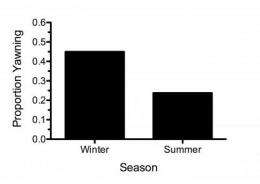
People yawn less frequently when outdoor temperatures exceed body temperature, suggesting that yawning could be a natural brain-cooling mechanism, Princeton University and University of Arizona researchers reported. They recorded yawning frequency in 160 people in summer and winter in Tucson, Ariz., 80 for each season. They found that nearly half of participants yawned in winter, opposed to less than a quarter in the summertime. Credit: Image by Andrew Gallup
Though considered a mark of boredom or fatigue, yawning might also be a trait of the hot-headed. Literally.
A study led by Andrew Gallup, a postdoctoral research associate in Princeton University's Department of Ecology and Evolutionary Biology, is the first involving humans to show that yawning frequency varies with the season and that people are less likely to yawn when the heat outdoors exceeds body temperature. Gallup and his co-author Omar Eldakar, a postdoctoral fellow in the University of Arizona's Center for Insect Science, report this month in the journal Frontiers in Evolutionary Neuroscience that this seasonal disparity indicates that yawning could serve as a method for regulating brain temperature.
Gallup and Eldakar documented the yawning frequency of 160 people in the winter and summer in Tucson, Arizona, with 80 people for each season. They found that participants were more likely to yawn in the winter, as opposed to the summer when ambient temperatures were equal to or exceeding body temperature. The researchers concluded that warmer temperatures provide no relief for overheated brains, which, according to the thermoregulatory theory of yawning, stay cool via a heat exchange with the air drawn in during a yawn.
Gallup describes the findings as follows:
"This provides additional support for the view that the mechanisms controlling the expression of yawning are involved in thermoregulatory physiology. Despite numerous theories posited in the past few decades, very little experimental research has been done to uncover the biological function of yawning, and there is still no consensus about its purpose among the dozen or so researchers studying the topic today.
"Enter the brain cooling, or thermoregulatory, hypothesis, which proposes that yawning is triggered by increases in brain temperature, and that the physiological consequences of a yawn act to promote brain cooling. I participated in a study [published in Frontiers in Evolutionary Neuroscience in September 2010] that confirmed this dynamic after we observed changes in the brain temperature of rats before and after the animals yawned. The cooling effect of yawning is thought to result from enhanced blood flow to the brain caused by stretching of the jaw, as well as countercurrent heat exchange with the ambient air that accompanies the deep inhalation.
"According to the brain cooling hypothesis, it is the temperature of the ambient air that gives a yawn its utility. Thus yawning should be counterproductive -- and therefore suppressed -- in ambient temperatures at or exceeding body temperature because taking a deep inhalation of air would not promote cooling. In other words, there should be a 'thermal window' or a relatively narrow range of ambient temperatures in which to expect highest rates of yawning.
"To test this theory in humans, I worked with Omar Eldakar to conduct a field-observational experiment that explored the relationship between ambient temperature and yawning frequency. We measured the incidence of yawning among people outdoors during the summer and winter months in Arizona. Summer conditions provided temperatures that matched or slightly exceeded body temperature (an average of 98.6 degrees Fahrenheit) with relatively low humidity, while winter conditions exhibited milder temperatures (71 degrees Fahrenheit on average) and slightly higher humidity. We randomly selected 160 pedestrians (80 for each season) and, because yawning is contagious, had them view images of people yawning.
"Our study accordingly showed a higher incidence of yawning across seasons when ambient temperatures were lower, even after statistically controlling for other features such as humidity, time spent outside and the amount of sleep the night before. Nearly half of the people in the winter session yawned, as opposed to less than a quarter of summer participants.
"Furthermore, when analyzing data for each season separately, we observed that yawning was related to the length of time a person spent outside exposed to the climate conditions. This was particularly true during the summer when the proportion of individuals yawning dropped significantly as the length of time spent outside increased prior to testing. Nearly 40 percent of participants yawned within the first five minutes outside, but the percentage of summertime yawners dropped to less than 10 percent thereafter. An inverse effect was observed in the winter, but the proportion of people who yawned increased only slightly for those who spent more than five minutes outdoors.
"This is the first report to show that yawning frequency varies from season to season. The applications of this research are intriguing, not only in terms of basic physiological knowledge, but also for better understanding diseases and conditions, such as multiple sclerosis or epilepsy, that are accompanied by frequent yawning and thermoregulatory dysfunction. These results provide additional support for the view that excessive yawning may be used as a diagnostic tool for identifying instances of diminished thermoregulation."
Provided by
Princeton University
-
Chimpanzees' contagious yawning evidence of empathy, not just sleepiness, study shows
Apr 06, 2011 |
not rated yet |
0
-
Children under 4 and children with autism don't yawn contagiously
Sep 15, 2010 |
not rated yet |
0
-
Yawning toons make an ape gape
Sep 08, 2009 |
not rated yet |
0
-
Yawn alert for weary drivers
Jul 27, 2009 |
not rated yet |
0
-
Researchers Find Evidence of Warming Climate In Ohio
Oct 08, 2007 |
not rated yet |
0
-
Of mice and mental models: Neuroscientific implications of risk-optimized behavior in the mouse
May 25, 2012 |
not rated yet |
0
-
Limits to growth: Scientists identify key metastasis-enabling enzyme
May 22, 2012 |
5 / 5 (4) |
0
-
Seeing is as seeing does: Spatially-structured retinal input in early development of cortical maps
Apr 26, 2012 |
5 / 5 (4) |
1
-
Dreamless nights: Brain activity during nonrapid eye movement sleep
Apr 09, 2012 |
4.4 / 5 (12) |
0
-
Take your time: Neurobiology sheds light on the superiority of spaced vs. massed learning
Mar 28, 2012 |
4.5 / 5 (21) |
3
-
Potential Breakthrough in Seizure Control
5 hours ago
-
Popping/Cracked sternum.
10 hours ago
-
Which Mental Illness Encompasses This Problem?
10 hours ago
-
A question about drug tolerance
May 23, 2012
-
Poor nutrition leading to overeating?
May 23, 2012
-
Math and dyslexia?
May 21, 2012
- More from Physics Forums - Medical Sciences
More news stories
Of mice and mental models: Neuroscientific implications of risk-optimized behavior in the mouse
(Medical Xpress) -- Regardless of an organism’s biological complexity, every encephalized animal continuously makes under-informed behavioral choices that can have serious consequences. Despite its ubiquity, ...
Neuroscience
May 25, 2012 |
not rated yet |
0
|
Persistent sensory experience is good for aging brain
Despite a long-held scientific belief that much of the wiring of the brain is fixed by the time of adolescence, a new study shows that changes in sensory experience can cause massive rewiring of the brain, even as one ages. ...
Neuroscience
May 24, 2012 |
not rated yet |
0
Boundary stops molecule right where it needs to be
A molecule responsible for the proper formation of a key portion of the nervous system finds its way to the proper place not because it is actively recruited, but instead because it can't go anywhere else.
Neuroscience
May 24, 2012 |
not rated yet |
0
|
Locating ground zero: How the brain's emergency workers find the disaster area
Like emergency workers rushing to a disaster scene, cells called microglia speed to places where the brain has been injured, to contain the damage by 'eating up' any cellular debris and dead or dying neurons. ...
Neuroscience
May 24, 2012 |
5 / 5 (2) |
0
|
Genetic 'reset switch' enables signaling pathway to induce multiple developmental outcomes for olfactory neurons
Within the nervous system, a handful of signaling pathways modulate development of a cornucopia of different neuronal subtypes. Even small alterations in neuron differentiation pathways can disrupt subsequent ...
Neuroscience
May 24, 2012 |
not rated yet |
0
Travel to high altitudes tied to Crohn's, colitis flare-ups
(HealthDay) -- People with inflammatory bowel disease, which includes Crohn's disease and colitis, may be at increased risk for flare-ups when they fly or travel to high altitudes for skiing or mountain climbing, ...
Transvaginal mesh op restores pelvic organ prolapse at price
(HealthDay) -- Transvaginal mesh (TVM) procedures are effective for anatomical restoration of pelvic organ prolapse (POP), but patients report a worsening of sexual function following surgery, according to ...
Cancer may require simpler genetic mutations than previously thought
Chromosomal deletions in DNA often involve just one of two gene copies inherited from either parent. But scientists haven't known how a deletion in one gene from one parent, called a "hemizygous" deletion, can contribute ...
Inherited DNA change explains overactive leukemia gene
A small inherited change in DNA is largely responsible for overactivating a gene linked to poor treatment response in people with acute leukemia.
Tongue analysis software uses ancient Chinese medicine to warn of disease
For 5,000 years, the Chinese have used a system of medicine based on the flow and balance of positive and negative energies in the body. In this system, the appearance of the tongue is one of the measures used to classify ...
Skp2 activates cancer-promoting, glucose-processing Akt
HER2 and its epidermal growth factor receptor cousins mobilize a specialized protein to activate a major player in cancer development and sugar metabolism, scientists report in the May 25 issue of Cell.
Sep 19, 2011
Rank: not rated yet
Sep 19, 2011
Rank: 5 / 5 (1)
Sep 19, 2011
Rank: not rated yet
Though it's a good rule of thumb to not settle for any notion--especially not before consensus finds it so (as in this case).
Sep 19, 2011
Rank: 5 / 5 (1)
Sep 20, 2011
Rank: not rated yet
If the theory is correct people in constantly hot tropical countries will never yawn while those in constantly cold arctic ones will all the time. But they did not do the phone calls (which is all that is needed) to check this out.
Sep 20, 2011
Rank: not rated yet
Sep 20, 2011
Rank: not rated yet
Sep 20, 2011
Rank: not rated yet
liquid coolant and a high speed fan... sign me up!