Immune system discoveries earn Nobel in medicine (Update)
October 3, 2011 in Medical research
Immune system discoveries earn Nobel in medicine (AP)

Enlarge

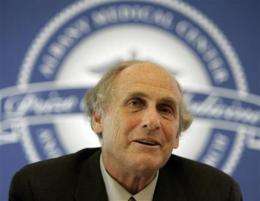
In this April 24, 2009 photo, Dr. Ralph Steinman of Rockefeller University speaks during a news conference in Albany, N.Y., Friday, April 24, 2009. The Nobel committee says American Bruce Beutler and Luxembourg-born scientist Jules Hoffmann have shared the 2011 Nobel Prize in medicine with Canadian-born Ralph Steinman on Monday, Oct. 3, 2011. Beutler and Hoffman were cited "for their discoveries concerning the activation of innate immunity." Steinman was honored for "his discovery of the dendritic cell and its role in adaptive immunity." (AP Photo/Mike Groll)

Three scientists won the Nobel Prize in medicine on Monday for discoveries about the immune system that opened new avenues for the treatment and prevention of infectious illnesses and cancer.

American Bruce Beutler and French scientist Jules Hoffmann shared the 10 million-kronor ($1.5 million) award with Canadian-born Ralph Steinman, the Nobel committee at Stockholm's Karolinska institute said.

Their discoveries have enabled the development of improved vaccines against infectious diseases. In the long term they could also yield better treatments of cancer, rheumatoid arthritis, type 1 diabetes, multiple sclerosis, and chronic inflammatory diseases, award committee secretary Goran Hansson told The Associated Press.

Beutler and Hoffmann were cited for their discoveries in the 1990s of receptor proteins that can recognize bacteria and other microorganisms as they enter the body, and activate the first line of defense in the immune system, known as innate immunity.

Steinman was honored for the discovery two decades earlier of dendritic cells, which help regulate adaptive immunity, the next stage of the immune system's response, when the invading microorganisms are purged from the body.

The discoveries have helped scientists understand why the immune system sometimes attacks its own tissues, paving the way for new ways to fight inflammatory diseases.

"They have made possible the development of new methods for preventing and treating disease, for instance with improved vaccines against infections and in attempts to stimulate the immune system to attack tumors," the committee said.

No vaccines are on the market yet, but Hansson told AP that vaccines against hepatitis are in the pipeline. "Large clinical trials are being done today," he said.

Hansson said he had not been able to reach any of the winners before the announcement.

"Hoffmann for example is traveling in China and is difficult to reach," he said.

Beutler, born in 1957, is professor of genetics and immunology at The Scripps Research Institute in San Diego, California. Hoffmann, 70, headed a research laboratory in Strasbourg, France, between 1974 and 2009 and served as president of the French National Academy of Sciences between 2007-2008.

Steinman, 68, has been affiliated with Rockefeller University in New York since 1970, and heads its Center for Immunology and Immune Diseases.

Hoffmann's discovery came in 1996 during research on how fruit flies fight infections. Two years later, Beutler's research on mice showed that fruit flies and mammals activate innate immunity in similar ways when attacked by germs.

Steinman's discovery dates back to 1973, when he found a new cell type, the dendritic cell, which has a unique capacity to activate so-called T-cells. Those cells have a key role in adaptive immunity, when antibodies and killer cells fight infections. They also develop a memory that helps the immune system mobilize its defenses next time it comes under a similar attack.

The medicine award kicked off a week of Nobel Prize announcements, and will be followed by the physics prize on Tuesday, chemistry on Wednesday, literature on Thursday and the Nobel Peace Prize on Friday. The winners of the economics award will be announced on Oct. 10.

The coveted prizes were established by wealthy Swedish industrialist Alfred Nobel - the inventor of dynamite - except for the economics award, which was created by Sweden's central bank in 1968 in Nobel's memory. The prizes are always handed out on Dec. 10, on the anniversary of Nobel's death in 1896.

Last year's medicine award went to British professor Robert Edwards for fertility research that led to the first test tube baby.

Recent winners of Nobel Medicine Prize

Here is a list of the 10 most recent winners of the Nobel Medicine Prize, awarded here Monday:

2011: Bruce Beutler (US), Jules Hoffmann (France) and Ralph Steinman (Canada)

2010: Robert G. Edwards (Britain)

2009: Carol Greider and Jack Szostak (US), Elizabeth Blackburn (Australia-US)

2008: Francoise Barre-Sinoussi and Luc Montagnier (France), Harald zur Hausen (Germany)

2007: Mario Capecchi (US), Oliver Smithies (US), and Martin Evans (Britain)

2006: Andrew Z. Fire (US), Craig C. Mello (US)

2005: Barry J. Marshall (Australia), J. Robin Warren (Australia)

2004: Richard Axel (US), Linda B. Buck (US)

2003: Paul C. Lauterbur (US) and Peter Mansfield (Britain)

2002: Sydney Brenner and John E. Sulston (Britain), H. Robert Horvitz (US)

©2011 The Associated Press. All rights reserved. This material may not be published, broadcast, rewritten or redistributed.

5 /5 (7 votes)  

Filter


Move the slider to adjust rank threshold, so that you can hide some of the comments.


Display comments: newest first

dlheller
Oct 10, 2011

Rank: not rated yet
I wonder if there is a way to improve the strength or efficiency of dendritic cells so that they can effectively purge invading cancer cells or a way to give a patient increased numbers of receptor proteins which work in the immune system. Our bodies have been getting diseases and using our immune systems for survival, yet evolution has not yet found a way to combat such powerful invasions of the immune system. If there is a way to increase the power of these proteins will those facing such diseases be able to withstand cancer in the future? I think this would be an interesting development to explore based on the Nobel prize findings.
Rank 5 /5 (7 votes)
Related Stories
Relevant PhysicsForums posts
  • A question about drug tolerance
    createdMay 23, 2012
  • Poor nutrition leading to overeating?
    createdMay 23, 2012
  • Math and dyslexia?
    createdMay 21, 2012
  • portable metabolism meter?
    createdMay 21, 2012
  • Rare medical conditions on 20/20 tonight
    createdMay 18, 2012
  • "Good" Cholesterol in Doubt
    createdMay 17, 2012
  • More from Physics Forums - Medical Sciences

More news stories

Implantable pain disk may help those with cancer

An estimated 3.5 million cancer patients around the globe are in severe pain from their disease, but many get no relief.

Medical research created 21 hours ago | popularity not rated yet | comments 0 | with audio podcast

Energy levels link sleep control mechanisms

Sleep, or lack of it, can determine level of cognitive performance which is linked with accidents as well as increased risk of serious health problems. Links between cell energy levels, gene transcription ...

Medical research created 22 hours ago | popularity not rated yet | comments 0

Researchers identify key brain cell in antidepressant action

(Medical Xpress) -- Antidepressant medications such as Prozac have helped improve mood and lessen anxiety in millions of people with major depression. But scientists know surprisingly little about how these drugs work.

Medical research created 23 hours ago | popularity 4.5 / 5 (2) | comments 0 | with audio podcast

Rockefeller scientists pioneer new method to determine mechanisms of drug action

(Medical Xpress) -- Knowing that a drug works is great. Knowing how it works is a luxury. And until now, determining a drug’s mechanism of action has been a tedious and difficult process for scientists.

Medical research created 23 hours ago | popularity not rated yet | comments 0 | with audio podcast

Like curry? New biological role identified for compound used in ancient medicine

Scientists have just identified a new reason why some curry dishes, made with spices humans have used for thousands of years, might be good for you.

Medical research created May 25, 2012 | popularity 4.4 / 5 (10) | comments 2 | with audio podcast


Of mice and mental models: Neuroscientific implications of risk-optimized behavior in the mouse

(Medical Xpress) -- Regardless of an organism’s biological complexity, every encephalized animal continuously makes under-informed behavioral choices that can have serious consequences. Despite its ubiquity, ...

Cancer may require simpler genetic mutations than previously thought

Chromosomal deletions in DNA often involve just one of two gene copies inherited from either parent. But scientists haven't known how a deletion in one gene from one parent, called a "hemizygous" deletion, can contribute ...

Inherited DNA change explains overactive leukemia gene

A small inherited change in DNA is largely responsible for overactivating a gene linked to poor treatment response in people with acute leukemia.

Tongue analysis software uses ancient Chinese medicine to warn of disease

For 5,000 years, the Chinese have used a system of medicine based on the flow and balance of positive and negative energies in the body. In this system, the appearance of the tongue is one of the measures used to classify ...

Skp2 activates cancer-promoting, glucose-processing Akt

HER2 and its epidermal growth factor receptor cousins mobilize a specialized protein to activate a major player in cancer development and sugar metabolism, scientists report in the May 25 issue of Cell.

Early physical therapist treatment associated with reduced risk of healthcare utilization and reduced overall healthcare

A new study published in Spine shows that early treatment by a physical therapist for low back pain (LBP), as compared to delayed treatment, was associated with reduced risk of subsequent healthcare utilization and lower ...