Coloring musical rhythms with colored noise
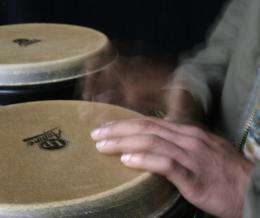
(Medical Xpress) -- Most people don’t like things to be too perfect – and this may well apply to the music they enjoy. Since no musician plays absolutely ‘in time’, electronically generated rhythms are often “humanized”, i.e. post-processed in recording studios to make them sound more natural. In particular, every beat is randomly shifted slightly in time – a method whose justification had up to now never been scrutinized.
Scientists from the Max Planck Institute for Dynamics and Self-Organization (MPIDS), the University of Göttingen, and the Bernstein Center for Computational Neuroscience in Göttingen have now discovered that this method does not reflect the statistical laws governing natural music. The tiny deviations from the perfect rhythms that are present in the performances of even very skilled drummers are not entirely random. The research shows that these fluctuations are not statistically independent, but are in fact correlated over long periods of time. Most listeners perceived music produced according to this new finding as more pleasing than with randomly shifted rhythms. The scientists have received a US-patent for their new method.
Small errors in rhythm happen to even the most professional drummers. Comparing his beats with those of an electrical metronome, one will always find slight deviations. The discrepancies are as small as a few milliseconds, but many music-lovers claim not only to hear a difference, but also to appreciate it. According to them, this human touch uniquely colours a piece of music each time it is played. In many recording studios, artificially created rhythms are therefore post-processed: Every beat is shifted slightly in time - a method referred to as ‘humanizing’.
Even though this method is widely employed, until now the exact nature of human inaccuracies in the playing of complex musical rhythms was completely unknown. For example, which statistical laws describe the rhythmical fluctuations in natural music has never been studied. In their new publication, the researchers from Göttingen have now examined these deviations in detail. In a first step, the scientists provided subjects with the flawless beat of an electrical metronome via headphones. The subjects were asked to reproduce this beat as exactly as possible by singing or drumming. "We wanted to make sure, that our results didn’t depend on the way the subjects generate the rhythm - for example, whether they use their hands or voice", says Holger Hennig from the Max Planck Institute for Dynamics and Self-Organization. In addition, the researchers paid attention to include musical laypersons as well as professional drummers. In a second step, the team of physicists and psychologists turned to more complex rhythms, where for example both hands and feet must be used. The subjects were asked to reproduce these rhythms as well.
"Our experiments showed that the rhythmical fluctuations are by no means entirely random", explains Theo Geisel, director of the Max Planck Institute for Dynamics and Self-Organization and professor for theoretical physics at the University of Göttingen. The scientist is a saxophone player himself and has formed a jazz band together with his PhD-students. "Instead, the deviations between perfect and human rhythms show statistical dependencies - not only from one beat to the next, but spanning almost arbitrarily long times." For example, a small irregularity at the beginning of a piece of music influences those occurring many seconds later. "It’s almost as if humans have a sort of memory for these mistakes", says Hennig. Physicists refer to this phenomenon as long-range correlations or coloured noise.
In the performances of untrained laypersons, who often lose the rhythm, these correlations are completely missing. "This could point to the fact, that the neuronal processes in the brain responsible for time intervals and the timing of movements are reset when the person rejoins the rhythm", says Geisel. The brains of more trained musicians, however, seem to have a sort of memory for these processes.
"In a second part of our study we had the idea to humanize electronically generated music according to the observed statistical law", says Hennig. "We wanted to find out whether listeners can perceive a difference to the conventional humanization and which kind of humanizing they prefer", adds Ragnar Fleischmann, also scientist at the Max-Planck-Institute for Dynamics and Self-Organization.
With this goal in mind the researchers produced a pop song in collaboration with a professional recording studio. The taped rhythms of the different instruments were first corrected to follow the precise beats and subsequently humanized in two different ways: either randomly or with long-range correlations. The team of physicists and psychologists then played both versions to 39 choir members in Göttingen, whom they asked to evaluate the two songs.
"Detecting a difference between both versions is no easy task", says Anneke Fredebohm from the Institute for Psychology of the University of Göttingen. Laypersons often cannot detect any difference at all. However, according to the statistical analysis of this study, experienced listeners found the version with long-range correlations to be much more pleasing. And, despite its ‘inaccuracy’, they also identified this version as the more precise one.
"Altogether, it seems to be necessary to revisit the commonly-used methods of humanizing", both Geisel and Hennig agree. In addition, the new results are of importance beyond the music industry. "It is still unclear how humans manage to coordinate certain motor tasks within a time range of milliseconds", the scientists explain. The neuronal processes in the brain that are responsible for this performance are still largely unknown. Here, the new study could offer valuable new insights.
More information: H. Hennig, et al., The nature and perception of fluctuations in human musical rhythms, PLoS ONE 6(10): e26457 (2011)


.jpg)


