Swedish heart test saves lives of newborns with heart defects
October 11, 2011 in Cardiology
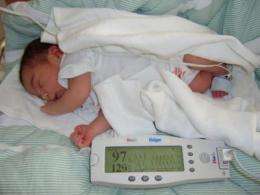
A test, known as pulse oximetry screening, takes only a couple of minutes and can be carried out by a midwife. When tested on 40,000 newborns in West Gotaland, 92 percent of cases of duct-dependent congenital heart disease were detected. Credit: University of Gothenburg
The US Secretary of Health recently supported a recommendation that all babies born in the US are to be screened for critical heart defects, before leaving hospital. Behind this decision is a study from the Sahlgrenska Academy at the University of Gothenburg, and the West Götaland Region's maternity units in Sweden which shows that a simple test can save the lives of newborns with these heart defects. Other countries too are set to make the test mandatory.
One or two out of every thousand babies are born with duct-dependent congenital heart disease, a life-threatening condition where the normal connection between the heart and either the lungs or the aorta is missing. When the ductus arteriosus, a blood vessel that is open only in the foetus, gradually closes in the days after delivery, the flow of blood to the lungs or the aorta is cut off, resulting in circulatory collapse. Most of these heart defects can be corrected by one or more operations, but many of the children do not have an audible heart murmur and they are rarely detected by the standard pre-discharge medical examination.
Critical defect undiscovered
It is estimated that a third of all newborns with duct-dependent congenital heart disease therefore leave hospital without their critical defect being discovered, and there is a risk of this number rising as the average stay in hospital grows ever shorter.
Most cases were detected
Between 2004 and 2009, researchers at the Sahlgrenska Academy lead by professor Ingegerd Östman-Smith managed to develop a simple test where sensors on the baby's right hand and either foot are used to check the blood's oxygen saturation. This test, known as pulse oximetry screening, takes only a couple of minutes and can be carried out by a midwife. When tested on 40,000 newborns in West Götaland, 92% of cases of duct-dependent congenital heart disease were detected.
Major international impact
The study from the Sahlgrenska Academy has made a major impact internationally after being published in the highly respected British Medical Journal. All newborns in Beijing are already being screened, and Anne de-Wahl Granelli, who based her thesis on the method, has been invited to Washington, Singapore, Vietnam and Argentina to present the results during the past year.
Screening recommended in the US
Last week the US Secretary of Health decided to recommend that all babies born in the US should be screened using the Swedish protocol before leaving hospital. Several counties in Sweden have also introduced the test, although there is not yet any coordinated national recommendation.
Worldwide attention
"People around the world are now talking about `the Swedish study´, and I've been invited to Nanjing in China to help start up a screening programme there this autumn," says de-Wahl Granelli.
"I'm absolutely delighted that the research has had such an impact. My colleagues and everyone else who helped us with the clinical side of the study over a three-and-a-half-year period all deserve a share of the credit for the attention it has been given worldwide."
Pulse oximetry screening for newborns
The study at the Sahlgrenska Academy revealed that mortality among infants discharged with an undiagnosed critical heart defect was 18%, or around one in six children, but only 0.9% for those diagnosed before leaving hospital. During the period covered by the study, there were no deaths from undiagnosed heart defects of this type in the West Götaland region, but five deaths at home in the regions used for comparison.
Provided by
University of Gothenburg
-
Simple screening test identifies heart defects in newborns
Aug 05, 2011 |
not rated yet |
0
-
Oxygen test has potential to detect some critical congenital heart defects in newborns
Jul 06, 2009 |
not rated yet |
0
-
Newest screen for newborns will indicate heart problems
Aug 22, 2011 |
not rated yet |
0
-
Heart pumps save lives
Jun 14, 2010 |
not rated yet |
0
-
Ground-breaking study to improve quality of life and outcomes for kids born with heart defect
May 26, 2010 |
not rated yet |
0
-
Motion perception revisited: High Phi effect challenges established motion perception assumptions
Apr 23, 2013 |
3 / 5 (2) |
2
-
Anything you can do I can do better: Neuromolecular foundations of the superiority illusion (Update)
Apr 02, 2013 |
4.5 / 5 (11) |
5
-
The visual system as economist: Neural resource allocation in visual adaptation
Mar 30, 2013 |
5 / 5 (2) |
9
-
Separate lives: Neuronal and organismal lifespans decoupled
Mar 27, 2013 |
4.9 / 5 (8) |
0
-
Sizing things up: The evolutionary neurobiology of scale invariance
Feb 28, 2013 |
4.8 / 5 (10) |
14
-
The Durability of Bone: Long Falls
3 hours ago
-
Is energy convertible to matter?
4 hours ago
-
Rotating electron as a dipole is this right?
7 hours ago
-
Dipole term in multipole expansion
11 hours ago
-
Bubbles in a Pre-Boiling/Boiling pot of water
12 hours ago
-
Assumptions of Griffith's fracture theory
22 hours ago
- More from Physics Forums - Classical Physics
More news stories
Biodegradable stent proves non-inferior to drug-eluting stent
The Orsiro stent, which is a novel stent platform eluting sirolimus from a biodegradable polymer, demonstrated non-inferiority to the Xience Prime everolimus-eluting stent for the primary angiographic endpoint of in-stent ...
Cardiology
7 hours ago |
not rated yet |
0
Post-approval TAVI registry shows high rates of device success at one year
One-year results from SOURCE XT – one of the largest, post-approval transcatheter aortic valve implantation (TAVI) registries to-date – reported today at EuroPCR 2013 show good clinical outcomes in routine clinical practice, ...
Cardiology
8 hours ago |
not rated yet |
0
Antidepressant reduces stress-induced heart condition
A drug commonly used to treat depression and anxiety may improve a stress-related heart condition in people with stable coronary heart disease, according to researchers at Duke Medicine.
Cardiology
9 hours ago |
5 / 5 (1) |
0
|
Study identifies superior hypertension treatment, efficacy between sexes
(Medical Xpress)—In a recent subgroup analysis of the largest blood pressure treatment trial in history, University of Alabama at Birmingham (UAB) researchers found that women and men react the same to ...
Cardiology
17 hours ago |
5 / 5 (1) |
0
Evaluating a new way to open clogged arteries
Over the past few decades, scientists have developed many devices that can reopen clogged arteries, including angioplasty balloons and metallic stents. While generally effective, each of these treatments ...
Cardiology
17 hours ago |
4.6 / 5 (5) |
0
|
If you can remember it, you can remember it wrong
(Medical Xpress)—Native peoples in regions where cameras are uncommon sometimes react with caution when their picture is taken. The fear that something must have been stolen from them to create the photo ...
B vitamins could delay dementia
(Medical Xpress)—Despite spending billions of dollars on research and development, drug companies have been unable to come up with effective treatments for dementia and Alzheimer's Disease (AD). Now, A. ...
New sleeping pill poised to hit US markets
An experimental sleeping pill from US drug company Merck is effective at helping people fall and stay asleep, according to reviewers at the US Food and Drug Administration, which could soon approve the new drug.
Reducing caloric intake delays nerve cell loss
Activating an enzyme known to play a role in the anti-aging benefits of calorie restriction delays the loss of brain cells and preserves cognitive function in mice, according to a study published in the May ...
Insight into the dazzling impact of insulin in cells
Australian scientists have charted the path of insulin action in cells in precise detail like never before. This provides a comprehensive blueprint for understanding what goes wrong in diabetes.
Drugs found to both prevent and treat Alzheimer's disease in mice
Researchers at USC have found that a class of pharmaceuticals can both prevent and treat Alzheimer's Disease in mice.