Boston hospital performs double hand transplant
October 14, 2011 By DENISE LAVOIE , Associated Press in Other
Boston hospital performs double hand transplant (AP)

Enlarge

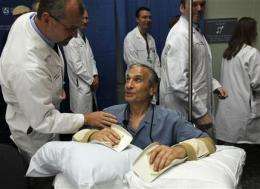
Double hand transplant recipient Richard Mangino, 65, of Revere, Mass., bottom, smiles as he is patted on the shoulder by Dr. Bohdan Pomahac, director of plastic surgery transplantation at Brigham Women's Hopsital, following a news conference at the hospital, in Boston, Friday, Oct. 14, 2011. Last week, a team of more than 40 surgeons, nurses and support staff at the hospital worked for more than 12 hours performing a bilateral hand transplant on Mangino. (AP Photo/Steven Senne)

(AP) -- A quadruple amputee who received new hands through a transplant operation says he is looking forward to doing ordinary things again: getting dressed, taking a shower, making coffee and, sweetest of all, touching the faces of his two grandsons.

Richard Mangino, 65, of Revere, lost his arms below the elbows and his legs below the knees after he had a kidney stone in 2002 and contracted a severe bloodstream infection.

Last week, a team of more than 40 surgeons, nurses and support staff at Boston's Brigham and Women's Hospital worked for more than 12 hours performing a hand transplant.

Mangino said at a news conference Friday that he had adjusted to his life as a quadruple amputee. The former director of the ground crew for United Airlines at Boston's Logan airport, Mangino taught himself to do daily activities with his prostheses, mowing the lawn, shoveling snow and painting. He said people kept telling him what a "miracle" he was.

"But the one miracle I have prayed for, since my oldest grandson Trevor was born, was to be able to feel the sense of touch again ... to touch his and Nicky's little faces, and stroke their hair, and to teach them to throw a ball," he said. "To me, that would be a miracle. And today, my miracle has come true."

Doctors said it will take six to nine months for Mangino to regain sensory function in his hands, but days after surgery he began independently moving his fingers.

The donor's name was not made public.

In a statement, the wife of the donor said her husband, in talking about donation, always said, "It's just a body."

"I didn't have to struggle with the decision," she said of donating her husband's hands. "After I digested what it entailed, I thought, if it can help someone else out - I felt strongly that my husband would feel the same way," she said in her statement.

Dr. Bohdan Pomahac, director of plastic surgery transplantation at Brigham and Women's, said there have been approximately 50 hands transplanted worldwide, about a dozen of them in the United States. He said Mangino's surgery was only the fourth bilateral hand transplant in the U.S.

Mangino's procedure was the second bilateral hand transplant by surgeons at Brigham and Women's, which has performed four face transplants.

In May, a Connecticut woman who was mauled by a chimpanzee received a new face and two hands at the hospital, but the hand transplant failed after Charla Nash developed pneumonia and other complications after surgery.

Mangino's surgery involved multiple tissues, including skin, tendons, muscles, ligaments, bones and blood vessels on his forearms and hands.

He said he is looking forward to being able to do everyday things without having to struggle.

"I won't have to perform a miracle anymore to just get up in the morning," he said.

©2011 The Associated Press. All rights reserved. This material may not be published, broadcast, rewritten or redistributed.

5 /5 (2 votes)  

Rank 5 /5 (2 votes)
Related Stories
Relevant PhysicsForums posts

More news stories

Transvaginal mesh op restores pelvic organ prolapse at price

(HealthDay) -- Transvaginal mesh (TVM) procedures are effective for anatomical restoration of pelvic organ prolapse (POP), but patients report a worsening of sexual function following surgery, according to ...

Other created 7 hours ago | popularity not rated yet | comments 0

Tongue analysis software uses ancient Chinese medicine to warn of disease

For 5,000 years, the Chinese have used a system of medicine based on the flow and balance of positive and negative energies in the body. In this system, the appearance of the tongue is one of the measures used to classify ...

Other created 22 hours ago | popularity 1 / 5 (1) | comments 0 | with audio podcast

Neck strength, cervical spine mobility don't predict pain

(HealthDay) -- Neither isometric neck muscle strength nor passive mobility of the cervical spine, two physical capacity parameters found to be associated with neck pain in other studies, predicts later neck ...

Other created May 25, 2012 | popularity not rated yet | comments 0

Pool access for the disabled sparks controversy

(AP) -- The Obama administration is sidestepping an election-year confrontation with the hotel industry and other pool owners to give them more time to comply with access rules for the disabled.

Other created May 25, 2012 | popularity not rated yet | comments 0

Chile to cover sex change operations

Chile will soon cover sex change surgeries under its public health plan in order to allow citizens of limited means to "recover their true sexual identity," Health Minister Jaime Manalich said.

Other created May 25, 2012 | popularity not rated yet | comments 0


Travel to high altitudes tied to Crohn's, colitis flare-ups

(HealthDay) -- People with inflammatory bowel disease, which includes Crohn's disease and colitis, may be at increased risk for flare-ups when they fly or travel to high altitudes for skiing or mountain climbing, ...

Family history of Alzheimer's affects functional connectivity

(HealthDay) -- Cognitively normal individuals with a family history of late-onset Alzheimer's disease (AD) may display lower resting state functional connectivity in the default mode network (DMN) of the brain, ...

Of mice and mental models: Neuroscientific implications of risk-optimized behavior in the mouse

(Medical Xpress) -- Regardless of an organism’s biological complexity, every encephalized animal continuously makes under-informed behavioral choices that can have serious consequences. Despite its ubiquity, ...

Weight struggles? Blame new neurons in your hypothalamus

New nerve cells formed in a select part of the brain could hold considerable sway over how much you eat and consequently weigh, new animal research by Johns Hopkins scientists suggests in a study published in the May issue ...

Most occupational injury and illness costs are paid by the government and private payers

UC Davis researchers have found that workers' compensation insurance is not used nearly as much as it should be to cover the nation's multi-billion dollar price tag for workplace illnesses and injuries. Instead, almost 80 ...

Thioridazine kills cancer stem cells in human while avoiding toxic side-effects of conventional cancer treatments

A team of scientists at McMaster University has discovered a drug, thioridazine, successfully kills cancer stem cells in the human while avoiding the toxic side-effects of conventional cancer treatments.