Combined arterial imaging technology reveals both structural and metabolic details
November 6, 2011 in Medical research

Combined arterial imaging technology reveals both structural and metabolic details

Enlarge

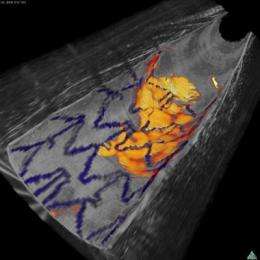
Combined optical frequency-domain imaging and near-infrared fluorescence image of the inner surface of a rabbit artery shows an implanted arterial stent (blue) and fibrin deposits (red-yellow). By revealing both structural and molecular detail, OFDI-NIRF may improve diagnosis of coronary artery disease and help evaluate stent healing. Credit: Hongki Yoo, PhD, and Jin Won Kim, MD, PhD; laboratories of Gary Tearney MD, PhD, and Farouc Jaffer, MD, PhD, Massachusetts General Hospital

A new device that combines two microimaging technologies can reveal both the detailed anatomy of arterial linings and biological activities that, in coronary arteries, could indicate the risk of heart attacks or the formation of clots in arterial stents. In their report receiving early online release in Nature Medicine, Massachusetts General Hospital (MGH) investigators describe using an intra-arterial catheter combining both optical frequency-domain imaging (OFDI) and near-infrared fluorescence (NIRF) imaging to obtain simultaneous structural and molecular images of internal arterial surfaces in rabbits.

"The ability to measure both microstructural and molecular information from the same location in the could provide a much better for assessing vascular pathology, information that is highly relevant for diagnosing , vulnerable plaque and evaluating stent healing," says Gary Tearney, MD, PhD, of the Wellman Center for Photomedicine and the MGH Pathology Department, co-senior author of the article.

Developed at the Wellman Center, OFDI utilizes a fiberoptic probe with a constantly rotating laser tip to create detailed molecular images of interior surfaces such as arterial walls. While OFDI can be used to guide procedures like coronary artery angioplasty and to confirm the correct positioning of metal stents inserted to keep cleared arteries open, its ability to determine important details of stent healing is limited. Properly healed stents become covered with endothelium, the same tissue that normally coats the arterial surface; but stents can become coated with the clot-inducing protein fibrin, which may put patients at risk for stent thrombosis – a clot that blocks bloodflow through the stent – and OFDI cannot determine the molecular composition of tissue covering a stent.

Intravascular NIRF technology was developed in the MGH Cardiovascular Research Center (CVRC), in collaboration with colleagues at the Technical University of Munich, and uses special imaging agents to detect cells and molecules involved in vascular processes like clotting and inflammation. Recognizing the potential advantage of combining both technologies, the Wellman researchers worked with the MGH-CVRC team, led by Farouc Jaffer, MD, PhD, of the MGH Heart Center to develop an integrated OFDI-NIRF imaging system incorporated in the same intravascular probe used for OFDI alone.

The team first confirmed that the system could provide detailed structural images of a stent implanted in a cadaveric human and could accurately identify the presence of fibrin on the stent. In a series of experiments in living rabbits, the OFDI-NIRF system was able to detect fibrin on implanted stents – including areas where it was not detected by OFDI alone – and to identify the presence of both atherosclerotic plaques and enzymatic activity associated with inflammation and plaque rupture. The enzyme signal detected by NIRF was not uniform throughout the imaged plaques, indicating biological differences that could be relevant to prognosis and treatment planning.

"At present we are not able to predict which patients may develop stent thrombosis, but integrated OFDI-NIRF can assess many key factors linked to the risk of clot formation," says Jaffer, co-senior author of the report. "If OFDI-NIRF is validated in clinical studies, patients at risk for stent thrombosis could undergo a 'stent checkup' to determine how well the stent is healing. Patients with unhealed stents could be advised to take or continue taking specific anti-clotting medications. Patients with well-healed , on the other hand, could potentially discontinue anti-clotting medications, which can cause excess bleeding." Clinical adoption of the integrated technology will require FDA approval of the molecular contrast agents used in NIRF.

Provided by Massachusetts General Hospital search and more info website

5 /5 (3 votes)  

Rank 5 /5 (3 votes)
Relevant PhysicsForums posts

More news stories

H. pylori, smoking trends, and gastric cancer in US men

Trends in Helicobacter pylori (H. pylori) and smoking explain a significant proportion of the decline of intestinal-type noncardia gastric adenocarcinoma (NCGA) incidence in US men between 1978 and 2008, and are estimated ...

Medical research created 3 hours ago | popularity not rated yet | comments 0

Common food supplement fights degenerative brain disorders

Widely available in pharmacies and health stores, phosphatidylserine is a natural food supplement produced from beef, oysters, and soy. Proven to improve cognition and slow memory loss, it's a popular treatment for older ...

Medical research created 8 hours ago | popularity 5 / 5 (1) | comments 0 | with audio podcast

Finding a family for a pair of orphan receptors in the brain

Researchers at Emory University have identified a protein that stimulates a pair of "orphan receptors" found in the brain, solving a long-standing biological puzzle and possibly leading to future treatments for neurological ...

Medical research created 8 hours ago | popularity not rated yet | comments 0 | with audio podcast

Insight into the dazzling impact of insulin in cells

Australian scientists have charted the path of insulin action in cells in precise detail like never before. This provides a comprehensive blueprint for understanding what goes wrong in diabetes.

Medical research created 9 hours ago | popularity 4.8 / 5 (4) | comments 0 | with audio podcast

Do men's and women's hearts burn fuel differently?

Researchers at the University of Illinois at Chicago College of Medicine will study gender differences in how the heart uses and stores fat—its main energy source—and how changes in fat metabolism play ...

Medical research created 11 hours ago | popularity not rated yet | comments 0


If you can remember it, you can remember it wrong

(Medical Xpress)—Native peoples in regions where cameras are uncommon sometimes react with caution when their picture is taken. The fear that something must have been stolen from them to create the photo ...

New sleeping pill poised to hit US markets

An experimental sleeping pill from US drug company Merck is effective at helping people fall and stay asleep, according to reviewers at the US Food and Drug Administration, which could soon approve the new drug.

Reducing caloric intake delays nerve cell loss

Activating an enzyme known to play a role in the anti-aging benefits of calorie restriction delays the loss of brain cells and preserves cognitive function in mice, according to a study published in the May ...

B vitamins could delay dementia

(Medical Xpress)—Despite spending billions of dollars on research and development, drug companies have been unable to come up with effective treatments for dementia and Alzheimer's Disease (AD). Now, A. ...

Antidepressant reduces stress-induced heart condition

A drug commonly used to treat depression and anxiety may improve a stress-related heart condition in people with stable coronary heart disease, according to researchers at Duke Medicine.

Changing cancer's environment to halt its spread

By studying the roles two proteins, thrombospondin-1 and prosaposin, play in discouraging cancer metastasis, a trans-Atlantic research team has identified a five-amino acid fragment of prosaposin that significantly reduces ...