First US embryonic stem cell trial is halted
November 15, 2011 by Kerry Sheridan in Medical research
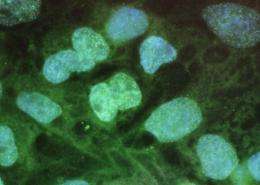
Stem cells are viewed on a computer screen in August 2010 in Farmington, Connecticut. The first-ever trial using human embryonic stem cells to treat paralysis has been halted due to high costs and the company, Geron, said it will focus instead on new cancer treatments.
The first-ever trial using human embryonic stem cells to treat paralysis has been halted due to high costs and the company will focus instead on new cancer treatments, Geron said Tuesday.
The California-based biotech firm, which had bypassed federal funding to get its pioneering but controversial trial off the ground in October 2010, said it was also cutting 66 full-time jobs, or 38 percent of its workforce.
"Geron plans to close the GRNOPC1 trial for spinal cord injury to further enrollment," the company said in a statement, adding that the decision was made after a "strategic review" of costs and "regulatory complexities."
The study was meant to include up to 10 people in the first trial of embryonic stem cell therapy on humans.
Another company, Advanced Cell Technology, began its first-ever trial on a form of juvenile blindness earlier this year, followed by a second on people with a type of macular degeneration. Those trials are ongoing.
In Geron's phase I trial, which was meant primarily to gauge safety, the therapy showed no harmful effects on the four patients enrolled so far, the company said.
Geron chief executive John Scarlett told a conference call of investors that the company was seeking partners to take up the costs of the stem cell unit, which it began in 1999.
"Deciding to move out of the stem cell business was a very difficult decision to make. Our stem cell programs and assets are widely recognized as being among the world's most comprehensive and advanced," Scarlett said, describing the move as a "business decision."
"Let me be very clear that in this trial, the treatment has been well tolerated with no serious adverse events reported," he added. "These therapies have held, and continue to hold, great promise."
Geron plans to focus instead on a pair of cancer treatments that are in phase II studies.
"We are making these changes because in the current environment of capital scarcity and uncertain economic conditions, we need to focus our resources," Scarlett said.
The company's chief financial officer, David Greenwood, said that without the changes, Geron would have "expected to incur stem cell related R and D (research and development) costs of approximately $25 million per year for the next several years."
Geron said in its statement that it now expected to "end 2011 with cash and investments in excess of $150 million."
The Christopher and Dana Reeve Foundation, founded by the late "Superman" actor and his wife to cure spinal cord injury by funding new paths of research, declined an AFP request for formal comment.
However, a spokeswoman noted that staff member Sam Maddox had blogged about the decision, calling it "a major blow to the notion that eSC (embryonic stem cells) could return function to people the way the cells seemed to in rats."
Maddox said Geron lost $110 million last year and about $60 million so far in 2011. "Totally unsustainable," he wrote, adding that Scarlett had joined Geron "just six weeks ago and quickly took out the hatchet."
The chief executive of ACT, Gary Rabin, told AFP that Geron was engaged in a "very expensive and complicated trial," in contrast to ACT's trials which he said are much more simple and straightforward.
"We are basically putting in new, very vibrant highly productive retinal pigment cells into people's eyes to take the place of retinal cells that have died. So it is a much more logical approach," he said.
"It is the equivalent of replacing a person's heart with a heart. You wouldn't replace a heart with a liver."
Those who support embryonic stem cell research believe the field holds great promise for a host of ailments, from Alzheimer's to diabetes and more.
But the research is controversial because it requires the destruction of human embryos, and opponents say it violates their religious beliefs and is unethical.
Federally funded stem cell research was halted under the George W. Bush administration, and though President Barack Obama lifted the ban in 2009, several legal battles have followed.
Scientists have also complained that a rush for patents on nearly every step of the process has made it almost impossible to advance their work.
(c) 2011 AFP
-
US treats first patient with human embryonic stem cells (Update 2)
Oct 11, 2010 |
not rated yet |
0
-
Europe's first human embryonic stem cell trial approved
Sep 22, 2011 |
not rated yet |
0
-
Northwestern first site open for spinal cord stem cell trial
Sep 22, 2010 |
not rated yet |
0
-
Nation's second participant enrolls in human embryonic stem cell trial
May 12, 2011 |
not rated yet |
0
-
US clears embryonic stem cell trial for blindness (Update 3)
Jan 03, 2011 |
not rated yet |
0
-
Motion perception revisited: High Phi effect challenges established motion perception assumptions
Apr 23, 2013 |
3 / 5 (2) |
2
-
Anything you can do I can do better: Neuromolecular foundations of the superiority illusion (Update)
Apr 02, 2013 |
4.5 / 5 (11) |
5
-
The visual system as economist: Neural resource allocation in visual adaptation
Mar 30, 2013 |
5 / 5 (2) |
9
-
Separate lives: Neuronal and organismal lifespans decoupled
Mar 27, 2013 |
4.9 / 5 (8) |
0
-
Sizing things up: The evolutionary neurobiology of scale invariance
Feb 28, 2013 |
4.8 / 5 (10) |
14
-
Why is zone 1 in liver more prone to ischemic injury?
May 23, 2013
-
How can there be villous adenoma in colon, if there are no villi there
May 22, 2013
-
How can there be a term called "intestinal metaplasia" of stomach
May 21, 2013
-
Pressure-volume curve: Elastic Recoil Pressure don't make sense
May 18, 2013
-
If you became brain-dead, would you want them to pull the plug?
May 17, 2013
-
MRI bill question
May 15, 2013
- More from Physics Forums - Medical Sciences
More news stories
Study reveals new mechanism for estrogen suppression of liver lipid synthesis
By discovering the new mechanism by which estrogen suppresses lipid synthesis in the liver, UC Irvine endocrinologists have revealed a potential new approach toward treating certain liver diseases.
Medical research
May 23, 2013 |
5 / 5 (1) |
0
|
MRI-based measurement helps predict vascular disease in the brain
Aortic arch pulse wave velocity, a measure of arterial stiffness, is a strong independent predictor of disease of the vessels that supply blood to the brain, according to a new study published in the June issue the journal ...
Medical research
May 23, 2013 |
not rated yet |
0
Antibiotics: A new understanding of sulfonamide nervous system side effects
Since the discovery of Prontosil in 1932, sulfonamide antibiotics have been used to combat a wide spectrum of bacterial infections, from acne to chlamydia and pneumonia. However, their side effects can include serious neurological ...
Medical research
May 23, 2013 |
3 / 5 (1) |
0
|
Scientists discover molecule triggers sensation of itch
Scientists at the National Institutes of Health report they have discovered in mouse studies that a small molecule released in the spinal cord triggers a process that is later experienced in the brain as ...
Medical research
May 23, 2013 |
5 / 5 (3) |
0
|
Discarded immune cells induce the relocation of stem cells
Spanish researchers have discovered that the daily clearance of neutrophils from the body stimulates the release of hematopoietic stem cells from the bone marrow into the bloodstream, according to a report published today ...
Medical research
May 23, 2013 |
5 / 5 (2) |
0
First drug to improve heart failure mortality in over a decade
Coenzyme Q10 decreases all cause mortality by half, according to the results of a multicentre randomised double blind trial presented today at Heart Failure 2013 congress. It is the first drug to improve heart failure mortality ...
Seniors more likely to crash when driving with pet, study finds
(HealthDay)—Animals make great companions for senior citizens, but elderly people who always drive with a pet in the car are far more likely to crash than those who never drive with a pet, researchers have ...
Heart failure accelerates male 'menopause'
Heart failure accelerates the aging process and brings on early andropausal syndrome (AS), according to research presented today at the Heart Failure Congress 2013. AS, also referred to as male 'menopause', was four times ...
Death highest in heart failure patients admitted in January, on Friday, and overnight
Mortality and length of stay are highest in heart failure patients admitted in January, on Friday, and overnight, according to research presented today at the Heart Failure Congress 2013. The analysis of nearly 1 million ...
Feds fight morning-after pill age ruling in NY
(AP)—Department of Justice lawyers have again asked a federal appeals court in New York to delay lifting age restrictions and prescription requirements on an emergency contraceptive popularly known as the morning-after ...
New immune system discovered
(Medical Xpress)—A research team, led by Jeremy Barr, a biology post-doctoral fellow, unveils a new immune system that protects humans and animals from infection.
Nov 15, 2011
Rank: 5 / 5 (3)
Nov 16, 2011
Rank: 5 / 5 (2)