Measuring mental aftershocks
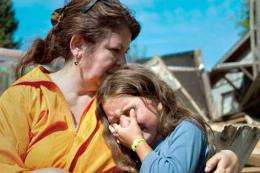
The massive 8.8-magnitude earthquake that struck Chile in February 2010 left thousands homeless, caused billions of dollars in damages and triggered a deadly tsunami. The psychological impact of such traumatic events over time is the focus of an ongoing research collaboration between UC Irvine psychologists and Chilean academic and government officials.
The quake — the sixth-strongest on record worldwide — was especially terrifying to children living near the epicenter, says Dana Garfin, a UCI doctoral student in psychology & social behavior who is studying the mental health effects of the disaster on people in the hard-hit city of Concepcion and surrounding areas.
"We found that a lot of these kids were highly traumatized by things such as viewing dead bodies in the street or having a friend or close relative who was seriously injured," says Garfin, whose work is supervised by Roxane Cohen Silver, UCI professor of psychology & social behavior and a leading expert on stressful life experiences and mental health.
According to Garfin, these children showed symptoms of post-traumatic stress such as nightmares, trouble concentrating and generally feeling on edge or easily startled by things such as loud noises.
Her research includes a study of 1,004 Chilean adults and 117 children who lived in the regions closest to the quake's epicenter. She partnered with colleagues from Chile's Universidad de Concepcion and Universidad Andres Bello to conduct face-to-face interviews and assess post-traumatic stress disorder symptoms as well as depression and fear of future disasters.
During a fall 2010 trip to Chile, Garfin conferred with government officials and helped train local graduate students to assist with data collection and interviewing. She also met with first lady Cecilia Morel and her staff.
"She was so warm and welcoming and asked a lot of good, sharp questions," Garfin says. "I don't even have my Ph.D. yet, and there I was, sharing my findings with the first lady. It felt like an amazing privilege."
For Garfin, the chance to participate in a global research partnership has been the highlight of her scholastic career. She intends to return to Chile this winter to pursue her work.
"Chile is an emerging economy, and there's a lot of interest in advancing science and bringing academics to a higher level," Garfin says. "This is a country that has suffered through some of the strongest earthquakes on record, and it's left a mark on the culture."
Groups that provide psychological counseling and services to children in the affected area rely on research studies to both design effective interventions and lobby the government for funding, Garfin says.
According to Garfin, Chilean government officials are interested in using research-based findings to understand factors that are correlated with increased distress among the population, and what might help mitigate the potential long-term impacts of the earthquakes.
Her project was made possible by a graduate fellowship award from the Newkirk Center for Science & Society. The Society for the Psychological Study of Social Issues and the International Society for Traumatic Stress Studies also support Garfin's studies. And she recently received a Global Health Travel Fellowship from UCI's Program in Public Health to fund her upcoming travels and research.
Garfin became involved with international research as an undergraduate at the University of Colorado, Boulder. Her desire for cross-cultural understanding led her to Juarez, Mexico, where she volunteered at Annunciation House, an organization that serves the physical and psychological needs of displaced migrants. She met displaced farm workers and listened to their stories, while assisting in cooking, cleaning and caring for resident orphans.
In the Navajo (Dine) Nation in the Arizona desert, she lived with a traditional family in an area dramatically altered by the operations of a mining company.
"Bulldozers had leveled the hills; sulfur polluted the streams, poisoning the sheep that grazed near the water," Garfin says. "But I learned that the coal mined in the area provided essential electricity to the western United States."
She also spent time in the small Himalayan village of Dharmakot, where she taught English at local community centers and learned about the culture through drinking chai tea with locals, hiking in the mountains and pursuing the rigorous study of Tibetan meditation. She also witnessed the gradual loss of local customs and beliefs to cultural assimilation.
Such research in diverse, global communities opened Garfin's eyes to the complexities of social, psychological and environmental problems.
Garfin plans to visit the Chilean capital of Santiago as well as Concepcion, where she'll perform follow-up assessments of children at the earthquake's epicenter. In addition, she will continue to train field staff to conduct interviews and will present findings to local schools and community groups.
"If people are still suffering psychologically from the effects of a disaster, it slows down the rebuilding process and makes it difficult for parents to help their kids cope," Garfin says. "We hope our research will be used to design interventions for those most in need and help Chile create a game plan for future earthquakes."


