Preterm birth rate shows three year improvement in most states
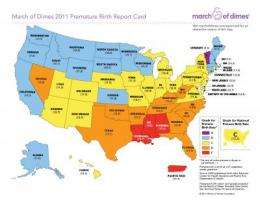
According to the 2011 March of Dimes Premature Birth Report Card, three states and Puerto Rico received an F, 11 states and the District of Columbia earned a D, 19 states got a C, 16 states received a B and only Vermont earned an A. The United States received a “C” based on comparing the nation’s 2009 preliminary preterm birth rate of 12.2 percent with the March of Dimes new 2020 goal of 9.6 percent of all live births. Credit: March of Dimes
Preterm birth rates improved in almost every state between 2006 and 2009, and in several states the change was more than 10 percent, according to the March of Dimes 2011 Premature Birth Report Card.
"The three-year improvement in the U.S. preterm birth rate means that 40,000 more babies were given a healthy start in life and spared the risk of life-long health consequences of an early birth," said Dr. Jennifer L. Howse, president of the March of Dimes. "It means that, nationwide, we saved at least $2 billion in health care and socio-economic costs. Now we owe it to the other half a million infants who were born too soon to work together to give them the same chance."
According to the 2011 report card, three states and Puerto Rico received an F, 11 states and the District of Columbia earned a D, 19 states got a C, 16 states received a B and only Vermont earned an A. The United States received a "C" based on comparing the nation's 2009 preliminary preterm birth rate of 12.2 percent with the March of Dimes new 2020 goal of 9.6 percent of all live births. The nation's preterm birth rate has declined nearly 5 percent from the 2006 peak of 12.8 percent.
The improvement in the preterm birth rate is due to a variety of health interventions, the March of Dimes says. For more than two years, the March of Dimes has been working with hospitals and health policy experts to identify and promote quality improvement initiatives that have reduced the number of medically unnecessary c-sections and inductions scheduled before 39 weeks of pregnancy. Also new treatments, such as progesterone, which has been shown to prevent some preterm births in medically eligible women, has helped lower the preterm birth rate.
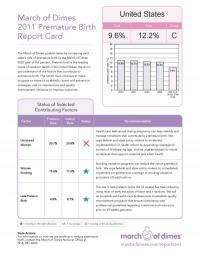
The United States received a “C” based on comparing the nation’s 2009 preliminary preterm birth rate of 12.2 percent with the March of Dimes new 2020 goal of 9.6 percent of all live births. The nation’s preterm birth rate has declined nearly 5 percent from the 2006 peak of 12.8 percent. Credit: March of Dimes
Preterm birth, birth before 37 weeks gestation, is a serious health problem that costs the United States more than $26 billion annually, according to the 2006 Institute of Medicine report. It is the leading cause of newborn death, and babies who survive an early birth often face the risk of lifetlong health challenges, such as breathing problems, cerebral palsy, intellectual disabilities and others. Even babies born just a few weeks early have higher rates of hospitalization and illness than full-term infants. If there are no medical complications that require an early delivery, at least 39 weeks of pregnancy are critical to a baby's health because many important organs, including the brain and lungs, are not completely developed until then.
The March of Dimes report card compares each state's preterm birth rate to the March of Dimes goal of lowering the rate to 9.6 percent of all live births by 2020. The March of Dimes says this goal can be achieved by a combination of activities: giving all women of childbearing age access to health care coverage, fully implementing proven interventions to reduce the risk of an early birth, such as not smoking during pregnancy, getting preconception and early prenatal care, progesterone treatments for women who are medically eligible, avoiding multiples from fertility treatments, avoiding elective c-sections and inductions before 39 weeks of pregnancy unless medically necessary, and by funding new research on prevention of preterm birth. The Report Card information for the U.S. and states are available online at: http://www.marchofdimes.com/prematurity.
This year, for the first time, a World Prematurity Day will be observed on November 17 by the March of Dimes along with organizations in Africa, Europe, and Australia. Worldwide, an estimated 13 million babies are born preterm and, of those, one million die as a result of their early birth, according to an October 2009 March of Dimes report on the global toll of preterm birth.
Provided by
March of Dimes Foundation
-
Preterm birth rates improve in most states
Nov 17, 2010 |
not rated yet |
0
-
Preterm birth rate drops
Mar 18, 2009 |
not rated yet |
0
-
Preterm birth rate drops 3 percent
Apr 06, 2010 |
not rated yet |
0
-
Preterm births rise 36 percent since early 1980s
Jan 07, 2009 |
not rated yet |
0
-
US gets a 'D' for preterm birth rate
Nov 17, 2009 |
not rated yet |
0
-
Motion perception revisited: High Phi effect challenges established motion perception assumptions
Apr 23, 2013 |
3 / 5 (2) |
2
-
Anything you can do I can do better: Neuromolecular foundations of the superiority illusion (Update)
Apr 02, 2013 |
4.5 / 5 (11) |
5
-
The visual system as economist: Neural resource allocation in visual adaptation
Mar 30, 2013 |
5 / 5 (2) |
9
-
Separate lives: Neuronal and organismal lifespans decoupled
Mar 27, 2013 |
4.9 / 5 (8) |
0
-
Sizing things up: The evolutionary neurobiology of scale invariance
Feb 28, 2013 |
4.8 / 5 (10) |
14
-
Classical and Quantum Mechanics via Lie algebras
Apr 15, 2011
- More from Physics Forums - Independent Research
More news stories
New rice contamination reported in China
Authorities are investigating rice mills in southern China following tests that found almost half of the staple grain in one of the country's largest cities was contaminated with a toxic metal.
Health
2 hours ago |
5 / 5 (1) |
0
Warning images for cigarette packs do not make a strong enough emotional impact
The warning images Brussels proposes to include on tobacco packages in order to reduce consumption do not make the desired impact on smokers because they only find some of them really unpleasant. So, if the ...
Health
3 hours ago |
not rated yet |
0
Cancer and birth defects in Iraq: The nuclear legacy
Ten years after the Iraq war of 2003 a team of scientists based in Mosul, northern Iraq, have detected high levels of uranium contamination in soil samples at three sites in the province of Nineveh which, coupled with dramatically ...
Health
3 hours ago |
not rated yet |
0
Dirty jokes the best medicine
When it comes to men's sexual health, dirty jokes may just be the best medicine. A QUT researcher is helping Family Planning Queensland (FPQ) use comedy and YouTube to deliver sexuality education to young ...
Health
4 hours ago |
not rated yet |
0
Salt consumption in India: The need for data to initiate population-based prevention efforts
(Medical Xpress)—International researchers are studying the salt intake of Indian adults to provide vital new data to aid the development of a national salt reduction strategy.
Health
5 hours ago |
not rated yet |
0
If you can remember it, you can remember it wrong
(Medical Xpress)—Native peoples in regions where cameras are uncommon sometimes react with caution when their picture is taken. The fear that something must have been stolen from them to create the photo ...
Insight into the dazzling impact of insulin in cells
Australian scientists have charted the path of insulin action in cells in precise detail like never before. This provides a comprehensive blueprint for understanding what goes wrong in diabetes.
Estimates reveal low population immunity to new bird flu virus H7N9 in humans
The level of immunity to the recently circulating H7N9 influenza virus in an urban and rural population in Vietnam is very low, according to the first population level study to examine human immunity to the virus, which was ...
Finding a family for a pair of orphan receptors in the brain
Researchers at Emory University have identified a protein that stimulates a pair of "orphan receptors" found in the brain, solving a long-standing biological puzzle and possibly leading to future treatments for neurological ...
Study finds vitamin C can kill drug-resistant TB (w/ video)
In a striking, unexpected discovery, researchers at Albert Einstein College of Medicine of Yeshiva University have determined that vitamin C kills drug-resistant tuberculosis (TB) bacteria in laboratory culture. The finding ...
Glaucoma drug can cause droopy eyelids
Prostaglandin analogues (PGAs), drugs which lower intraocular pressure, are often the first line of treatment for people with glaucoma, but their use is not without risks. PGAs have long been associated with blurred vision, ...
