New thinking required on wildlife disease
November 29, 2011 in Diseases, Conditions, Syndromes
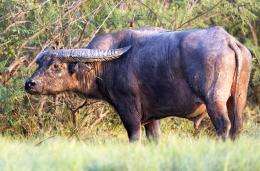
A wild water buffalo in the Northern Territory. Credit: flickr
A University of Adelaide scientist says much more could be done to predict the likelihood and spread of serious disease - such as tuberculosis (TB) or foot-and-mouth disease - in Australian wildlife and commercial stock.
Professor Corey Bradshaw and colleagues have evaluated freely available software tools that provide a realistic prediction of the spread of disease among animals.
They used a combination of models to look at the possible spread of TB among feral water buffalo in the Northern Territory.
Buffalo can harbour bovine tuberculosis, which poses a threat to commercial cattle livestock. They were introduced to northern Australia in the 1800s from Timor-Leste. In the 1980s and 1990s the government of the time began a broad-scale culling program, culling tens of thousands of buffalo.
"The cull successfully reduced or eradicated buffalo from major pastoral lands in the Northern Territory, taking tuberculosis with it, but since then there has been no major follow-up culling. The buffalo population is re-invading the formerly culled areas," says Professor Bradshaw, who is Director of Ecological Modelling at the University of Adelaide's Environment Institute.
"Although Australia now trades its livestock under the `TB-free' banner, the disease is prevalent throughout Africa, southern Europe, the Middle East and parts of Asia. Realistically, it's only a matter of time before it rears its ugly head again here. If it does, it could potentially cost our cattle industry billions of dollars."
Professor Bradshaw says Australia needs to implement tools such as those combining disease and population models to help plan the response to any potential return of TB - or other, nastier diseases, such as foot-and-mouth.
"We found that the probability of detecting a disease as well known as TB in buffalo was extremely small, even for thousands of `sentinel' animals culled each year. Current monitoring programs by the Northern Australia Quarantine Strategy (part of the Australian Quarantine and Inspection Service - AQIS) could definitely benefit from the use of these software tools, which are freely available for anyone to download," Professor Bradshaw says.
"If the goal of culling programs is to reduce prevalence of TB to near-zero, our prediction is that somewhere between 30-50% of the current buffalo population would have to be culled each year for about 15 years. That's a lot of buffalo - at least 100,000 killed over the first five years."
The team's work has been published in the Journal of Applied Ecology.
Provided by
University of Adelaide
-
Localized reactive badger culling raises bovine tuberculosis risk, new analysis confirms
Jul 13, 2011 |
not rated yet |
0
-
Killing in the name of conservation
Feb 22, 2010 |
not rated yet |
0
-
Bovine tuberculosis in wildlife threatens endangered lynx and cattle health
Jul 23, 2008 |
not rated yet |
0
-
Benefits of badger culling not long lasting for reducing cattle TB, says study
Feb 10, 2010 |
not rated yet |
0
-
Research on early fur trade sheds new light on how tuberculosis persists in populations
Apr 05, 2011 |
not rated yet |
0
-
Motion perception revisited: High Phi effect challenges established motion perception assumptions
Apr 23, 2013 |
3 / 5 (2) |
2
-
Anything you can do I can do better: Neuromolecular foundations of the superiority illusion (Update)
Apr 02, 2013 |
4.5 / 5 (11) |
5
-
The visual system as economist: Neural resource allocation in visual adaptation
Mar 30, 2013 |
5 / 5 (2) |
9
-
Separate lives: Neuronal and organismal lifespans decoupled
Mar 27, 2013 |
4.9 / 5 (8) |
0
-
Sizing things up: The evolutionary neurobiology of scale invariance
Feb 28, 2013 |
4.8 / 5 (10) |
14
-
Classical and Quantum Mechanics via Lie algebras
Apr 15, 2011
- More from Physics Forums - Independent Research
More news stories
UN reports 22 deaths worldwide from coronavirus
A new coronavirus has now claimed 22 lives worldwide out of 44 lab-confirmed cases, mostly in Saudi Arabia, World Health Organization officials said Thursday.
Diseases, Conditions, Syndromes
2 hours ago |
not rated yet |
0
Researchers suggest boosting body's natural flu killers
A known difficulty in fighting influenza (flu) is the ability of the flu viruses to mutate and thus evade various medications that were previously found to be effective. Researchers at the Hebrew University of Jerusalem have ...
Diseases, Conditions, Syndromes
3 hours ago |
not rated yet |
0
|
Swine flu pandemic of 2009 more deadly for younger adults, study finds
As the world prepares for what may be the next pandemic strain of influenza virus, in the H7N9 bird flu, a new UC Irvine study reveals that the 2009 H1N1 swine flu pandemic was deadliest for people under the age of 65, while ...
Diseases, Conditions, Syndromes
22 hours ago |
not rated yet |
0
Polio cases found in Kenya and Somalia, WHO says
The World Health Organization says the Horn of Africa is experiencing an outbreak of polio with cases confirmed in Kenya and Somalia.
Diseases, Conditions, Syndromes
22 hours ago |
not rated yet |
0
SARS-like virus claims new life in Saudi
A man who had contracted the coronavirus has died in Saudi Arabia, raising the death toll in the kingdom from the SARS-like virus to 17, the health ministry announced on its website on Wednesday.
Diseases, Conditions, Syndromes
22 hours ago |
not rated yet |
0
Drug reverses Alzheimer's disease deficits in mice, research confirms
An anti-cancer drug reverses memory deficits in an Alzheimer's disease mouse model, University of Pittsburgh Graduate School of Public Health researchers confirm in the journal Science.
Economic incentives increase blood donation without negative consequences
Can economic incentives such as gift cards, T-shirts, and time off from work motivate members of the public to increase their donations of blood?
Scientists discover molecule triggers sensation of itch
Scientists at the National Institutes of Health report they have discovered in mouse studies that a small molecule released in the spinal cord triggers a process that is later experienced in the brain as the sensation of ...
Multiple research teams unable to confirm high-profile Alzheimer's study
Teams of highly respected Alzheimer's researchers failed to replicate what appeared to be breakthrough results for the treatment of this brain disease when they were published last year in the journal Science.
Motion quotient: IQ predicted by ability to filter motion (w/ video)
A brief visual task can predict IQ, according to a new study. This surprisingly simple exercise measures the brain's unconscious ability to filter out visual movement. The study shows that individuals whose ...
Researchers find common childhood asthma unconnected to allergens or inflammation
Little is known about why asthma develops, how it constricts the airway or why response to treatments varies between patients. Now, a team of researchers at Weill Cornell Medical College, Columbia University Medical Center ...