New safe practices room provides prevention training space for nursing students
November 21, 2011 in Other
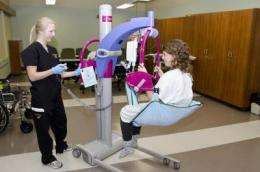
An MU nursing student practices using a lift that helps transfer patients from one chair to another. Credit: MU
Nursing is among construction and law enforcement as one of seven professions reporting the most on-the-job injuries, according to the U.S. Department of Labor. Sprains, strains or tears due to overexertion account for many of the injuries. Those injuries often can be attributed to improperly lifting, handling and moving patients. Now, nursing students at the University of Missouri have a new facility that will help them develop skills to keep themselves and their patients safe.
An unused locker room in the Sinclair School of Nursing has been transformed into the nursing safe practices room, funded by a $300,000 donation from an anonymous donor. Part of the Essig Simulation Lab, the safe practices room provides spaces for students to practice communication "handoffs," medication safety and lifting and moving patients. The room features a bariatric (obese) mannequin and patient transfer stations with specialized lifting equipment. Bathroom and shower facilities provide additional space for students to learn how to safely transfer patients.
"Hospitals conduct safety simulations with nurses using similar facilities," said Gretchen Gregory, an instructor of nursing. "Now we can use the safe practices room to do simulations with students before they enter the field."
Emelia Fujita, a senior nursing student, said the room will help familiarize students with equipment and procedures. She said continued practice in the room will help make prevention of errors second nature to the students.
"Incorporating the safe practices room into the curriculum goes beyond teaching
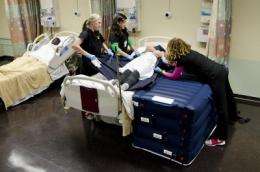
Students in the Sinclair School of Nursing practice safely transferring a patient from an inflatable lift to a hospital bed. Credit: MU
students safe practices," Fujita said. "These students will become professionals who practice safe patient care, which will make hospitals safer for patients."Gregory and Myra Aud, associate professor of nursing, use the room for clinical simulations with nursing students and students in other health professions, such as respiratory therapy, pharmacology and medicine. During the simulations, students work together to identify, solve and prevent safety issues.
"Everyone contributes different perspectives on safety, and they learn from the expertise of their colleagues," Aud said.
Cassie Johanningmeier, another senior nursing student, said the room benefits students because it allows them to test their safety skills without facing real-life consequences.
"One of the best ways to learn is through practice," Johanningmeier said. "The safe practices room helps students build confidence so they can prevent errors that could harm themselves or their patients."
Provided by
University of Missouri-Columbia
-
Next generation of health care workers train through medical simulation (w/Video)
May 19, 2009 |
not rated yet |
0
-
High-tech mom helps teach student nurses
Oct 28, 2009 |
not rated yet |
0
-
Elsevier, Redfox Technologies and Microsoft launch innovative e-learning nursing solution
May 05, 2011 |
not rated yet |
0
-
Few professionals keep current
Feb 22, 2010 |
not rated yet |
0
-
Strong leadership necessary to provide more sophisticated care for aging population, study finds
Sep 13, 2011 |
not rated yet |
0
-
Of mice and mental models: Neuroscientific implications of risk-optimized behavior in the mouse
May 25, 2012 |
not rated yet |
0
-
Limits to growth: Scientists identify key metastasis-enabling enzyme
May 22, 2012 |
5 / 5 (4) |
0
-
Seeing is as seeing does: Spatially-structured retinal input in early development of cortical maps
Apr 26, 2012 |
5 / 5 (4) |
1
-
Dreamless nights: Brain activity during nonrapid eye movement sleep
Apr 09, 2012 |
4.4 / 5 (12) |
0
-
Take your time: Neurobiology sheds light on the superiority of spaced vs. massed learning
Mar 28, 2012 |
4.5 / 5 (21) |
3
-
Classical and Quantum Mechanics via Lie algebras
Apr 15, 2011
- More from Physics Forums - Independent Research
More news stories
Transvaginal mesh op restores pelvic organ prolapse at price
(HealthDay) -- Transvaginal mesh (TVM) procedures are effective for anatomical restoration of pelvic organ prolapse (POP), but patients report a worsening of sexual function following surgery, according to ...
Other
8 hours ago |
not rated yet |
0
Tongue analysis software uses ancient Chinese medicine to warn of disease
For 5,000 years, the Chinese have used a system of medicine based on the flow and balance of positive and negative energies in the body. In this system, the appearance of the tongue is one of the measures used to classify ...
Other
23 hours ago |
1 / 5 (1) |
0
|
Neck strength, cervical spine mobility don't predict pain
(HealthDay) -- Neither isometric neck muscle strength nor passive mobility of the cervical spine, two physical capacity parameters found to be associated with neck pain in other studies, predicts later neck ...
Other
May 25, 2012 |
not rated yet |
0
Pool access for the disabled sparks controversy
(AP) -- The Obama administration is sidestepping an election-year confrontation with the hotel industry and other pool owners to give them more time to comply with access rules for the disabled.
Other
May 25, 2012 |
not rated yet |
0
Chile to cover sex change operations
Chile will soon cover sex change surgeries under its public health plan in order to allow citizens of limited means to "recover their true sexual identity," Health Minister Jaime Manalich said.
Other
May 25, 2012 |
not rated yet |
0
Travel to high altitudes tied to Crohn's, colitis flare-ups
(HealthDay) -- People with inflammatory bowel disease, which includes Crohn's disease and colitis, may be at increased risk for flare-ups when they fly or travel to high altitudes for skiing or mountain climbing, ...
Family history of Alzheimer's affects functional connectivity
(HealthDay) -- Cognitively normal individuals with a family history of late-onset Alzheimer's disease (AD) may display lower resting state functional connectivity in the default mode network (DMN) of the brain, ...
Of mice and mental models: Neuroscientific implications of risk-optimized behavior in the mouse
(Medical Xpress) -- Regardless of an organism’s biological complexity, every encephalized animal continuously makes under-informed behavioral choices that can have serious consequences. Despite its ubiquity, ...
Weight struggles? Blame new neurons in your hypothalamus
New nerve cells formed in a select part of the brain could hold considerable sway over how much you eat and consequently weigh, new animal research by Johns Hopkins scientists suggests in a study published in the May issue ...
Most occupational injury and illness costs are paid by the government and private payers
UC Davis researchers have found that workers' compensation insurance is not used nearly as much as it should be to cover the nation's multi-billion dollar price tag for workplace illnesses and injuries. Instead, almost 80 ...
Thioridazine kills cancer stem cells in human while avoiding toxic side-effects of conventional cancer treatments
A team of scientists at McMaster University has discovered a drug, thioridazine, successfully kills cancer stem cells in the human while avoiding the toxic side-effects of conventional cancer treatments.

Nov 22, 2011
Rank: 1 / 5 (2)