States could see substantial savings with tobacco control programs
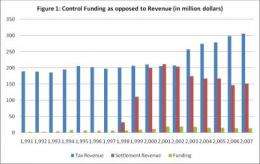
States' collective spending on tobacco control programs (shown in green) between 1991 and 2007 compared to tax revenues from tobacco sales (blue) and revenue from the Tobacco Master Settlement Agreement (red). A new study by San Francisco State University economist Sudip Chattopadhyay shows that states could save 14-20 times more than the cost of implementing tobacco control programs, reaping savings in medical costs, Medicaid payments and lost productivity by workers. Credit: Contemporary Economic Policy
States that have shifted funds away from tobacco control programs may be missing out on significant savings, according to a new study co-authored by San Francisco State University economist Sudip Chattopadhyay.
If these programs were funded at the levels recommended by the Centers for Disease Control and Prevention (CDC), states could save an astonishing 14-20 times more than the cost of implementing the programs. The costs of smoking are felt by the states, mostly through medical costs, Medicaid payments and lost productivity by workers.
The evidence is clear that state tobacco control programs have a "sustained and steadily increasing long-run impact" on the demand for cigarettes, Chattopadhyay and his colleague David R. Pieper at University of California, Berkeley write in a paper published online today in the journal Contemporary Economic Policy. Chattopadhyay is the chair of the Economics Department and professor of economics.
The study uses data from 1991 to 2007, during which time the states paid for the programs with the help of the tobacco tax, public and private initiatives and funds from the Tobacco Master Settlement Agreement between the nation's four largest tobacco companies and 46 states.
Unfortunately, says Chattopadhyay, funding for the programs has been declining steadily since about 2002. In 2010, states on average were spending 17 percent of the total investment recommended by the CDC for the programs. And in tough economic times, many states have turned to cigarette taxes to raise revenue.
Chattopadhyay said the shift in spending priorities was part of his motivation for examining the benefits and costs behind the programs. "Almost all states are facing financial crisis, and they are really diverting their funds, possibly moving funds from productive use."
Unless the benefits of fully funding the programs are shown to outweigh the costs, the researchers suggest, states may continue to divert revenue away from the programs.
After accounting for multiple factors, the researchers determined that tobacco control programs do reduce the demand for cigarettes. It's a trend that grows over time, in part because it takes smokers time to quit and because the programs become more efficient at delivering their services.
Unlike earlier studies, Chattopadhyay and Pieper even examined the effects of different state tobacco taxes, and how the differences might affect cigarette demand. Smokers in a state with a high tobacco tax could be more easily tempted to buy cigarettes if they share a border with a low-tax state, for instance. Tobacco taxes can range from less than 20 cents per pack in some states to nearly $5 in others.
In 2007, the CDC revised its recommendations on how much states should spend on tobacco control programs to make them successful. If individual states would follow the new CDC guidelines, they could realize future savings of 14-20 times what the programs cost, the study concluded. Chattopadhyay said he would like to deliver the results of the study to the states, "to convince them that they can use that money for more productive purposes" and to encourage them not to let their past investments in tobacco control programs go to waste.
"They would save money in terms of reduced Medicaid, and reduced medical and productivity costs," he said. "Those kinds of costs are only going to go up."
Provided by
San Francisco State University
-
CDC: Cigarette taxes rose in 14 states last year
Apr 08, 2010 |
not rated yet |
0
-
Smoking cessation rates stall
Oct 27, 2006 |
not rated yet |
0
-
Report: Smoking rate decline hits wall
Nov 09, 2007 |
not rated yet |
0
-
Anti-smoking policies for adults also reduce kids' smoking
Jun 20, 2011 |
not rated yet |
0
-
Adult smoking rate edges down slightly: CDC data
Sep 06, 2011 |
not rated yet |
0
-
Motion perception revisited: High Phi effect challenges established motion perception assumptions
Apr 23, 2013 |
3 / 5 (2) |
2
-
Anything you can do I can do better: Neuromolecular foundations of the superiority illusion (Update)
Apr 02, 2013 |
4.5 / 5 (11) |
5
-
The visual system as economist: Neural resource allocation in visual adaptation
Mar 30, 2013 |
5 / 5 (2) |
9
-
Separate lives: Neuronal and organismal lifespans decoupled
Mar 27, 2013 |
4.9 / 5 (8) |
0
-
Sizing things up: The evolutionary neurobiology of scale invariance
Feb 28, 2013 |
4.8 / 5 (10) |
14
-
Classical and Quantum Mechanics via Lie algebras
Apr 15, 2011
- More from Physics Forums - Independent Research
More news stories
Consumers largely underestimating calorie content of fast food
People eating at fast food restaurants largely underestimate the calorie content of meals, especially large ones, according to a paper published today in BMJ.
Health
1 hour ago |
not rated yet |
0
It's not your imagination: Memory gets muddled at menopause
Don't doubt it when a woman harried by hot flashes says she's having a hard time remembering things. A new study published online in Menopause, the journal of The North American Menopause Society (NAMS), helps confirm with o ...
Health
2 hours ago |
not rated yet |
0
Farm bill: Senate rejects GMO labeling amendment
The Senate has overwhelmingly rejected an amendment allowing states to require labeling of genetically modified foods.
Health
3 hours ago |
not rated yet |
1
McDonald's can't shake criticism about nutrition
(AP)—McDonald's once again faced criticism that it's a purveyor of junk food that markets to children at its annual shareholder meeting Thursday.
Health
4 hours ago |
not rated yet |
0
Economic incentives increase blood donation without negative consequences
Can economic incentives such as gift cards, T-shirts, and time off from work motivate members of the public to increase their donations of blood?
Health
6 hours ago |
not rated yet |
0
|
Glucosamine supplements tied to risk of eye condition
(HealthDay)—Glucosamine supplements that millions of Americans take to help treat hip and knee osteoarthritis may have an unexpected side effect: They may increase risk for developing glaucoma, a small ...
Controlling mood through the motions of mitochondria
(Medical Xpress)—Regulating the distribution of power in neurons is done by a system that makes the national electric grid look simple by comparison. Each neuron has several thousand mitochondria confined ...
Scientists discover molecule triggers sensation of itch
Scientists at the National Institutes of Health report they have discovered in mouse studies that a small molecule released in the spinal cord triggers a process that is later experienced in the brain as ...
Multiple research teams unable to confirm high-profile Alzheimer's study
Teams of highly respected Alzheimer's researchers failed to replicate what appeared to be breakthrough results for the treatment of this brain disease when they were published last year in the journal Science.
Researchers find common childhood asthma unconnected to allergens or inflammation
Little is known about why asthma develops, how it constricts the airway or why response to treatments varies between patients. Now, a team of researchers at Weill Cornell Medical College, Columbia University Medical Center ...
Motion quotient: IQ predicted by ability to filter motion (w/ video)
A brief visual task can predict IQ, according to a new study. This surprisingly simple exercise measures the brain's unconscious ability to filter out visual movement. The study shows that individuals whose ...