Doctors look to treat sick children in virtual worlds
December 27, 2011 by Michel Viatteau in Health
Three-dimensional images of a child's bedroom at home could make him forget he is in a hospital

Enlarge

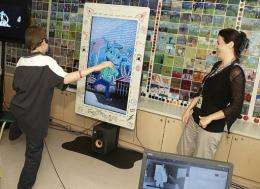
This photo, courtesy Societe des Arts technologiques (SAT), shows a child following the movements of an avatar (on screen) during a demonstration of a new therapy designed to treat anxiety and social behavior issues, at the St. Justine Hospital Center in Montreal, Quebec, Canada.

Doctors in a domed laboratory in Canada are designing a virtual world where they hope to one day treat traumatized children with colorful avatars using toy-like medical gadgets.

Sensory stimulation could be used to make a burn victim feel she is encased in a block of ice. of a child's bedroom at home could make him forget he is in a hospital.

"You could take a child suffering from burns and put him in a polar environment, crossing the threshold of reality, to dull his pain," said Patrick Dube, who is leading a team of medics from Montreal's Sainte-Justine hospital and at the Society for Arts and Technology.

"We know that cognitive illusions have an effect on the perception of pain," he said.

At the Satosphere, an 18-meter-wide (60-foot) dome originally designed to provide spectators with a of art projections, the team has set up a hospital room, or "living lab", to try out new treatment ideas.

The dome, touted by Satosphere president Monique Savoie as a "cinema for the 21st century," is a scion of the Circle-Vision theatre unveiled at the 1967 International and Universal Exposition's Bell Pavilion in Montreal.

"We can, through multiple projectors, create immersive environments that integrate not only walls, but also the furniture in a room," Dube said.

Another tool being tested by the doctors would allow them to give medical gadgets the appearance of fantastical, non-threatening toys.

Children would in theory be able to familiarize themselves with "scary" , like syringes, easing common fears over medical tests and treatments.

In the hands of a little girl, a syringe is transformed into a storybook rocket. "I'm no longer scared of injections," said Maxime, 11, the daughter of one of the researchers.

The researchers are also looking into avatars that could one day allow doctors and nurses to communicate with children traumatized by sickness or a crippling accident, who may not be comfortable opening up to an adult.

Such high-tech puppetry might be used to build a child's confidence or help re-socialize them. The person controlling the avatar from another room could ask a child to mimic its movements as part of physical rehabilitation.

The ultimate aim is to apply the technology to help the children "overcome their fears and discover things about themselves," said Patricia Garel, head of Sainte-Justine's psychiatry department.

"There's enormous potential in our discipline, but we're still at a very early exploratory stage."

Virtual communication and video games are known to sometimes have a negative impact on the socialization of children, particularly the most emotionally fragile, who might shut themselves in.

But Garel insists that if the tools are used correctly they could carve a virtual path back to normal life.

(c) 2011 AFP

not rated yet  

Rank not rated yet
Relevant PhysicsForums posts

More news stories

Keep food safety in mind this memorial day weekend

(HealthDay) -- Picnics, parades and cookouts are as much a part of Memorial Day weekend as tributes to the United States' war veterans.

Health created 6 minutes ago | popularity not rated yet | comments 0

Most occupational injury and illness costs are paid by the government and private payers

UC Davis researchers have found that workers' compensation insurance is not used nearly as much as it should be to cover the nation's multi-billion dollar price tag for workplace illnesses and injuries. Instead, almost 80 ...

Health created May 25, 2012 | popularity not rated yet | comments 0

Early physical therapist treatment associated with reduced risk of healthcare utilization and reduced overall healthcare

A new study published in Spine shows that early treatment by a physical therapist for low back pain (LBP), as compared to delayed treatment, was associated with reduced risk of subsequent healthcare utilization and lower ...

Health created May 25, 2012 | popularity not rated yet | comments 0 | with audio podcast

Cancer patients share web info with docs for insight, advice

(HealthDay) -- Cancer patients' primary goal in talking with their doctors about information they've found on the Internet is to get more insight and advice on the online information, new research indicates.

Health created May 25, 2012 | popularity not rated yet | comments 0

P&G to add latches to make detergent packs safer

(AP) -- Procter & Gamble says it will change the design of packaging for its miniature laundry detergent product to deter children from eating the brightly colored packets that look like candy.

Health created May 25, 2012 | popularity not rated yet | comments 0


Travel to high altitudes tied to Crohn's, colitis flare-ups

(HealthDay) -- People with inflammatory bowel disease, which includes Crohn's disease and colitis, may be at increased risk for flare-ups when they fly or travel to high altitudes for skiing or mountain climbing, ...

Family history of Alzheimer's affects functional connectivity

(HealthDay) -- Cognitively normal individuals with a family history of late-onset Alzheimer's disease (AD) may display lower resting state functional connectivity in the default mode network (DMN) of the brain, ...

Transvaginal mesh op restores pelvic organ prolapse at price

(HealthDay) -- Transvaginal mesh (TVM) procedures are effective for anatomical restoration of pelvic organ prolapse (POP), but patients report a worsening of sexual function following surgery, according to ...

Of mice and mental models: Neuroscientific implications of risk-optimized behavior in the mouse

(Medical Xpress) -- Regardless of an organism’s biological complexity, every encephalized animal continuously makes under-informed behavioral choices that can have serious consequences. Despite its ubiquity, ...

Weight struggles? Blame new neurons in your hypothalamus

New nerve cells formed in a select part of the brain could hold considerable sway over how much you eat and consequently weigh, new animal research by Johns Hopkins scientists suggests in a study published in the May issue ...

Thioridazine kills cancer stem cells in human while avoiding toxic side-effects of conventional cancer treatments

A team of scientists at McMaster University has discovered a drug, thioridazine, successfully kills cancer stem cells in the human while avoiding the toxic side-effects of conventional cancer treatments.