New strain of lab mice mimics human alcohol consumption patterns
December 12, 2011 in Medical research
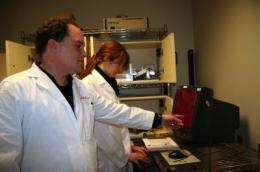
Nicholas Grahame, Ph.D., associate professor of psychology in the School of Science at IUPUI, and School of Science doctoral student Liana M. Matson conduct research to gain a better understanding of the basic brain mechanism involved in alcohol consumption as well as greater insight into the toxic effects of alcohol on the brain, with the goal of developing therapies. Credit: School of Science at Indiana University-Purdue University Indianapolis
A line of laboratory mice developed by a researcher from the School of Science at Indiana University-Purdue University Indianapolis drinks more alcohol than other animal models and consumes it in a fashion similar to humans: choosing alcohol over other options and binge drinking.
Animal models previously available to alcohol abuse and alcoholism researchers do not get as drunk as the new strain, unless alcohol is the only choice of fluids, or alcohol is administered by the experimenter. When given the option, previously bred mouse lines continue to drink water even when they can select alcohol.
These new mice, selectively bred over 40 generations at the School of Science at IUPUI to prefer alcohol over all other choices, will help researchers explore new aspects of the behavioral and genetic determinants of alcoholism.
In a study published online ahead of print in the journal Addiction Biology on Nov. 29, senior author Nicholas Grahame, Ph.D., associate professor of psychology in the School of Science at IUPUI, reports on the mice he has bred since 1997. The rodents reach blood-alcohol levels of more than 260 mg/dl of alcohol daily, over three times the equivalent of the human legal driving limit and the approximate consumption level that the severest human alcoholics attain.
"The free-choice drinking demonstrated by the new mouse line provides a unique opportunity to study the excessive intake that often occurs in alcohol-dependent individuals and to explore the predisposing factors for excessive consumption, as well as the development of physiological, behavioral and toxicological outcomes following alcohol exposure," says Grahame, who is a biopsychologist specializing in alcoholism.
According to the National Institute on Alcohol Abuse and Alcoholism, part of the National Institutes of Health, an estimated 17.6 million Americans abuse alcohol or are alcohol dependent. Alcohol abuse and alcoholism can be treated but cannot be cured.
Mice share 80 percent of their genes with humans, so they are an excellent model to study alcoholism, a disease with a strong genetic component. The risk of developing alcoholism is known to be influenced by lifestyle. Animal models allow researchers to employ methods that they are unable to use in humans.
"This line of high-alcohol-seeking mice should be able to give us a better understanding of the basic brain mechanism involved in alcohol consumption as well as greater insight into the toxic effects on the brain, with the goal of developing therapies," said Grahame, whose research focuses on behavioral genetics and behavioral pharmacology.
As with humans, the mice become intoxicated when the pace of alcohol consumption is faster than the liver can eliminate it. Typically it takes six or seven hours of continuous alcohol drinking for the new strain of mice to reach the highest levels of intoxication.
Doctoral candidate Liana M. Matson is a co-author of the study. She has conducted research focusing on when the mice drink and determined that they are nocturnal drinkers. This knowledge enabled the mice's blood-alcohol levels to be tested when at their highest level.
Undergraduate School of Science students Amy Buckingham and Nick Villalta assisted in the research by measuring intake and blood-alcohol levels in the new strain of high-alcohol-seeking mice. In a related study, they analyzed how drunk the mice became by testing how they performed on a balance beam.
Provided by
Indiana University
-
Genes relate to level of alcohol consumption among Asians
Mar 30, 2011 |
not rated yet |
0
-
Heredity behind subjective effects of alcohol
May 23, 2011 |
not rated yet |
0
-
Study reveals new alcoholic genes
Apr 18, 2006 |
not rated yet |
0
-
Research shows a link between alcoholism and memory
Sep 10, 2008 |
not rated yet |
0
-
Scientists identify gene that influences alcohol consumption
Dec 05, 2007 |
not rated yet |
0
-
Motion perception revisited: High Phi effect challenges established motion perception assumptions
Apr 23, 2013 |
3 / 5 (2) |
2
-
Anything you can do I can do better: Neuromolecular foundations of the superiority illusion (Update)
Apr 02, 2013 |
4.5 / 5 (11) |
5
-
The visual system as economist: Neural resource allocation in visual adaptation
Mar 30, 2013 |
5 / 5 (2) |
9
-
Separate lives: Neuronal and organismal lifespans decoupled
Mar 27, 2013 |
4.9 / 5 (8) |
0
-
Sizing things up: The evolutionary neurobiology of scale invariance
Feb 28, 2013 |
4.8 / 5 (10) |
14
-
Pressure-volume curve: Elastic Recoil Pressure don't make sense
May 18, 2013
-
If you became brain-dead, would you want them to pull the plug?
May 17, 2013
-
MRI bill question
May 15, 2013
-
Ratio of Hydrogen of Oxygen in Dessicated Animal Protein
May 13, 2013
-
Alcohol and acetaminophen
May 13, 2013
-
Marie Curie's leukemia
May 13, 2013
- More from Physics Forums - Medical Sciences
More news stories
Computational tool translates complex data into simplified 2-dimensional images
In their quest to learn more about the variability of cells between and within tissues, biomedical scientists have devised tools capable of simultaneously measuring dozens of characteristics of individual ...
Medical research
6 hours ago |
5 / 5 (1) |
0
|
Now we know why old scizophrenia medicine works on antibiotics-resistant bacteria
In 2008 researchers from the University of Southern Denmark showed that the drug thioridazine, which has previously been used to treat schizophrenia, is also a powerful weapon against antibiotic-resistant bacteria such as ...
Medical research
May 17, 2013 |
3.7 / 5 (3) |
0
|
SUMO wrestling cells reveal new protective mechanism target for stroke
Scientists investigating the interaction of a group of proteins in the brain responsible for protecting nerve cells from damage have identified a new target that could increase cell survival.
Medical research
May 17, 2013 |
5 / 5 (1) |
0
How serotonin receptors can shape drug effects, from LSD to migraine medication
New findings by researchers carrying out experiments at the U.S. Department of Energy Office of Science's Advanced Photon Source (APS) help explain why some drugs that interact with two kinds of human serotonin ...
Medical research
May 17, 2013 |
4 / 5 (1) |
0
|
Preventing blood poisoning
Peptide molecules derived from the body's natural immune system can help boost the body's defence against life-threatening blood poisoning, joint University research has uncovered.
Medical research
May 17, 2013 |
4 / 5 (1) |
0
|
Researchers identify a potential new risk for sleep apnea: Asthma
Researchers at the University of Wisconsin have identified a potential new risk factor for obstructive sleep apnea: asthma. Using data from the National Institutes of Health (Heart, Lung, and Blood Institute)-funded Wisconsin ...
Study finds that sleep apnea and Alzheimer's are linked
A new study looking at sleep-disordered breathing (SDB) and markers for Alzheimer's disease (AD) risk in cerebrospinal fluid (CSF) and neuroimaging adds to the growing body of research linking the two.
New theory on genesis of osteoarthritis comes with successful therapy in mice
Scientists at Johns Hopkins have turned their view of osteoarthritis (OA) inside out. Literally. Instead of seeing the painful degenerative disease as a problem primarily of the cartilage that cushions joints, ...
Ginger compounds may be effective in treating asthma symptoms
Gourmands and foodies everywhere have long recognized ginger as a great way to add a little peppery zing to both sweet and savory dishes; now, a study from researchers at Columbia University shows purified components of the ...
'Gap' for HIV vaccine efforts after latest setback
The hunt for an HIV vaccine has gobbled up $8 billion in the past decade, and the failure of the most recent efficacy trial has delivered yet another setback to 26 years of efforts.
Alzheimer's leaves bilingual victims stranded in Canada
The devastating effect of Alzheimer's disease on bilingual people has been thrown into focus in Canada, where the sudden loss of a second language can leave sufferers feeling like strangers in their own country.