Novel synthetic bone graft in running for national innovation award
December 2, 2011 in Medical research
Novel synthetic bone graft in running for national innovation award

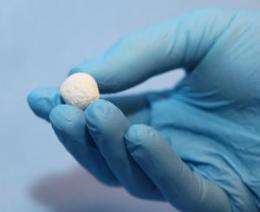
A new and exciting synthetic bone graft to repair bone defects and trauma could take a valuable step nearer to being used in orthopaedic operating theatres, as an innovative Aberdeen company waits to hear if it has won a major UK award for innovation.

SIRAKOSS Limited, a company spun out of the University of Aberdeen in May of this year, is one of only five companies shortlisted for the UK’s Genesis 2011 Med-Tech Innovation Awards, and will find out on December 1 if it has scooped the national prize at an Awards Dinner in London.

The SIRAKOSS entry is the development of a new Synthetic Substitute product called MaxSiTM.

Bone grafts are used to repair or fuse bone defects or trauma. Synthetic bone graft substitutes are increasingly used to replace the need to harvest the patient’s own bone from a healthy site - with the resultant issues of secondary site pain and extended operating time - or the use of cadaver bone with its variable performance and potential for disease transmission.

The team of biomedical chemists, physicists and materials scientists led by Professor Iain Gibson and including Dr Jan Skakle, Jordan Conway, Dr Basil Annaz and Professor Richard Aspden, secured Proof of Concept funding from Scottish Enterprise in 2007. Having secured a further SMART award from Scottish Enterprise to produce novel formulations of their technology, the fledgling company is now keen to attract VC investment to take the product through regulatory approval and clinical trials and onto the global market.

MaxSiTM incorporates a unique chemical composition and physical properties. In specific combination, these have been shown to deliver clear benefits in bone fusion, correlating to early recovery for the patient, and cost benefits for healthcare funders.

SIRAKOSS is competing in the Med Tech category to win a package of support worth an estimated £25,000, provided by sponsors Schwartz Communications, Strategem Intellectual Property Management, Cambridge Healthcare & Biotech, PHASTAR, Global Regulatory Services, and EDB Group. The winner will have access to the full package of advice and support on intellectual property and patenting, being attractive to investors, communications and PR, business development tactics, statistics and audits, and negotiating the route to market.

The company’s initial focus will be on the $3bn global spine fusion market, with other applications also apparent in , maxillofacial and dental surgery.

Professor Iain Gibson said: “For such a new company, we are delighted to have reached this stage in this national competition. The University of Aberdeen has been very supportive throughout the development of this technology, enabling us to reach a stage where we have the opportunity to translate academic research through to clinical use. This would mean that a product that we are very excited about may one day be able to make a real difference in the quality of care available to patients.”

Provided by University of Aberdeen search and more info website

not rated yet  

Rank not rated yet
Relevant PhysicsForums posts
  • Potential Breakthrough in Seizure Control
    created16 hours ago
  • Popping/Cracked sternum.
    created21 hours ago
  • Which Mental Illness Encompasses This Problem?
    created21 hours ago
  • A question about drug tolerance
    createdMay 23, 2012
  • Poor nutrition leading to overeating?
    createdMay 23, 2012
  • Math and dyslexia?
    createdMay 21, 2012
  • More from Physics Forums - Medical Sciences

More news stories

Implantable pain disk may help those with cancer

An estimated 3.5 million cancer patients around the globe are in severe pain from their disease, but many get no relief.

Medical research created May 25, 2012 | popularity 5 / 5 (1) | comments 0 | with audio podcast

Energy levels link sleep control mechanisms

Sleep, or lack of it, can determine level of cognitive performance which is linked with accidents as well as increased risk of serious health problems. Links between cell energy levels, gene transcription ...

Medical research created May 25, 2012 | popularity not rated yet | comments 0

Researchers identify key brain cell in antidepressant action

(Medical Xpress) -- Antidepressant medications such as Prozac have helped improve mood and lessen anxiety in millions of people with major depression. But scientists know surprisingly little about how these drugs work.

Medical research created May 25, 2012 | popularity 4.7 / 5 (3) | comments 0 | with audio podcast

Rockefeller scientists pioneer new method to determine mechanisms of drug action

(Medical Xpress) -- Knowing that a drug works is great. Knowing how it works is a luxury. And until now, determining a drug’s mechanism of action has been a tedious and difficult process for scientists.

Medical research created May 25, 2012 | popularity not rated yet | comments 0 | with audio podcast

Like curry? New biological role identified for compound used in ancient medicine

Scientists have just identified a new reason why some curry dishes, made with spices humans have used for thousands of years, might be good for you.

Medical research created May 25, 2012 | popularity 4.5 / 5 (12) | comments 2 | with audio podcast


Keep food safety in mind this memorial day weekend

(HealthDay) -- Picnics, parades and cookouts are as much a part of Memorial Day weekend as tributes to the United States' war veterans.

Travel to high altitudes tied to Crohn's, colitis flare-ups

(HealthDay) -- People with inflammatory bowel disease, which includes Crohn's disease and colitis, may be at increased risk for flare-ups when they fly or travel to high altitudes for skiing or mountain climbing, ...

Family history of Alzheimer's affects functional connectivity

(HealthDay) -- Cognitively normal individuals with a family history of late-onset Alzheimer's disease (AD) may display lower resting state functional connectivity in the default mode network (DMN) of the brain, ...

Transvaginal mesh op restores pelvic organ prolapse at price

(HealthDay) -- Transvaginal mesh (TVM) procedures are effective for anatomical restoration of pelvic organ prolapse (POP), but patients report a worsening of sexual function following surgery, according to ...

Of mice and mental models: Neuroscientific implications of risk-optimized behavior in the mouse

(Medical Xpress) -- Regardless of an organism’s biological complexity, every encephalized animal continuously makes under-informed behavioral choices that can have serious consequences. Despite its ubiquity, ...

Weight struggles? Blame new neurons in your hypothalamus

New nerve cells formed in a select part of the brain could hold considerable sway over how much you eat and consequently weigh, new animal research by Johns Hopkins scientists suggests in a study published in the May issue ...