Book on teen brains can help improve decision making
December 16, 2011 By Karene Booker in Neuroscience
Book on teen brains can help improve decision making

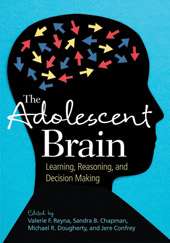
Teenage brains undergo big changes, and they won't look or function like adult brains until well into one's 20s. In the first book on the adolescent brain and development of higher cognition, a Cornell professor helps highlight recent neuroscience discoveries about how the brain develops and their implications for real-world problems and how we teach young people and prepare them to make healthy life choices.

For the new book, "The Adolescent Brain: Learning, Reasoning, and Decision Making" (APA Books), Valerie Reyna, professor of human development in the College of and co-director of Cornell's Center for and Decision Research, brought together an interdisciplinary group of leading scientists to focus on and higher cognition, which is necessary for students to learn math and science and make good decisions. Higher cognition is the set of thinking skills students use to manipulate information and ideas in ways that lead to problem solving and new insights.

"A major implication of the provocative research highlighted in this book is the contrast between adolescents' cognitive skills, which are at a lifetime peak, and their frequent inability to use this competence in everyday decision making," said Reyna, who co-edited the volume with Sandra Chapman, director of the Center for at the University of Texas at Dallas; Michael Dougherty, professor of psychology at University of Maryland; and Jere Confrey, professor of mathematics education at North Carolina State University.

"But the evidence suggests that the way young people learn, reason and decide can be changed," said Reyna. "We must move education beyond rote learning to fostering the cognitive skills essential for academic achievement and economic well-being in our knowledge-based economy. Higher cognition is a foundation critical for individuals and our country to be competitive. This volume introduces a new framework for interdisciplinary collaboration among scientists in neuroscience, psychology and education."

"The Adolescent Brain" addresses the major changes in memory, learning and decision making experienced by adolescents as they mature, beginning with a review of the changes in brain anatomy and physiology based on extensive neuroimaging studies. The ensuing chapters examine the developing capacity of the , covering such topics as the underpinnings of intelligence and problem solving, strategies for training teen reasoning abilities, effectively teaching mathematical concepts, the effects of emotion on reasoning, and factors that promote teen engagement in health-related behaviors.

The book wraps up with a chapter by Reyna and Ph.D. student Christina Chick that integrates the behavioral and neuroscience evidence in a process model of adolescent risky . Chick and Reyna explain, for example, how massive pruning of gray matter in late adolescence fits with the growth of adolescents' ability to connect the dots and understand the underlying meaning of situations. This gist thinking facilitates recognition of danger and protects against unhealthy risk-taking, they say.

The book is intended for researchers, students and professionals in the fields of cognitive neuroscience and psychology and for education policymakers and educators, especially in mathematics.

More information: Reyna will present a talk on the "Adolescent Brain" March 1 at 4-5:30 p.m., 160 Mann Library.

Provided by Cornell University search and more info website

4 /5 (1 vote)  

Rank 4 /5 (1 vote)
Relevant PhysicsForums posts
  • Potential Breakthrough in Seizure Control
    created16 hours ago
  • Popping/Cracked sternum.
    created20 hours ago
  • Which Mental Illness Encompasses This Problem?
    created21 hours ago
  • A question about drug tolerance
    createdMay 23, 2012
  • Poor nutrition leading to overeating?
    createdMay 23, 2012
  • Math and dyslexia?
    createdMay 21, 2012
  • More from Physics Forums - Medical Sciences

More news stories

Of mice and mental models: Neuroscientific implications of risk-optimized behavior in the mouse

(Medical Xpress) -- Regardless of an organism’s biological complexity, every encephalized animal continuously makes under-informed behavioral choices that can have serious consequences. Despite its ubiquity, ...

Neuroscience created May 25, 2012 | popularity not rated yet | comments 0 | with audio podcast feature

Persistent sensory experience is good for aging brain

Despite a long-held scientific belief that much of the wiring of the brain is fixed by the time of adolescence, a new study shows that changes in sensory experience can cause massive rewiring of the brain, even as one ages. ...

Neuroscience created May 24, 2012 | popularity not rated yet | comments 0

Boundary stops molecule right where it needs to be

A molecule responsible for the proper formation of a key portion of the nervous system finds its way to the proper place not because it is actively recruited, but instead because it can't go anywhere else.

Neuroscience created May 24, 2012 | popularity not rated yet | comments 0 | with audio podcast

Locating ground zero: How the brain's emergency workers find the disaster area

Like emergency workers rushing to a disaster scene, cells called microglia speed to places where the brain has been injured, to contain the damage by 'eating up' any cellular debris and dead or dying neurons. ...

Neuroscience created May 24, 2012 | popularity 5 / 5 (2) | comments 0 | with audio podcast

Genetic 'reset switch' enables signaling pathway to induce multiple developmental outcomes for olfactory neurons

Within the nervous system, a handful of signaling pathways modulate development of a cornucopia of different neuronal subtypes. “Even small alterations in neuron differentiation pathways can disrupt subsequent ...

Neuroscience created May 24, 2012 | popularity not rated yet | comments 0


Keep food safety in mind this memorial day weekend

(HealthDay) -- Picnics, parades and cookouts are as much a part of Memorial Day weekend as tributes to the United States' war veterans.

Travel to high altitudes tied to Crohn's, colitis flare-ups

(HealthDay) -- People with inflammatory bowel disease, which includes Crohn's disease and colitis, may be at increased risk for flare-ups when they fly or travel to high altitudes for skiing or mountain climbing, ...

Family history of Alzheimer's affects functional connectivity

(HealthDay) -- Cognitively normal individuals with a family history of late-onset Alzheimer's disease (AD) may display lower resting state functional connectivity in the default mode network (DMN) of the brain, ...

Transvaginal mesh op restores pelvic organ prolapse at price

(HealthDay) -- Transvaginal mesh (TVM) procedures are effective for anatomical restoration of pelvic organ prolapse (POP), but patients report a worsening of sexual function following surgery, according to ...

Weight struggles? Blame new neurons in your hypothalamus

New nerve cells formed in a select part of the brain could hold considerable sway over how much you eat and consequently weigh, new animal research by Johns Hopkins scientists suggests in a study published in the May issue ...

Thioridazine kills cancer stem cells in human while avoiding toxic side-effects of conventional cancer treatments

A team of scientists at McMaster University has discovered a drug, thioridazine, successfully kills cancer stem cells in the human while avoiding the toxic side-effects of conventional cancer treatments.