Waging the war against salmonella ... One molecule at a time
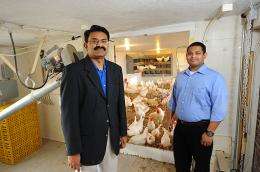
Salmonella is the enemy and UConn researchers in the College of Agriculture and Natural Resources may have discovered a way to defeat it – one molecule at a time.
Annually in the United States, this tiny, rod-shaped, gram-negative bacterium causes over a million cases of salmonellosis, a potentially fatal disease in the elderly, the very young, and those with suppressed immune systems.
Small but tough and commonly found in poultry and dairy products, salmonella can survive for relatively long periods of time in the environment – from weeks to months – and some serotypes have emerged that are resistant to many available antibiotics.
But, animal science professor Kumar Venkitanarayanan and his post-doctoral fellow Anup Kollanoor Johny, funded by grants from the United States Department of Agriculture (USDA) totaling nearly $1.4 million, have determined that natural food grade molecules found in such familiar sources as cinnamon, cloves, oregano, and coconut oil seem to have the ability to shut down the genes that enable the bacterium to colonize in the cecum of chickens.
Venkitanarayanan explains the problem this way: “The bacterium colonizes the intestinal tract of chickens. It’s excreted in droppings and contaminates the meat and the eggs. Within the bird, Salmonella travels from the intestine to the ovaries and contaminates the yolk even before an egg shell is formed. So an intact egg can have Salmonella in the yolk.”
During his doctoral studies with Venkitanarayanan, Kollanoor Johny hypothesized that the molecules contained in certain foods could help ‘turn down’ the genes in the bacteria that prompt them to colonize and invade chickens’ intestinal cells before they are spread to internal organs. Research has proven him correct.
The ability to prevent the colonization and spread of Salmonella is of enormous importance to U.S. agriculture, given the fact that poultry is a favored host for the pathogen, and poultry meat and eggs are sources of infections in humans. In a country that consumes nearly 40 billion pounds of chicken annually, and where the average person consumes approximately 20 dozen eggs in a year, the positive effect on agricultural economics and on the safety of the American food supply is potentially enormous.
While consumers are routinely told to cook poultry and eggs thoroughly, and to avoid cross-contamination in food preparation, being able to largely eliminate the possibility of infection before a food source reaches the marketplace is the goal of farmers and researchers alike.
According to Mike Darre, professor of animal science in the College of Agriculture and Natural Resources and extension poultry specialist, “We have about 8½ billion broiler birds being raised in this country. There are a million eggs being hatched every hour, and a million broilers being processed every hour; that’s a lot of meat birds.
“We’re looking at the same thing on the egg side,” Darre continues. “We have just under 300 million laying hens in the U.S.; that’s just about one hen for every person alive. There have been Salmonella reduction programs in place on poultry farms for years, but it’s a tough thing to get rid of completely. The idea of using natural food molecules in feed and in washes, at a relatively low cost to the farmer … and without the need for antibiotics … has great benefit.”
Kollanoor Johny says these natural molecules have multiple functionality. “They are derived from nature,” he says. “At the same time they are killing Salmonella, we also believe that they have potential human health benefits because of the various functional capabilities, including everything from acting as antioxidants to lowering blood pressure and aiding in cardiovascular health.
“That’s not the kind of work being done in our lab,” he says, “but still, it’s encouraging to think that these molecules have multiple benefits. As a matter of fact, we are currently investigating their potential to control antibiotic resistance in food animals other than poultry; they may be very good alternatives to the use of antibiotics – which is a concern to many people.”
The next step, according to Kollanoor Johny, is to make sure that adding food grade molecules to poultry feed is not harmful to the birds: “Our initial findings show that these molecules are completely safe in chickens, but we need to do more studies to make sure the meat and eggs are still palatable. We don’t want eggs to be cinnamon flavored!”


