British pharmacy chain announces roll-out of new smart pills loaded with microchip
January 18, 2012 by Bob Yirka in Medications report

British pharmacy chain announces roll-out of new smart pills loaded with microchip

Enlarge

(Medical Xpress) -- A new pharmaceutical program that many Britons might find literally hard to swallow, has been announced. Pharmacy chain Lloydspharmacy has partnered with American technology firm Proteus Biomedical to bring to the British public a product called Helius; a tiny microchip that is swallowed in pill form and whose purpose is to help remind patients to take their medications on time and to offer bio-feedback such as body temperature, heart rate and even sleeping patterns.

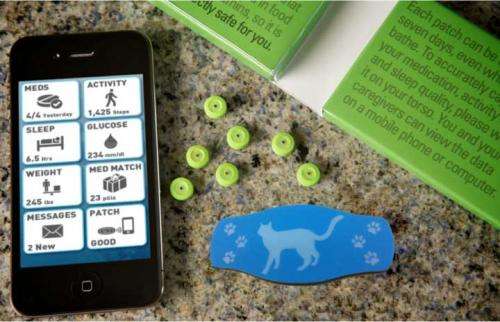
The microchip, which becomes active when subjected to water, can be either embedded directly in regular medication pills, or placed in a placebo meant only to deliver the pill to the stomach in conjunction with regular medication. In either case, the microchip, or "ingestible event marker" (IEM) as Proteus calls it, is powered by a thin film non-toxic battery. Once activated, the IEM sends a tiny uniquely modulated high frequency throughout the body, using the body as a conduit, thus, no is used. Instead, a patch is applied to the skin on the outside of the body to listen for bodily interactions with the electrical signal, allowing for measurement of the heart-beat rate, , respiration rate, posture and sleeping patterns. All of this information is relayed via app to a web site that provides statistics in graph form. Thus, patients can simply check their chart to see if they have taken all of their pills or not. The information could also be sent to the doctor who prescribed the medication to see if it’s having the desired effect.

This video is not supported by your browser at this time.

The whole idea is get patients to take all of their medications when they are supposed to be taken, which is a serious problem. The World Health Organization recently announced that it believes that as many as half the people in the world don’t take their medications correctly, putting themselves at risk.

What’s not clear is how long the operates inside the body, and what happens to it once it dies. Is it digested, or is it flushed out into the sewer system wholly intact? And if it’s flushed, what happens to all those millions of chips that wind up in sewage treatment facilities?

Such questions appear to be beside the point at this juncture, as the real issue is whether people will buy into the new technology, and if they do, if it will help them take their mediation properly. On the one hand, it might help people live better or longer. On the other, it appears that such pill takers would have to wear the patch that reads the data all the time and would have to have their Smartphones near at hand constantly as well. There’s also likely to be privacy issues as patients would have to rely on promises made by corporations that may or may not be securing their medical histories as well as patients would expect.

© 2011 PhysOrg.com

4.1 /5 (13 votes)  

Filter


Move the slider to adjust rank threshold, so that you can hide some of the comments.


Display comments: newest first

hyongx
Jan 18, 2012

Rank: not rated yet
Somehow, I'm not that keen on swallowing something that sends "high frequency electrical signal throughout the body"
tadchem
Jan 18, 2012

Rank: 5 / 5 (2)
Somehow, I'm not that keen on swallowing something that sends "high frequency electrical signal throughout the body"

As opposed to carrying one around in your pocket all day?
btb101
Jan 19, 2012

Rank: not rated yet
it is strange that lloyds keep deferring their annual pay award to their staff, constantly push and push with higher and higher targets for their staff to achieve. complain bitterly about not enough profit despite the fact that 3.2 billion was made last year and looks to be higher this year.
and then they come out with this.
who is seriously going to use this?i can not think of a single person who would willingly use this.
or is this going to be their excuse for not giving their staff a rise this year?
oh, sorry. lost money on this thing.
Rank 4.1 /5 (13 votes)
Relevant PhysicsForums posts

More news stories

Merck ends development of Parkinson's disease drug

(AP)—Merck & Co. says it is ending development of an experimental Parkinson's disease drug because the drug wasn't working.

Medications created May 23, 2013 | popularity 1 / 5 (1) | comments 0

J&J expects 10-plus new drug applications by 2017

(AP)—Johnson & Johnson is developing what could eventually be game-changing treatments for depression and pain, and it's aiming to apply for approval of more than 10 new medicines by 2017, executives said Thursday during ...

Medications created May 23, 2013 | popularity 5 / 5 (1) | comments 0

Experts favor US approval of Merck sleeping pill (Update)

An independent panel of experts on Wednesday recommended US approval of a new Merck sleeping pill called suvorexant, but expressed concerns over the highest dosage and risks of drowsy daytime driving.

Medications created May 22, 2013 | popularity not rated yet | comments 0

Glaxo, US partnering to develop new antibiotics

GlaxoSmithKline PLC says it's starting an unusual collaboration with the U.S. government to develop several antibiotics for both bioterrorism threats and bacterial infections resistant to current medicines.

Medications created May 22, 2013 | popularity not rated yet | comments 0

Study finds new pneumococcal vaccine appears to be as safe as previously used vaccine

The new 13-valent pneumococcal conjugate vaccine (PCV13) appears to be as safe as the previous version used prior to 2010, the 7-valent pneumococcal conjugate vaccine (PCV7), according to a Kaiser Permanente study published ...

Medications created May 22, 2013 | popularity not rated yet | comments 0


Researchers identify first drug targets in childhood genetic tumor disorder

Two mutations central to the development of infantile myofibromatosis (IM)—a disorder characterized by multiple tumors involving the skin, bone, and soft tissue—may provide new therapeutic targets, according to researchers ...

Engineered cytomegalovirus protects monkeys from HIV equivalent

(Medical Xpress)—A new study by researchers in the US has shown that an ancient virus can be modified to help in the fight against the simian immunodeficiency virus SIV, which is the equivalent in monkeys ...

Driving and hands-free talking lead to spike in errors, study shows

Talking on a hands-free device while behind the wheel can lead to a sharp increase in errors that could imperil other drivers on the road, according to new research from the University of Alberta.

Hormone levels may provide key to understanding psychological disorders in women

Women at a particular stage in their monthly menstrual cycle may be more vulnerable to some of the psychological side-effects associated with stressful experiences, according to a study from UCL.

Going live: Immune cell activation in multiple sclerosis

Biological processes are generally based on events at the molecular and cellular level. To understand what happens in the course of infections, diseases or normal bodily functions, scientists would need to ...

Pollen count apps for smartphones are nothing to sneeze at

Kate O'Reilly's spring allergy survival kit includes the usual stuff - nasal sprays, allergy pills and a box of tissues. This season, she's added a new weapon to her line of defense: an app on her smartphone.