Diets high in fiber won't protect against diverticulosis
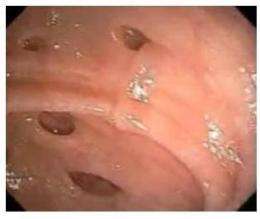
This is an endoscopic picture of a clean colon (large intestine) with diverticula. Credit: Anne Peery, MD
For more than 40 years, scientists and physicians have thought eating a high-fiber diet lowered a person's risk of diverticulosis, a disease of the large intestine in which pouches develop in the colon wall. A new study of more than 2,000 people reveals the opposite may be true.
The study, conducted by researchers at the University of North Carolina at Chapel Hill School of Medicine , found that consuming a diet high in fiber raised, rather than lowered, the risk of developing diverticulosis. The findings also counter the commonly-held belief that constipation increases a person's risk of the disease.
"Despite the significant morbidity and mortality of symptomatic diverticulosis, it looks like we may have been wrong, for decades, about why diverticula actually form," said Anne Peery, MD, a fellow in the gastroenterology and hepatology division at UNC and the study's lead researcher. The study appears in the February 2012 issue of the journal Gastroenterology.
"While it is too early to tell patients what to do differently, these results are exciting for researchers," said Peery. "Figuring out that we don't know something gives us the opportunity to look at disease processes in new ways."
Diverticulosis affects about one-third of adults over age 60 in the United States. Although most cases are asymptomatic, when complications develop they can be severe, resulting in infections, bleeding, intestinal perforations and even death. Health care associated with such complications costs an estimated $2.5 billion per year.
Since the late 1960s, doctors have recommended a high-fiber diet to regulate bowel movements and reduce the risk of diverticulosis. This recommendation is based on the idea that a low fiber diet will cause constipation and in turn generate diverticula as a result of increased pressure in the colon. However, few studies have been conducted to back up that assumption. "Our findings dispute commonly-held beliefs because asymptomatic diverticulosis has never been rigorously studied," said Peery.
The UNC study is based on data from 2,104 patients aged 30-80 years who underwent outpatient colonoscopy at UNC Hospitals from 1998-2010. Participants were interviewed about their diet, bowel movements and level of physical activity.
"We were surprised to find that a low-fiber diet was not associated with a higher prevalence of asymptomatic diverticulosis," said Peery. In fact, the study found those with the lowest fiber intake were 30 percent less likely to develop diverticula than those with the highest fiber intake.
The study also found constipation was not a risk factor and that having more frequent bowel movements actually increased a person's risk. Compared to those with fewer than seven bowel movements per week, individuals with more than 15 bowel movements per week were 70 percent more likely to develop diverticulosis.
The study found no association between diverticulosis and physical inactivity, intake of fat, or intake of red meat. The disease's causes remain unknown, but the researchers believe gut flora may play a role.
Peery said more research is needed before doctors change dietary recommendations, but the study offers valuable insights on diverticulosis risk factors. "At this time, we cannot predict who will develop a complication, but if we can better understand why asymptomatic diverticula form we can potentially reduce the population at risk for symptomatic disease," said Peery.
Provided by
University of North Carolina School of Medicine
-
Diverticulosis not associated with higher incidence of polyps
Oct 26, 2009 |
not rated yet |
0
-
Consumption of nuts, corn or popcorn not associated with increased risk of diverticulosis in men
Aug 26, 2008 |
not rated yet |
0
-
Fiber the best bet to help kids with constipation
Sep 29, 2011 |
not rated yet |
0
-
Load up on fiber now, avoid heart disease later
Mar 22, 2011 |
not rated yet |
0
-
Vegetarian diet may protect against common bowel disorder
Jul 20, 2011 |
not rated yet |
0
-
Motion perception revisited: High Phi effect challenges established motion perception assumptions
Apr 23, 2013 |
3 / 5 (2) |
2
-
Anything you can do I can do better: Neuromolecular foundations of the superiority illusion (Update)
Apr 02, 2013 |
4.5 / 5 (11) |
5
-
The visual system as economist: Neural resource allocation in visual adaptation
Mar 30, 2013 |
5 / 5 (2) |
9
-
Separate lives: Neuronal and organismal lifespans decoupled
Mar 27, 2013 |
4.9 / 5 (8) |
0
-
Sizing things up: The evolutionary neurobiology of scale invariance
Feb 28, 2013 |
4.8 / 5 (10) |
14
-
Classical and Quantum Mechanics via Lie algebras
Apr 15, 2011
- More from Physics Forums - Independent Research
More news stories
Calorie information in fast food restaurants used by 40 percent of 9-18 year olds when making food choices
A new study published online today (Thursday) in the Journal of Public Health has found that of young people who visited fast food or chain restaurants in the U.S. in 2010, girls and youth who were obese were more likely ...
Health
51 minutes ago |
not rated yet |
0
Systematic screening of med adherence will ID barriers
(HealthDay)—Implementation of systematic monitoring for medication adherence will allow for identification of barriers to adherence and tailoring of interventions, according to a viewpoint piece published ...
Health
2 hours ago |
not rated yet |
0
More doctors, hospitals using electronic records
(AP)—The Obama administration says more doctors and hospitals are embracing technology as adoption of computerized medical records reaches a "tipping point" in America.
Health
3 hours ago |
not rated yet |
0
Hospitals profit when patients develop bloodstream infections
Johns Hopkins researchers report that hospitals may be reaping enormous income for patients whose hospital stays are complicated by preventable bloodstream infections contracted in their intensive care units.
Health
4 hours ago |
not rated yet |
0
Alleviating hunger in the US, it's a SNAP, researcher says
A University of Illinois researcher says that the cornerstone of our efforts to alleviate food insecurity should be to encourage more people to participate in the Supplemental Nutrition Assistance Program (SNAP) "because ...
Health
4 hours ago |
not rated yet |
0
Having both migraines, depression may mean smaller brain
(HealthDay)—Migraines and depression can each cause a great deal of suffering, but new research indicates the combination of the two may be linked to something else entirely—a smaller brain.
Slowing the aging process—only with antibiotics
Swiss scientists reveal the mechanism responsible for aging hidden deep within mitochondria—and dramatically slow it down in worms by administering antibiotics to the young.
Brain can be trained in compassion, study shows
Until now, little was scientifically known about the human potential to cultivate compassion—the emotional state of caring for people who are suffering in a way that motivates altruistic behavior.
Researchers complete largest genetic sequencing study of human disease
Researchers from Queen Mary, University of London have led the largest sequencing study of human disease to date, investigating the genetic basis of six autoimmune diseases.
Novel approach for influenza vaccination shows promise in early animal testing
A new approach for immunizing against influenza elicited a more potent immune response and broader protection than the currently licensed seasonal influenza vaccines when tested in mice and ferrets. The vaccine ...
Experts favor US approval of Merck sleeping pill (Update)
An independent panel of experts on Wednesday recommended US approval of a new Merck sleeping pill called suvorexant, but expressed concerns over the highest dosage and risks of drowsy daytime driving.