The ethics of brain boosting
January 26, 2012 By Jonathan Wood in Neuroscience
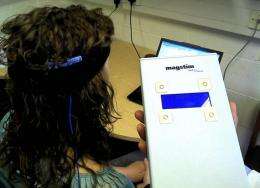
A healthy adult volunteer takes part in a brain stimulation study. Photo: Roi Cohen Kadosh.
(Medical Xpress) -- The idea of a simple, cheap and widely available device that could boost brain function sounds too good to be true.
Yet promising results in the lab with emerging brain stimulation techniques, though still very preliminary, have prompted Oxford neuroscientists to team up with leading ethicists at the University to consider the issues the new technology could raise. They spoke to Radio 4's Today program this morning.
Recent research in Oxford and elsewhere has shown that one type of brain stimulation in particular, called transcranial direct current stimulation or TDCS, can be used to improve language and maths abilities, memory, problem solving, attention, even movement.
Critically, this is not just helping to restore function in those with impaired abilities. TDCS can be used to enhance healthy peoples mental capacities. Indeed, most of the research so far has been carried out in healthy adults.
TDCS uses electrodes placed on the outside of the head to pass tiny currents across regions of the brain for 20 minutes or so. The currents of 12 mA make it easier for neurons in these brain regions to fire. It is thought that this enhances the making and strengthening of connections involved in learning and memory.
The technique is painless, all indications at the moment are that it is safe, and the effects can last over the long term.
Dr. Roi Cohen Kadosh, who has carried out brain stimulation studies at the Department of Experimental Psychology, very definitely has a vision for how TDCS could be used in the future: "I can see a time when people plug a simple device into an iPad so that their brain is stimulated when they are doing their homework, learning French or taking up the piano," he says.
The growing number of positive results in early-stage studies, led the neuroscientists Dr. Cohen Kadosh and Dr. Jacinta OShea to talk to Professor Neil Levy, Dr. Nick Shea and Professor Julian Savulescu in the Oxford Centre for Neuroethics about what ethical issues there may be in future widespread use of TDCS to boost abilities in healthy people.
The researchers outline the issues in a short paper in the journal Current Biology (pdf), and indicate the research that is now necessary to address some of the potential concerns.
"We ask: should we use brain stimulation to enhance cognition, and what are the risks?" explains Roi. "Our aim was to look at whether it gives rise to new ethical issues, issues that will increasingly need to be thought about in our field but also by policymakers and the public."
"This research cuts to core of humanity: the capacity to learn," says Professor Julian Savulescu. "The capacity to learn varies across people, across ages and with illness. This kind of technology enables people to get more out of the work they put into learning something."
He adds: "This is a first step down the path of maximizing human potential. It is a very exciting development but we need to control the release of the genie. Although this looks like a simple external device, it acts by affecting the brain. That could have very good effects, but unpredictable side effects."
One of the most obvious uses of brain stimulation techniques is in children as an educational or learning aid. The researchers believe that their use in children would be warranted, and that we should begin research to understand how TDCS might be used in children.
Roi notes that: "Parents will often send their child to piano lessons or to football lessons, wanting them to do well." He considers that providing people with ways of fulfilling their potential is not a bad thing.
The researchers consider whether brain stimulation could be thought of as cheating, with the idea that we can get extra cognitive abilities for no effort. Here they offer a resounding No.
The technique seems to boost the learning process in conjunction with standard education or training. There is no free ride here people still need to work at learning a new skill or language themselves. "It wont be possible to go to sleep at night with the electrodes on, wake up the next day and pass all your exams," says Roi.
They also look at access to this technology, and will it further benefit the well off. But they suggest the TDCS kit is simple and cheap enough to be available to all in schools.
"This technology overcomes some standard objections to enhancement: It is not a set of cheat notes," says Julian. "You require effort and hard work to learn. It is just that you get more out of your effort. And because it is cheap, low tech, easily affordable, it could be widely available. This addresses the objection that it will introduce inequality and unfairness. It could be available and should be available to all, if it is safe and effective."
The researchers concern is more that the technology is such that people could assemble all the components needed at home reasonably simply. Roi clearly says that this is not warranted yet with our limited current knowledge about the techniques use: "The message should very much be 'Dont try this at home'."
While there have been some ethical discussions in the past of using some drugs to boost concentration or attention, the researchers explain that TDCS is different and needs to be considered separately.
For example, drugs in general are prescribed for use by one person, ingested and taken internally, and with limits on dose. There are no such in-built limits with brain stimulation, and it may not feel as serious as taking a drug because it is an externally applied treatment though its effects may be as strong.
"Once you have a brain stimulation device, you can use it as often as you want and there are no limits on who uses it," Roi points out.
But at the current time, most of the TDCS work that has been done is preliminary, small-scale and in the lab. There are no clear guidelines for its use as yet, as research is still establishing the optimal ways of using TDCS for different areas of cognition.
The researchers are concerned that in this gap, some people could step in to offer TDCS to vulnerable patients or parents desperate to advance their children before the technique is fully understood.
The researchers also identify a number of outstanding questions:
Are there downsides to boosting capacity in one area of cognitive ability? Do other mental abilities lose out?
The developing brain in children is different to adults. With most research having been in adults, the use of TDCS in children becomes a pressing question.
And are the benefits seen in the lab clinically relevant: can TDCS lead to improvements that matter in normal daily life?
Julian says: "At this stage, we need more research to understand better the risks and benefits, in specific populations, in real life. Any regulation should prevent misuse and abuse, but facilitate good research. This kind of technology could be as important as the internet and computing. Those are external cognitive enhancements. This is basic fundamental cognitive enhancement."
The researchers conclude the exciting potential of TDCS requires that this research be done and all these ethical questions considered.
"Enhancing cognitive abilities, or our ability to learn, is not a bad thing to do. There is no problem with that, as far as we see, as long as there are no side effects," says Roi.
"What is the ethical way forward? More research before deployment," says Julian. "It is promising but not proven at this stage."
Provided by
Oxford University
-
Electrical brain stimulation improves math skills
Nov 04, 2010 |
not rated yet |
0
-
Noninvasive brain stimulation may improve swallowing after stroke
Mar 24, 2011 |
not rated yet |
0
-
Motor skill learning may be enhanced by mild brain stimulation
Jan 19, 2009 |
not rated yet |
0
-
Brain stimulation improves dexterity
Oct 27, 2008 |
not rated yet |
0
-
Electrical stimulation to the brain makes learning easier
Sep 21, 2011 |
not rated yet |
0
-
Motion perception revisited: High Phi effect challenges established motion perception assumptions
Apr 23, 2013 |
3 / 5 (2) |
2
-
Anything you can do I can do better: Neuromolecular foundations of the superiority illusion (Update)
Apr 02, 2013 |
4.5 / 5 (11) |
5
-
The visual system as economist: Neural resource allocation in visual adaptation
Mar 30, 2013 |
5 / 5 (2) |
9
-
Separate lives: Neuronal and organismal lifespans decoupled
Mar 27, 2013 |
4.9 / 5 (8) |
0
-
Sizing things up: The evolutionary neurobiology of scale invariance
Feb 28, 2013 |
4.8 / 5 (10) |
14
-
Pressure-volume curve: Elastic Recoil Pressure don't make sense
13 hours ago
-
If you became brain-dead, would you want them to pull the plug?
May 17, 2013
-
MRI bill question
May 15, 2013
-
Ratio of Hydrogen of Oxygen in Dessicated Animal Protein
May 13, 2013
-
Alcohol and acetaminophen
May 13, 2013
-
Marie Curie's leukemia
May 13, 2013
- More from Physics Forums - Medical Sciences
More news stories
For combat veterans suffering from post-traumatic stress disorder, 'fear circuitry' in the brain never rests
Chronic trauma can inflict lasting damage to brain regions associated with fear and anxiety. Previous imaging studies of people with post-traumatic stress disorder, or PTSD, have shown that these brain regions can over-or ...
Neuroscience
15 hours ago |
5 / 5 (1) |
0
|
Temporal processing in the olfactory system
The neural machinery underlying our olfactory sense continues to be an enigma for neuroscience. A recent review in Neuron seeks to expand traditional ideas about how neurons in the olfactory bulb might encode information about ...
Neuroscience
May 17, 2013 |
not rated yet |
0
|
Melon focus headband turns to Kickstarter for rollout plans
(Medical Xpress)—What if the quality of your work depends more on your focus on the piano keys or canvas or laptop than your musical or painting or computing skills? If target users can be convinced, they ...
Neuroscience
May 17, 2013 |
3.7 / 5 (3) |
0
|
Deep brain stimulation: A fix when the drugs don't work
Neurological disorders can have a devastating impact on the lives of sufferers and their families.
Neuroscience
May 17, 2013 |
5 / 5 (1) |
0
|
Brain makes call on which ear is used for cell phone
If you're a left-brain thinker, chances are you use your right hand to hold your cell phone up to your right ear, according to a newly published study from Henry Ford Hospital in Detroit.
Neuroscience
May 16, 2013 |
2 / 5 (2) |
0
|
New research identifies risks, interventions for children's GI health
An increasing number of U.S. children are experiencing gastrointestinal issues that require interventions to resolve, according to research presented at Digestive Disease Week (DDW).
AIDS science at 30: 'Cure' now part of lexicon
Big names in medicine are set to give an upbeat assessment of the war on AIDS on Tuesday, 30 years after French researchers identified the virus that causes the disease.
US psychiatry gets makeover in new manual
The latest makeover to a massive psychiatric tome honored by some, reviled by others and even called the "Bible" of mental disorders is being released Saturday with a host of new changes.
New case of SARS-like virus in Saudi: ministry
A new case of the deadly coronavirus has been detected in Saudi Arabia where 15 people have already died after contracting it, the health ministry announced on Saturday on its Internet website.
New colonoscope provides ground-breaking view of colon
A ground-breaking advance in colonoscopy technology signals the future of colorectal care, according to research presented today at Digestive Disease Week(DDW). Additional research focuses on optimizing the minimal withdrawal ...
Flesh-eating disease victim gets prosthetic hands
(AP)—A woman who lost both hands, her left leg and right foot after contracting a flesh-eating disease has been fitted with prosthetic hands.
Jan 26, 2012
Rank: 4.6 / 5 (5)
If that were the case, this device would have a similar effect on cognition as caffeine. You use it for a few weeks to great effect, then your baseline is reset to the new conditions, and you can't function properly without it (but without the boosting effect, which quickly disappears). In the case of caffeine, people who've been on it for a mere 3 weeks *require* caffeine just to reach what they once considered "normal" levels of attention and wakefulness.
Anyway, this team is doing awesome research:). Even if this device turns out to have horrible side effects, we'll still have learnt interesting things.
Jan 26, 2012
Rank: 5 / 5 (4)
Jan 26, 2012
Rank: 1.5 / 5 (11)
Jan 26, 2012
Rank: 3.5 / 5 (2)
Jan 26, 2012
Rank: 3.4 / 5 (7)
Jan 26, 2012
Rank: 3.1 / 5 (9)
Books are an antiquated medium for propagating knowledge. There is nothing you can learn in a book that I can't learn on the internet, and when researching something specific I will find the answer faster than you will if you are relying on books.
Jan 26, 2012
Rank: 5 / 5 (4)
Jan 26, 2012
Rank: 2.7 / 5 (6)
Did you ever hear of fiction, like 'Huckleberry Finn' for instance? When you read a book like that, your brain goes into overdrive with cinematic imagery, just the kind of thing a young mind needs to exercise. Your reliance on the internet for information will result in shortfalls in creativity, imagination, and problem solving. Some savvy Silicon Valley parents in the industry are sending...
Jan 26, 2012
Rank: 1 / 5 (5)
Jan 26, 2012
Rank: 5 / 5 (1)
haha, I've always been a curmudgeon, but call it a "realist"
I have no idea about the development of artistic skills or creativity, I have very little, so perhaps you are correct about that.
Jan 26, 2012
Rank: 5 / 5 (4)
Jan 27, 2012
Rank: 3.3 / 5 (3)
Who wouldn't?
I, personally, don't see the ethical "dilemma" of brain boosting. What are the negatives of a more intelligent society? This could also benefit people with low I.Qs, as those sorts of people should first be considered priority for this sort of technology.
Jan 27, 2012
Rank: 3.7 / 5 (6)
-Dr. Eldon Tyrell
Jan 27, 2012
Rank: 5 / 5 (6)
While I agree on the information part there are side effects of researching something in books that cannot be had from the internet.
I found that the slowness of research in books gives you more time to think about the problem while doing the research. You're less likely to just google stuff because you're too lazy to figure it out yourself. This may sound inefficient, but in my experience it somtimes leads to understanding, whereas internet research just leads to fact accumulation. (though I heartily endorse that one should check their newfound understanding against existing facts - and revise it if found to be wrong!)
Also books engage more senses than internet research - leading to better knowledge retention in the brain One reason why I print out interesting papers and read them this way rather than reading them on screen.
Just goes to show: nothing ever replaces anything.
Jan 27, 2012
Rank: 5 / 5 (6)
I wouldn't.
Not that this isn't fascinating research - but when it comes down to it: your brain is the one thing you don't want to screw with for, well, anything.
The loss of any other facility (eyesight, limbs, speech, ... ) you can handle - but if something goes wrong with your brain it's 'game over'.
More intelligence without more empathy just leads to increasingly clever people trying to screw you over. It would be like putting nukes into people's hands instead of guns.
Good? Bad? I don't know. But if we don't foster social competence at the same time we increase intelligence then we're treading dangerous ground.
Jan 27, 2012
Rank: 5 / 5 (3)
Thanks for the response. I've since changed my mind. I think you're probably right about most of the things you said. I hadn't thought of any of it like that. This sort of thing could be disastrous depending on how it's used. I agree with what you said; those with higher I.Qs could easily exploit, con and manipulate those with lower I.Qs. I guess there needs to be some kind of regulation of sorts if they *do* ever go ahead with this.
Jan 27, 2012
Rank: 5 / 5 (4)
And then lied. So Roy shortened his lifespan.
Ethelred
Jan 27, 2012
Rank: 5 / 5 (1)
Jan 27, 2012
Rank: not rated yet
Jan 27, 2012
Rank: not rated yet
Jan 27, 2012
Rank: not rated yet
"TDCS uses electrodes placed on the outside of the head to pass tiny currents across regions of the brain for 20 minutes or so. The currents of 12 mA make it easier for neurons in these brain regions to fire."
That's all it took to acquire a slight boost in memory/knowledge acquisition? I guess I'm just surprised research like this hasn't been done before (that I've heard of).
I'm curious to see this method applied to different areas of the cerebral cortex (where the function of that area is known).
Jan 27, 2012
Rank: 4.5 / 5 (2)
True. But how would increasing intelligence NOT result in increasing social competence? Isn't evolving in a social environment one of the reasons we think we humans evolved such powerful cognitive abilities? Wouldn't our empathy-driving mirror neurons benefit in the same way as the others?
Jan 27, 2012
Rank: 4 / 5 (1)
AFAIC, AA's absolutely right on that score. Those are two different "skill sets". See "The Smartest Guys in the Room" for a good example of where (supposed) intelligence without compassion leads. Or read about the attitude those who manage "smart money" have with respect to those who they refer to as managing "dumb money". Intelligence without compassion leads to vanity and arrogance; intellectual bullying that can all too easily take the form of "deserving to screw your inferiors". It's not a healthy place to go.
Jan 27, 2012
Rank: 5 / 5 (3)
Jan 27, 2012
Rank: 4 / 5 (1)
Hardly. They're the qualities of CEOs, godfathers, pimps, Israeli arms dealers, generals, narco kingpins, politicians etc. Anywhere sending others out to do your dirty work is the norm.
Jan 27, 2012
Rank: 5 / 5 (2)
Jan 27, 2012
Rank: 5 / 5 (2)
All very small demographics. VERY small. They also aren't necessarily smarter than average (~100 IQ), but more successful at one single approach to life.
Guys, you don't need to tell me that smarter people are more likely to be deceptive. I've read those articles, too, and I see it in myself. What I'm suggesting, is that there is a practical limit to how deceptive a person can successfully be in any civil society before negative repercussions occur, and a more intelligent person would recognize that and then change themselves accordingly.
Jan 27, 2012
Rank: 5 / 5 (2)
Jan 27, 2012
Rank: 4 / 5 (1)
Jan 27, 2012
Rank: 5 / 5 (1)
Jan 27, 2012
Rank: not rated yet
Jan 27, 2012
Rank: 5 / 5 (1)
Jan 27, 2012
Rank: 5 / 5 (2)
One observation on the above philosophical/psychological discussion: If it truly works, all of our nation state competitors will be using it. In that case, not using this technology will not be an option.
Jan 28, 2012
Rank: not rated yet
Jan 29, 2012
Rank: 5 / 5 (1)
'Brainwave' (Poul Anderson, I think) was an excellent book.
Jan 29, 2012
Rank: not rated yet
Jan 29, 2012
Rank: 1 / 5 (2)
The key to what humans want to label 'intelligence' is associativity - the associations acquire and attached to the experience one undergoes during the duration of that experience.
Intelligence: the associations one becomes aware from recall, from whatever (physical or nonphysical) event provoking a 'desire' to 'know'.
The numbers of associations brought in association with the 'desire' to experience more of anything of interest to you, makes you what laypersons will label 'genius'.
Example:
Sound - if you hear a sound that sounds like the a word that is pronounced like the word 'water' (presupposing English language exposure) and you have 'learned' this 'label' for your experiences this object or event, before having a label for it - those 'associations numbers in the thousands for people of 'normal' intelligence.
TDCS stimulates more associations - related or unrelated - without control to the word 'water'.
Their research is charlatanry.
Jan 29, 2012
Rank: 5 / 5 (2)
Don't forget to get the polarity right, or you'll be dumbed down and end up watching daytime TV
Jan 30, 2012
Rank: 3 / 5 (1)
Jan 30, 2012
Rank: 5 / 5 (2)
Actually, it is not - as long as most people are hones it's an exceedingly successful strategy (in games theory and in real life).
The assumption is that if you give people such a 'weapon' without them having acclimatized to an environment where everyone has the same weapon the temptation is great to try it out.
Intelligence, knowledge, wisdom and socal competence (empathy) are four very distinct skillsets. Boosting one does not necessarily boost any of the others.
Jan 30, 2012
Rank: 5 / 5 (2)
Not necessarily. If someone is smart enough to maneuver those they are screwing over into a position where they can't retaliate, the "smart asshole" can be left with long term access to more wealth and resources.
Well, this would certainly be something I would HOPE for, but realistically, just on a personal level I've dealt with enough highly intelligent people to know that compassion and social skills aren't directly tied to intelligence. Lots of really smart guys are just asses, some are really decent folks, and others can be quite "nice", but in a frustratingly paternalistic kind of way. I'd even say that in the worst cases, being highly intellient can often be socially isolating.
Jan 30, 2012
Rank: 1 / 5 (1)
Astonishing is assertion from all of age four years or older claiming superior intelligence to all those younger than this.
The caveat here is the assumption that the capacity to learn (the greatest amount in the least time) is the measure of intelligence.
GrayLensman does your rating express a disagreement with intelligence as a measure of associativity?
What is your unit of measurement for intelligence?
Jan 31, 2012
Rank: 1 / 5 (1)
Whatever one labels thought or consciousness, one is never at a lost to name physical sources to account for these labels.