India marks milestone in fight against polio
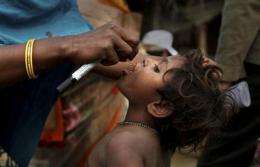
(AP) -- India will celebrate a full year since its last reported case of polio on Friday, a major victory in a global eradication effort that appeared to be stalled just a few years ago.
If no previously undisclosed cases of the crippling disease are discovered across the country, India will no longer be considered to be polio endemic, leaving only Pakistan, Afghanistan and Nigeria on that list.
"This is a game changer in a huge way," said Bruce Aylward, head of the World Health Organization's global polio campaign.
The achievement gives a major morale boost to health advocates and donors who had begun to lose hope of ever defeating the stubborn disease that the world had promised to eradicate by 2000.
It also helps India, which bills itself as one of the world's emerging powers, shed the embarrassing link to a disease associated with poverty and chaos, one that had been conquered long ago by most of the globe.
The government cautiously welcomed the milestone as a confirmation of its commitment to fighting the disease and the 120 billion rupees ($2.4 billion) it has spent on the program.
"We are excited and hopeful. At the same time, vigilant and alert," Health Minister Ghulam Nabi Azad said in a statement. Azad warned that India needed to push forward with its vaccination campaign to ensure the elimination of any residual virus and to prevent the import and spread of virus from abroad.
The polio virus, which usually infects children in unsanitary conditions, attacks the central nervous system, sometimes causing paralysis, muscular atrophy, deformation and, in some cases, death.
With its dense population, poor sanitation, high levels of migration and weak public health system, India had been seen as "the perfect storm of polio," Aylward said. In addition, even some vaccinated children fell ill with the virus because malnutrition and chronic diarrhea made their bodies too weak to properly process the oral vaccine.
In 2009, there were 741 cases in the country. That plunged to 42 in 2010. Last year, there was a single case, an 18-month-old girl named Ruksana Khatun who fell ill in the Indian state of West Bengal on Jan. 13. She was the country's last reported polio victim.
Part of the sudden success is credited to a tighter monitoring program that allowed health officials to quickly hit areas of outbreaks with emergency vaccinations. Part is also attributed to the rollout of a new vaccine in 2010 that more powerfully targeted the two remaining strains of the disease.
Under the $300 million-a-year campaign the government runs with help from the WHO and UNICEF, 2.5 million workers fan out across the country twice a year to give the vaccine to 175 million children.
They hike to remote villages, wander through trains to reach migrating families and stop along roadsides to vaccinate the homeless.
Philanthropist Bill Gates, whose foundation has made polio eradication a priority, hailed India's achievement as an example of the progress that can be made on difficult development problems.
"Polio can be stopped when countries combine the right elements: political will, quality immunization campaigns and an entire nation's determination. We must build on this historic moment and ensure that India's polio program continues to move full-steam ahead until eradication is achieved," he said in a statement.
Health officials are working to make polio the second disease ever eradicated from the globe after smallpox. But while smallpox carriers were easy to find because everyone infected developed symptoms, only a tiny fraction of those infected with the polio virus ever contract the disease. So while no one in India is reported to have suffered from polio in a year, the virus - which travels through human waste - could still be lingering.
That's why the country will not be certified as completely polio-free until it goes at least three full years without a case. And it is why public health advocates warn against complacency in the massive vaccination efforts.
"We are at a threshold. If we take a long step, we may be in trouble," said Dr. Yash Paul, a pediatrician in the northern city of Jaipur who was a member of the Indian Academy of Pediatrics' polio eradication committee until it was dismantled last year because the academy felt it was no longer needed.
Paul also appealed to public health officials to begin switching from the oral vaccine, which is easy to administer but contains live virus that can cause the disease in rare cases, to an injectible vaccine that uses dead virus.
The last time a country came off the endemic list was Egypt in 2006. If India succeeds in getting removed from the list in the coming weeks, only Pakistan, Afghanistan and Nigeria will remain. All three saw a rise in cases last year over 2010, and Pakistan is suffering a particularly explosive outbreak, Aylward said.
In addition, 22 other countries that had eradicated the disease suffered new outbreaks. However, some of those outbreaks stemmed from polio imported from India, so getting rid of the virus here is expected to lessen such outbreaks in the future.
Aylward hopes India's success will spur donors to dedicate more money to the polio fight, partly because full eradication could free up funds for other global health issues.
The WHO program needs another $500 million to fund operations for the rest of the year, and some programs could run out of funding by March, he said.
"If we fail at this point, it's an issue of will," he said.
©2012 The Associated Press. All rights reserved. This material may not be published, broadcast, rewritten or redistributed.


