First link between potentially toxic PFCs in office air and in office workers' blood
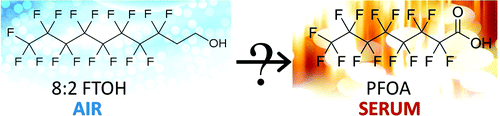
In a first-of-its-kind study, scientists are reporting that the indoor air in offices is an important source of worker exposure to potentially toxic substances released by carpeting, furniture, paint and other items. Their report, which documents a link between levels of these so-called polyfluorinated compounds (PFCs) in office air and in the blood of workers, appears in ACS' journal Environmental Science & Technology.
Michael McClean and colleagues explain that PFCs, used in water-repellent coatings on carpet and furniture, may have adverse effects on human health. The substances are widespread in the environment and in humans around the world. Scientists know that potential sources of exposure include food, water, indoor air, indoor dust and direct contact with PFC-containing objects. But the link between levels in air and blood had not been explored previously, so McClean's group set out to fill that gap with a study of 31 office workers in Boston.
They found concentrations of a PFC called fluorotelomer alcohol (FTOH) in office air that were 3-5 times higher than those reported in previous studies of household air, "suggesting that offices may represent a unique and important exposure environment." In addition, the study found a strong link between concentrations of FTOH in office air and perfluorooctanoic acid (a metabolite of FTOH) in the blood of office workers. The results also suggested that workers in newly renovated office buildings may receive considerably higher doses of PFCs than workers in older buildings.
More information: Polyfluorinated Compounds in Serum Linked to Indoor Air in Office Environments, Environ. Sci. Technol., 2012, 46 (2), pp 12091215. DOI: 10.1021/es2038257
Abstract
We aimed to investigate the role of indoor office air on exposure to polyfluorinated compounds (PFCs) among office workers. Week-long, active air sampling was conducted during the winter of 2009 in 31 offices in Boston, MA. Air samples were analyzed for fluorotelomer alcohols (FTOHs), sulfonamides (FOSAs), and sulfonamidoethanols (FOSEs). Serum was collected from each participant (n = 31) and analyzed for 12 PFCs including PFOA and PFOS. In air, FTOHs were present in the highest concentrations, particularly 8:2-FTOH (GM = 9920 pg/m3). FTOHs varied significantly by building with the highest levels observed in a newly constructed building. PFOA in serum was significantly correlated with air levels of 6:2-FTOH (r = 0.43), 8:2-FTOH (r = 0.60), and 10:2-FTOH (r = 0.62). Collectively, FTOHs in air significantly predicted PFOA in serum (p < 0.001) and explained approximately 36% of the variation in serum PFOA concentrations. PFOS in serum was not associated with air levels of FOSAs/FOSEs. In conclusion, FTOH concentrations in office air significantly predict serum PFOA concentrations in office workers. Variation in PFC air concentrations by building is likely due to differences in the number, type, and age of potential sources such as carpeting, furniture, and/or paint.
Provided by
American Chemical Society
-
Exposure to chemicals in environment associated with onset of early menopause
Mar 23, 2011 |
not rated yet |
0
-
'Thirdhand smoke' may be bigger health hazard than previously believed
Jan 12, 2011 |
not rated yet |
0
-
Dust on office surfaces can be a source of exposure to PBDEs
Jun 30, 2011 |
not rated yet |
0
-
Researchers link widely used chemicals to ADHD in children
Jul 20, 2010 |
not rated yet |
0
-
Older, cheaper vacuum cleaners release more bacteria and dust: study
Jan 04, 2012 |
not rated yet |
0
-
Motion perception revisited: High Phi effect challenges established motion perception assumptions
Apr 23, 2013 |
3 / 5 (2) |
2
-
Anything you can do I can do better: Neuromolecular foundations of the superiority illusion (Update)
Apr 02, 2013 |
4.5 / 5 (11) |
5
-
The visual system as economist: Neural resource allocation in visual adaptation
Mar 30, 2013 |
5 / 5 (2) |
9
-
Separate lives: Neuronal and organismal lifespans decoupled
Mar 27, 2013 |
4.9 / 5 (8) |
0
-
Sizing things up: The evolutionary neurobiology of scale invariance
Feb 28, 2013 |
4.8 / 5 (10) |
14
-
Classical and Quantum Mechanics via Lie algebras
Apr 15, 2011
- More from Physics Forums - Independent Research
More news stories
Life expectancy gap widens between those with mental illness and general population
The gap between life expectancy in patients with a mental illness and the general population has widened since 1985 and efforts to reduce this gap should focus on improving physical health, suggest researchers in a paper ...
Health
27 minutes ago |
not rated yet |
0
Failure to use linked health records may lead to biased disease estimates
Failure to use linked electronic health records may lead to biased estimates of heart attack incidence and outcome, warn researchers in a paper published in BMJ today.
Health
27 minutes ago |
not rated yet |
0
Dietary advice on added sugar is damaging our health, warns heart expert
Dietary advice on added sugar is damaging our health, warns a cardiologist in BMJ today. Dr. Aseem Malhotra believes that "not only has this advice been manipulated by the food industry for profit but it is actually a risk ...
Health
27 minutes ago |
5 / 5 (1) |
0
CDC presents recent trends in health behaviors of US adults
(HealthDay)—In 2008 to 2010, the prevalence of key health behaviors among U.S. adults varied, with about one in five adults current smokers and 62.1 percent overweight or obese, according to a report presented ...
Health
2 hours ago |
not rated yet |
0
Americans still making unhealthy choices, CDC reports
(HealthDay)—The overall health of Americans isn't improving much, with about six in 10 people either overweight or obese and large numbers engaging in unhealthy behaviors like smoking, heavy drinking or ...
Health
3 hours ago |
not rated yet |
0
New sleeping pill poised to hit US markets
An experimental sleeping pill from US drug company Merck is effective at helping people fall and stay asleep, according to reviewers at the US Food and Drug Administration, which could soon approve the new drug.
Small cancer risk following CT scans in childhood and adolescence confirmed
The gap between life expectancy in patients with a mental illness and the general population has widened since 1985 and efforts to reduce this gap should focus on improving physical health, suggest researchers in a paper ...
Iodine deficiency during pregnancy may adversely affect children's mental development
A study of around 1,000 UK mothers and their children, published in The Lancet, has revealed that iodine deficiency in pregnancy may have an adverse effect on children's mental development. The research raises concerns that t ...
Reducing caloric intake delays nerve cell loss
Activating an enzyme known to play a role in the anti-aging benefits of calorie restriction delays the loss of brain cells and preserves cognitive function in mice, according to a study published in the May ...
If you can remember it, you can remember it wrong
(Medical Xpress)—Native peoples in regions where cameras are uncommon sometimes react with caution when their picture is taken. The fear that something must have been stolen from them to create the photo ...
Changing cancer's environment to halt its spread
By studying the roles two proteins, thrombospondin-1 and prosaposin, play in discouraging cancer metastasis, a trans-Atlantic research team has identified a five-amino acid fragment of prosaposin that significantly reduces ...