Mid-lane driving helps older adults stay safe
January 4, 2012 in Psychology & Psychiatry

Mid-lane driving helps older adults stay safe

Enlarge

(Medical Xpress) -- It's official: older adults are naturally inclined to drive in the middle of the road, leaving the younger generation to cut corners.

This tendency to sit mid-lane is an in-built safety mechanism that helps pensioners stay safe behind the wheel, according to researchers at the University of Leeds.

The findings of the study, which are published in the and Performance, have shown how naturally adapt when they can no longer move with the freedom they once had. Researchers hope that the work will be used to find new ways of helping patients recover lost motor skills, for example, after a stroke.

Aging causes the body to respond more slowly and movements to become less precise. To see how this might affect performance behind the wheel, a team from the University of Leeds' Institute of compared the motor skills of healthy younger adults, aged between 18 and 40, with a group of over-60s.

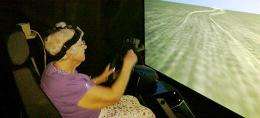
Using a touch-screen laptop, participants were asked to trace wiggly lines of varying widths - slowly, quickly and at their own preferred pace. They were also asked to steer along 'virtual' winding roads when sitting in a driving simulator.

The researchers found that the made allowances for their age by adopting a 'middle-of-the-road' strategy in both tests. This meant they remained well inside the wiggly lines when tracing, and stayed in the middle of the road lines when driving. Younger participants, in contrast, had a greater tendency to cut corners.

However, when were asked to drive faster in the simulator and to follow narrower paths, all tended to cut corners more - regardless of their age.

"Our results suggest that this compensation strategy is a general phenomenon and not just tied to driving. It seems older people naturally adjust their movements to compensate for their reduced level of skill," said postgraduate researcher Rachel Raw, lead author of the study.

"But this compensation can only take you so far, and when conditions are difficult, perhaps because of snow or hail, or when driving at night time on poorly lit roads, older adults can struggle," she said.

"It is important to establish what strategies are adopted by older drivers in order to ensure their safety - as well as the safety of other road users." said psychology researcher Dr. Richard Wilkie, who supervised the work. "More generally, understanding how older people learn to adapt to a diminished level of skill has implications for our approach to rehabilitating patients with reduced movement, for instance, after a ."

More information: Raw RK et al, 'Movement control in older adults: does old age mean middle of the road?' Journal of Experimental Psychology Human Perception and Performance is published online in advance of publication [doi: 10.1037/a0026568].

Provided by University of Leeds search and more info website

4.5 /5 (2 votes)  

Filter


Move the slider to adjust rank threshold, so that you can hide some of the comments.


Display comments: newest first

tadchem
Jan 04, 2012

Rank: not rated yet
"Cutting corners" is an abbreviation for 'lazy driving,' or if you prefer, compliance with minimal effort. A middle-of-the-road attitude requires tighter cornering and faster reflexes than taking the 'racer's line' through a course, and calls for more planning ahead and for less speed. The algorithms used are completely different, designed to maximize safety margins rather than to minimize effort, time, or distance travelled. Taking the racer's line minimizes G-forces on turns at any particular speed.
FainAvis
Jan 05, 2012

Rank: not rated yet
Drivers who do not cut corners are survivors. That is how we got to be old.
Rank 4.5 /5 (2 votes)
Relevant PhysicsForums posts

More news stories

Storm chasers: born to be wild?

(HealthDay)—We've all seen them: the surfers who race to the beach when a hurricane hits, the guy who decides to ride out the storm in his overmatched boat, the tornado chasers who fearlessly steer their ...

Psychology & Psychiatry created 5 hours ago | popularity not rated yet | comments 0

Hormone levels may provide key to understanding psychological disorders in women

Women at a particular stage in their monthly menstrual cycle may be more vulnerable to some of the psychological side-effects associated with stressful experiences, according to a study from UCL.

Psychology & Psychiatry created 6 hours ago | popularity 5 / 5 (1) | comments 0 | with audio podcast

Are there atheists in foxholes? Study says they're the minority

Ernie Pyle – an iconic war correspondent in World War II – reportedly said "There are no atheists in foxholes." A new joint study between two brothers at Cornell and Virginia Wesleyan found that only ...

Psychology & Psychiatry created 8 hours ago | popularity 2.5 / 5 (4) | comments 1

Breathing exercises help veterans find peace after war, scholar says

(Medical Xpress)—Research by Stanford scholar Emma Seppala at the Center for Compassion and Altruism Research and Education found that post-traumatic stress disorder decreased in veterans who participated ...

Psychology & Psychiatry created 9 hours ago | popularity 5 / 5 (1) | comments 0

Depression raises diabetics' risk of severe low blood sugar episodes

(Medical Xpress)—Patients with diabetes who are depressed are much more likely to develop episodes of dangerously low blood sugars, or hypoglycemia, than are those who are not depressed, a new study has ...

Psychology & Psychiatry created 10 hours ago | popularity not rated yet | comments 0 | with audio podcast


Engineered cytomegalovirus protects monkeys from HIV equivalent

(Medical Xpress)—A new study by researchers in the US has shown that an ancient virus can be modified to help in the fight against the simian immunodeficiency virus SIV, which is the equivalent in monkeys ...

Going live: Immune cell activation in multiple sclerosis

Biological processes are generally based on events at the molecular and cellular level. To understand what happens in the course of infections, diseases or normal bodily functions, scientists would need to ...

Researchers identify first drug targets in childhood genetic tumor disorder

Two mutations central to the development of infantile myofibromatosis (IM)—a disorder characterized by multiple tumors involving the skin, bone, and soft tissue—may provide new therapeutic targets, according to researchers ...

Driving and hands-free talking lead to spike in errors, study shows

Talking on a hands-free device while behind the wheel can lead to a sharp increase in errors that could imperil other drivers on the road, according to new research from the University of Alberta.

Audiologists recommend smart phone apps to monitor noise levels

After studying noise in one French Quarter neighborhood of New Orleans to determine whether or not noise levels exceeded municipal ordinances, Annette Hurley, PhD, Assistant Professor of Audiology at LSU Health Sciences Center ...

ACOG: Hormone therapy not recommended to prevent CHD

(HealthDay)—Menopausal hormone therapy should not be used for prevention of coronary heart disease, according to a Committee Opinion from the American College of Obstetricians and Gynecologists (ACOG) published ...