Can robots take over rehab?
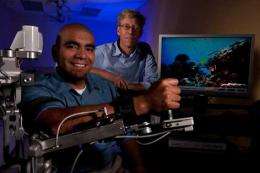
Visiting the iMove center at UC Irvine's Gross Hall is like being on the set of a sci-fi movie. Here, the merging of machines and humans — the premise of such futuristic films as "Alien" and "The Terminator" — has become a reality.
Inside the lab, at Sue & Bill Gross Hall: A CIRM Institute, patients whose limbs have been impaired by a stroke or spinal cord injury don robotic arms, gloves with special sensors and other high-tech devices designed to help get them moving again.
For more than 20 years, iMove center director David Reinkensmeyer has sought to restore human mobility by developing new technologies for motion training, exercise and rehabilitation.
"I started in this field because I was interested in robotics and how the brain works. And I wanted to help people. You put those three things together, and you get this," he says, gesturing to the assorted contraptions. "One of my close friends in graduate school had cerebral palsy, and I saw what it was like to live with a disability."
A professor of mechanical & aerospace engineering, anatomy & neurobiology and biomedical engineering, Reinkensmeyer is like Q in the James Bond movies without the stuffy British attitude. Instead of weapons, though, he and his collaborators create exoskeletons that attach to patients' limbs, facilitate their movement and relay progress to a computer.
"David is a leader in biomechatronics robotic systems that interact with something alive. But he's so self-effacing that you'd never know it," says Robert Sanchez, Ph.D. '05, who worked with Reinkensmeyer while pursuing his doctorate in mechanical & aerospace engineering and now designs surgical eye equipment for Alcon Research Ltd. in Irvine.
On a fall afternoon, Reinkensmeyer and Sanchez demonstrate one of their favorite inventions: ArmeoSpring, a robotic arm that assists patients unable to perform rehab exercises on their own.
"When someone suffers a stroke, the nerve pathways to the brain that operate a limb are no longer viable. To repair them, patients need to practice moving the limb, but often they're too weak. Gravity holds them back," Sanchez says. "Armeo utilizes springs to counteract the weight, so they can move their arm and restore those neural connections."
Adds Reinkensmeyer: "If they didn't have the device, their arm would just drop. It's exciting to see patients move in ways they haven't since their illness or injury."
Working out with Armeo feels more like playing a computer game. The patient's movements are tracked on software that guides them through simple challenges, such as loading virtual apples into a cart.
"It's like a three-dimensional mouse," Reinkensmeyer says of the robotic arm. "The tasks mimic activities in daily life."
People using Armeo have shown greater improvement than those who underwent conventional therapy. The device is now sold by Hocoma and employed in more than 200 clinics worldwide.
"Patients like training with Armeo more than table top exercises because it's a game against themselves. So the hope is that they'll spend more time training," Sanchez says.
Reinkensmeyer's lab, in collaboration with UCI mechanical & aerospace engineering professor James Bobrow, has developed another exoskeleton called PAM/POGO (Pelvic Assist Manipulator/Pneumatically Operated Gait Orthosis) that gives patients full range of motion in their legs and pelvis while training on a treadmill. "It helps you stand and start moving," Reinkensmeyer says.
Sophisticated software enables the robot to adapt to people's different strides, instead of leading them astray "like the 'wrong trousers' in that Wallace & Gromit movie," he says.
PAM/POGO even caught the attention of rapper Dr. Dre, who borrowed it for the "I Need a Doctor" (5:54) video, in which his character undergoes rehabilitation after a car accident.
"At first I wasn't sure if we should do the video, " Reinkensmeyer says. "I worried that it wouldn't treat people with disabilities with respect. But — although some of the language is objectionable — the video does portray the hope and hard work of rehabilitation.
"It's had more than 73 million hits on YouTube. Young people see robotic rehabilitation and think, 'This is really cool.' It might inspire them to want to help others with technology."
Another cool invention, the Music Glove, fosters finger dexterity. Doctoral student Nizan Friedman, electrical engineering assistant professor Mark Bachman and Reinkensmeyer attached sensors to ordinary leather sports gloves, then hooked them up to a computer. Patients play songs on Guitar Hero by tapping their fingers together.
"It's a low-cost way to do a lot of hand exercises," Reinkensmeyer says. "If we asked people to move their fingers 1,000 times like that without playing the game, they'd say, 'No way.'"
Because these devices can precisely gauge a patient's progress in rehab, they're valuable tools for stem cell researchers, which is why iMove is located in the Sue & Bill Gross Stem Cell Research Center.
"We hope to give stem cell scientists the gadgets to better measure if stem cell therapy is working and to enhance regeneration through intense exercise," Reinkensmeyer says.
In 2010, Reinkensmeyer received a $1.5 million grant from the National Institutes of Health to study how effective robots are in restoring motor skills.
"Right now, we're limited by making these devices strong yet lightweight enough for people to wear them but it's becoming increasingly possible," he says.
Reinkensmeyer hopes that robotic devices, coupled with the kind of stem cell therapies being developed at UCI, will someday help patients live better, more active lives.
"To see a person who's been injured recover completely may seem like science fiction, but that's what we all dream about," he says.


