Study: Stem cells may aid vision in blind people
January 23, 2012 in Medical research
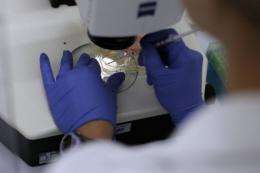
Assistant Professor of Genetics and Developmental Biology Stormy Chamberlain works on stem cells at the University of Connecticut's Stem Cell Institute in 2010 in Farmington, Connecticut. Embryonic stem cells are extraordinarily versatile cells, found in early-stage embryos, that can differentiate into any tissue of the body.
The first use of embryonic stem cells in humans eased a degenerative form of blindness in two volunteers and showed no signs of any adverse effects, according to a study published by The Lancet on Monday.
Publication in the peer-reviewed journal marks an important step for embryonic stem cells, which were hailed as a miracle cure after they were discovered in 1998 but then ran into technical and political hurdles.
The results of the cautious first-stage test, designed to evaluate whether the treatment is safe, had been previously announced by Massachusetts biotech firm Advanced Cell Technology (ACT) Inc.
The positive outcome in the United States opened the way to the first trials in Europe, which began on Monday.
Embryonic stem cells are extraordinarily versatile cells, found in early-stage embryos, that can differentiate into any tissue of the body.
Scientists have been hoping to turn them into replacement for tissue lost through disease or lost in accidents or war.
The quest to use embryonic stem cells has been arduous.
One problem is biological: that donated stem cells, provoking an immune response, can be rejected by the body or cause cancer. The other is ethical, with moral conservatives contending that an embryo is a human life.
Addressing the biological question, ACT used the stem cells at a so-called "immunoprivileged" site, the eye, where there is not a strong immune response because of a shield known as the blood-ocular barrier.
Around 50,000 embryonic stem cells that had diversified into replacement cells for the pigmented layer of the retina were transplanted into two legally-blind volunteers.
One, a woman in her 70s, had a condition called dry age-related macular degeneration, the leading cause of blindness in the developed world; the other was a woman in her fifties who had Stargardt's macular dystrophy, the commonest form of vision loss among young people.
For the next six weeks, the patients received treatment to prevent their immune systems from attacking the implanted cells, but this was gradually scaled back.
In the first four months, no signs of cancer, rejection or other safety concerns emerged and both patients recovered a little vision, although this was not the point of the test.
At the outset, the older patient was able to read 21 letters on a standard chart of visual acuity. This rose to 33 letters after two weeks before settling at a stable ability to read 28 letters, the study said.
The woman with Stargardt's disease, a former graphic artist, at first could only see hand movements, but this improved after the transplant to being able to see single fingers and to reading five letters of the alphabet.
"However, that doesn't really capture the difference it has made in their life," Bob Lanza, ACT's chief scientific officer, said in an email to AFP.
"The Stargardt's patient reports that she can see more colour and has better contract and dark adaptation out of the operated eye. In fact, she started using her computer and could even read her watch... (and) says she can even thread a needle now."
Lanza noted that the improvements occurred in patients who were already at a very advanced state of the disease, so the trials were encouraging for patients at an earlier stage of degeneration.
Clinical trials of novel drugs or treatments typically undergo a three-phase process, enrolling a progressively larger number of patients, to make sure they are firstly safe and, secondly, effective.
The Lancet had been scheduled to publish the study on Thursday but released it on Monday as ACT launched its first European trials of the retinal treatment.
Twelve patients with Stargardt's have been cleared by British medical authorities to undergo transplant, with progressively higher doses of cells, at the Moorfields Eye Hospital in London.
(c) 2012 AFP
-
First patients enroll in US stem cell trials on blindness
Jun 16, 2011 |
not rated yet |
0
-
Scientists rescue visual function in rats using induced pluripotent stem cells
Dec 03, 2009 |
not rated yet |
0
-
Embryonic stem cells can kill cancer cells
Oct 11, 2005 |
not rated yet |
0
-
Feds OK 2nd human study of embryonic stem cells
Nov 22, 2010 |
not rated yet |
0
-
Study: Skin cells turned into stem cells
Aug 22, 2005 |
not rated yet |
0
-
Motion perception revisited: High Phi effect challenges established motion perception assumptions
Apr 23, 2013 |
3 / 5 (2) |
2
-
Anything you can do I can do better: Neuromolecular foundations of the superiority illusion (Update)
Apr 02, 2013 |
4.5 / 5 (11) |
5
-
The visual system as economist: Neural resource allocation in visual adaptation
Mar 30, 2013 |
5 / 5 (2) |
9
-
Separate lives: Neuronal and organismal lifespans decoupled
Mar 27, 2013 |
4.9 / 5 (8) |
0
-
Sizing things up: The evolutionary neurobiology of scale invariance
Feb 28, 2013 |
4.8 / 5 (10) |
14
-
Why is zone 1 in liver more prone to ischemic injury?
15 hours ago
-
How can there be villous adenoma in colon, if there are no villi there
May 22, 2013
-
How can there be a term called "intestinal metaplasia" of stomach
May 21, 2013
-
Pressure-volume curve: Elastic Recoil Pressure don't make sense
May 18, 2013
-
If you became brain-dead, would you want them to pull the plug?
May 17, 2013
-
MRI bill question
May 15, 2013
- More from Physics Forums - Medical Sciences
More news stories
Study reveals new mechanism for estrogen suppression of liver lipid synthesis
By discovering the new mechanism by which estrogen suppresses lipid synthesis in the liver, UC Irvine endocrinologists have revealed a potential new approach toward treating certain liver diseases.
Medical research
3 hours ago |
not rated yet |
0
|
MRI-based measurement helps predict vascular disease in the brain
Aortic arch pulse wave velocity, a measure of arterial stiffness, is a strong independent predictor of disease of the vessels that supply blood to the brain, according to a new study published in the June issue the journal ...
Medical research
3 hours ago |
not rated yet |
0
Antibiotics: A new understanding of sulfonamide nervous system side effects
Since the discovery of Prontosil in 1932, sulfonamide antibiotics have been used to combat a wide spectrum of bacterial infections, from acne to chlamydia and pneumonia. However, their side effects can include serious neurological ...
Medical research
5 hours ago |
not rated yet |
0
|
Scientists discover molecule triggers sensation of itch
Scientists at the National Institutes of Health report they have discovered in mouse studies that a small molecule released in the spinal cord triggers a process that is later experienced in the brain as ...
Medical research
5 hours ago |
5 / 5 (2) |
0
|
Discarded immune cells induce the relocation of stem cells
Spanish researchers have discovered that the daily clearance of neutrophils from the body stimulates the release of hematopoietic stem cells from the bone marrow into the bloodstream, according to a report published today ...
Medical research
7 hours ago |
5 / 5 (2) |
0
Glucosamine supplements tied to risk of eye condition
(HealthDay)—Glucosamine supplements that millions of Americans take to help treat hip and knee osteoarthritis may have an unexpected side effect: They may increase risk for developing glaucoma, a small ...
Controlling mood through the motions of mitochondria
(Medical Xpress)—Regulating the distribution of power in neurons is done by a system that makes the national electric grid look simple by comparison. Each neuron has several thousand mitochondria confined ...
WHO: Scientific red tape mars efforts vs. virus
International efforts to combat a new pneumonia-like virus that has now killed 22 people are being slowed by unclear rules and competition for the potentially profitable rights to disease samples, the head ...
Future doctors unaware of their obesity bias
Two out of five medical students have an unconscious bias against obese people, according to a new study by researchers at Wake Forest Baptist Medical Center. The study is published online ahead of print in the Journal of ...
Multiple research teams unable to confirm high-profile Alzheimer's study
Teams of highly respected Alzheimer's researchers failed to replicate what appeared to be breakthrough results for the treatment of this brain disease when they were published last year in the journal Science.
When oxygen is short, EGFR prevents maturation of cancer-fighting miRNAs
Even while being dragged to its destruction inside a cell, a cancer-promoting growth factor receptor fires away, sending signals that thwart the development of tumor-suppressing microRNAs (miRNAs) before it's dissolved, researchers ...