Well-controlled HIV doesn't affect heart metabolism, function
January 26, 2012 By Jim Dryden in HIV & AIDS
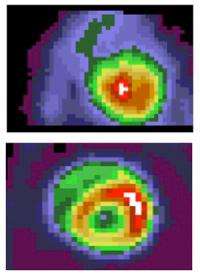
PET images from patients with blood sugar and lipid problems and other metabolic complications (top) show the heart has difficulty converting glucose to energy. In those without metabolic complications (bottom), the heart more effectively converts glucose to energy. (W. TODD CADE)
(Medical Xpress) -- People with HIV often develop blood sugar and lipid problems and other metabolic complications that increase the risk of heart disease. But new research at Washington University School of Medicine in St. Louis shows that the HIV virus and the drugs used to treat it dont worsen heart metabolism and function in these patients, compared with HIV-negative patients with metabolic complications.
The findings are reported online in the journal Cardiovascular Diabetology.
The researchers say the findings were surprising because metabolic complications like insulin resistance, diabetes and problems with blood lipids such as cholesterol, triglycerides and fatty acids have become common as improved drug therapies enable patients with HIV to live longer. These complications also tend to strike HIV-infected people at a younger age. Scientists have long speculated that these problems are caused either by the virus or the antiretroviral therapies used to prevent the infection from progressing to full-blown AIDS.
The scientists used positron emission tomography (PET) imaging and echocardiography to study the heart in four groups of patients: 23 HIV-positive men with metabolic complications; 15 HIV-positive men without those problems; nine HIV-negative men with metabolic complications; and 22 HIV-negative men without them.
The PET studies measured how well the heart processes glucose, an indicator of how well the heart converts sugar into energy. The echocardiograms measured heart function, in particular the ability of the heart to relax between beats, known as diastolic function.
We had thought that HIV-positive men with insulin and blood lipid problems would have the worst glucose utilization in the heart and the worst diastolic heart function, says principal investigator W. Todd Cade, PT, PhD, assistant professor of physical therapy and of medicine. But instead we found that HIV really didnt make much difference. Men with these metabolic complications had impaired glucose utilization in the heart and poor diastolic function, regardless of HIV status.
But the effectiveness of anti-HIV drugs may explain why heart function among HIV-positive men in this study was not worse than that of their HIV-negative counterparts, Cade says.
We think HIV infection made little difference because the virus was so well controlled in the men we studied, he says. They had strong immune systems. If we had looked at patients with impaired immune systems and higher virus levels, we may have seen more heart problems.
Cade says its possible that if a larger study were conducted, researchers may be able to tease out very small differences in heart function between HIV-positive and HIV-negative men.
Our results suggest that men with metabolic problems should receive treatment, regardless of HIV status, Cade says. Whether you have HIV or not, insulin resistance and high blood lipids impair your hearts ability to process nutrients, which over time can interfere with heart function, but our study showed that having well-controlled HIV infection doesnt make heart metabolism and function any worse.
More information: Cade WT, et al. Effects of human immunodeficiency virus and metabolic complications on myocardial nutrient metabolism, blood flow and oxygen consumption: a cross-sectional analysis. Cardiovascular Diabetology, Dec. 2011. (Epub ahead of print).
Provided by
Washington University School of Medicine in St. Louis
-
Kids born with HIV growing up well
Apr 21, 2011 |
not rated yet |
0
-
HIV infection appears to increases the risk of heart attack
Apr 24, 2007 |
not rated yet |
0
-
Why HIV treatment makes people so susceptible to heart disease and diabetes
Nov 17, 2008 |
not rated yet |
0
-
Long-term HIV treatment may reduce risk for atherosclerosis
Aug 04, 2008 |
not rated yet |
0
-
FDA warns of heart risk with HIV drug combination
Oct 21, 2010 |
not rated yet |
0
-
Motion perception revisited: High Phi effect challenges established motion perception assumptions
Apr 23, 2013 |
3 / 5 (2) |
2
-
Anything you can do I can do better: Neuromolecular foundations of the superiority illusion (Update)
Apr 02, 2013 |
4.5 / 5 (11) |
5
-
The visual system as economist: Neural resource allocation in visual adaptation
Mar 30, 2013 |
5 / 5 (2) |
9
-
Separate lives: Neuronal and organismal lifespans decoupled
Mar 27, 2013 |
4.9 / 5 (8) |
0
-
Sizing things up: The evolutionary neurobiology of scale invariance
Feb 28, 2013 |
4.8 / 5 (10) |
14
-
Classical and Quantum Mechanics via Lie algebras
Apr 15, 2011
- More from Physics Forums - Independent Research
More news stories
Engineered cytomegalovirus protects monkeys from HIV equivalent
(Medical Xpress)—A new study by researchers in the US has shown that an ancient virus can be modified to help in the fight against the simian immunodeficiency virus SIV, which is the equivalent in monkeys ...
HIV & AIDS
12 hours ago |
5 / 5 (3) |
0
|
New microsphere-based methods for detecting HIV antibodies
Detection of HIV antibodies is used to diagnose HIV infection and monitor trials of experimental HIV/AIDS vaccines. New, more sensitive detection systems being developed use microspheres to capture HIV antibodies ...
HIV & AIDS
May 23, 2013 |
5 / 5 (1) |
0
Fecal microbiota tx feasible for recurrent C. difficile in HIV
(HealthDay)—For HIV-infected individuals with recurrent Clostridium difficile infection, fecal microbiota therapy is feasible, according to a letter published in the May 21 issue of the Annals of Intern ...
HIV & AIDS
May 22, 2013 |
not rated yet |
0
Canada lifts ban on gay men donating blood
Canadian health authorities lifted Wednesday what was effectively a ban on gay men giving blood, announcing new rules making men who have not had sex with men in the past five years eligible.
HIV & AIDS
May 22, 2013 |
not rated yet |
1
AIDS scientists optimistic of AIDS cure, for some
Top AIDS scientists were optimistic Wednesday of finding a cure for the disease that has claimed 30 million lives—but said it might not work for all people.
HIV & AIDS
May 22, 2013 |
not rated yet |
0
Researchers identify first drug targets in childhood genetic tumor disorder
Two mutations central to the development of infantile myofibromatosis (IM)—a disorder characterized by multiple tumors involving the skin, bone, and soft tissue—may provide new therapeutic targets, according to researchers ...
Hormone levels may provide key to understanding psychological disorders in women
Women at a particular stage in their monthly menstrual cycle may be more vulnerable to some of the psychological side-effects associated with stressful experiences, according to a study from UCL.
Going live: Immune cell activation in multiple sclerosis
Biological processes are generally based on events at the molecular and cellular level. To understand what happens in the course of infections, diseases or normal bodily functions, scientists would need to ...
Driving and hands-free talking lead to spike in errors, study shows
Talking on a hands-free device while behind the wheel can lead to a sharp increase in errors that could imperil other drivers on the road, according to new research from the University of Alberta.
Pollen count apps for smartphones are nothing to sneeze at
Kate O'Reilly's spring allergy survival kit includes the usual stuff - nasal sprays, allergy pills and a box of tissues. This season, she's added a new weapon to her line of defense: an app on her smartphone.
Comorbidities common with alopecia areata
(HealthDay)—Comorbid conditions often accompany alopecia areata, according to a study published online May 22 in JAMA Dermatology.