Mending the brain with a mechanical glove
February 29, 2012 By Jason Kornwitz in Medical research
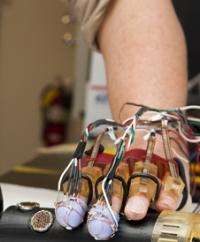
Northeastern student-researchers have created a post-stroke rehabilitation glove designed to improve cognitive ability to complete everyday tasks. Credit: Mike Mazzanti
Northeastern University student-researchers have created a post-stroke rehabilitation glove designed to increase hand strength through finger extension and improve cognitive ability to complete everyday tasks such as picking up a glass, turning a doorknob or unscrewing a soda bottle.
The innovative device, dubbed Excelsior, was designed for a senior capstone project under the direction of Constantinos Mavroidis, Distinguished Professor of Engineering, and Richard Ranky, a mechanical engineering doctoral candidate. The undergraduate team members included Aaron Bickel, Abhishek Singhal, Craig Pacella and Nisha Parekh, whose work was supported by a three-year, $270,000 grant from the National Science Foundation.
According to the Centers for Disease Control and Prevention, some 800,000 stroke cases occur in the United States each year. Ranky said survivors require physical therapy and ongoing exercise to regain mobility and dexterity. As he put it, A major goal for patients post-stroke is regaining their fine motor control.
Excelsior which was developed using 3-D additive manufacturing with embedded sensors and can be customized to fit a patients hand was designed with that goal in mind.
To improve cognitive function, users match colored LEDs (light-emitting diodes) on the devices fingertips with those on external objects fashioned into household shapes, such as cups or doorknobs.
In preparation for designing the prototype, students interviewed physical therapists at Spaulding Rehabilitation Hospital in Boston who shed light on patient needs.
Pacella, a senior mechanical engineering major, praised his groups final design. No other device assists with opening the hand and has cognitive exercises like this, he said. Most commercial hand motion rehab devices dont use sensors to measure range of motion and control of the fingers.
Mavroidis, who has filed a provisional patent on the glove, plans to license and commercialize the rehab device, which would cost patients approximately $200. But theres work to be done. It still needs to become more user-friendly, stronger and thinner, Mavroidis explained.
Pacella said programming and developing circuit boards for the prototype forced him outside of his comfort zone, which, he said, would serve him well in his first professional job.
Theres no such thing as a job in only mechanical engineering, Pacella said. In the real world, you need to understand other disciplines, which you can only learn through experience.
Ranky agreed, highlighting the value of experiential learning. Working on a capstone project is different from solving a problem in class where there is only one solution, he said. Capstone is as close as you can get to the real world.
Provided by
Northeastern University
-
Helping hands
Dec 15, 2009 |
not rated yet |
0
-
Many hands make light work: Robotic therapy to help stroke patients
Dec 14, 2010 |
not rated yet |
0
-
Wheelchair follows orders, but can act on its own, too
May 25, 2011 |
not rated yet |
0
-
A brainy innovation takes flight
Jun 02, 2011 |
not rated yet |
0
-
Laser music: BYU electrical engineers use light to beam songs across a room
Dec 20, 2011 |
not rated yet |
0
-
Motion perception revisited: High Phi effect challenges established motion perception assumptions
Apr 23, 2013 |
3 / 5 (2) |
2
-
Anything you can do I can do better: Neuromolecular foundations of the superiority illusion (Update)
Apr 02, 2013 |
4.5 / 5 (11) |
5
-
The visual system as economist: Neural resource allocation in visual adaptation
Mar 30, 2013 |
5 / 5 (2) |
9
-
Separate lives: Neuronal and organismal lifespans decoupled
Mar 27, 2013 |
4.9 / 5 (8) |
0
-
Sizing things up: The evolutionary neurobiology of scale invariance
Feb 28, 2013 |
4.8 / 5 (10) |
14
-
How can there be a term called "intestinal metaplasia" of stomach
4 hours ago
-
Pressure-volume curve: Elastic Recoil Pressure don't make sense
May 18, 2013
-
If you became brain-dead, would you want them to pull the plug?
May 17, 2013
-
MRI bill question
May 15, 2013
-
Ratio of Hydrogen of Oxygen in Dessicated Animal Protein
May 13, 2013
-
Alcohol and acetaminophen
May 13, 2013
- More from Physics Forums - Medical Sciences
More news stories
Do men's and women's hearts burn fuel differently?
Researchers at the University of Illinois at Chicago College of Medicine will study gender differences in how the heart uses and stores fat—its main energy source—and how changes in fat metabolism play ...
Medical research
2 hours ago |
not rated yet |
0
Study suggests new source of kidneys for transplant
Nearly 20 percent of kidneys that are recovered from deceased donors in the U.S. are refused for transplant due to factors ranging from scarring in small blood vessels of the kidney's filtering units to the organ going too ...
Medical research
19 hours ago |
5 / 5 (2) |
0
|
Discovery of circadian clock in mice hair reveals period of time when damage from radiotherapy can be quickly repaired
Discovering that mouse hair has a circadian clock - a 24-hour cycle of growth followed by restorative repair - researchers suspect that hair loss in humans from toxic cancer radiotherapy and chemotherapy ...
Medical research
19 hours ago |
5 / 5 (2) |
1
|
Do salamanders hold the solution to regeneration?
Salamanders' immune systems are key to their remarkable ability to regrow limbs, and could also underpin their ability to regenerate spinal cords, brain tissue and even parts of their hearts, scientists have ...
Medical research
20 hours ago |
4.9 / 5 (7) |
4
|
New study finds blind people have the potential to use their 'inner bat' to locate objects
New research from the University of Southampton has shown that blind and visually impaired people have the potential to use echolocation, similar to that used by bats and dolphins, to determine the location of an object.
Medical research
23 hours ago |
not rated yet |
1
|
If you can remember it, you can remember it wrong
(Medical Xpress)—Native peoples in regions where cameras are uncommon sometimes react with caution when their picture is taken. The fear that something must have been stolen from them to create the photo ...
Study shows where scene context happens in our brain
In a remote fishing community in Venezuela, a lone fisherman sits on a cliff overlooking the southern Caribbean Sea. This man –– the lookout –– is responsible for directing his comrades on the water, ...
New immune system discovered
(Medical Xpress)—A research team, led by Jeremy Barr, a biology post-doctoral fellow, unveils a new immune system that protects humans and animals from infection.
Genetic predictors of postpartum depression uncovered
Johns Hopkins researchers say they have discovered specific chemical alterations in two genes that, when present during pregnancy, reliably predict whether a woman will develop postpartum depression.
Monoclonal antibody appears effective and safe in asthma Phase IIa trial
A novel approach to obstructing the runaway inflammatory response implicated in some types of asthma has shown promise in a Phase IIa clinical trial, according to U. S. researchers.
New rice contamination reported in China
Authorities are investigating rice mills in southern China following tests that found almost half of the staple grain in one of the country's largest cities was contaminated with a toxic metal.