Your brain on 'shrooms: fMRI elucidates neural correlates of psilocybin psychedelic state
February 29, 2012
by Stuart Mason Dambrot
in Neuroscience
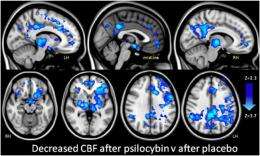
Decreased cerebral blood flow (CBF) after psilocybin imaged by fMRI. Regions where there was significantly decreased CBF after psilocybin versus after placebo are shown in blue. No CBF increases in any region were observed. Image Copyright © PNAS, doi:10.1073/pnas.1119598109
(Medical Xpress) -- Psychedelic substances have long been used for healing, ceremonial, or mind-altering subjective experiences due to compounds that, when ingested or inhaled, generate hallucinations, perceptual distortions, or altered states of awareness. Of these, the psychedelic substance psilocybin, the prodrug (a precursor of a drug that must in vivo chemical conversion by metabolic processes before becoming an active pharmacological agent) of psilocin (4-hydroxy-dimethyltryptamine) and the key hallucinogen found in so-called magic mushrooms, is widely used not only in healing ceremonies, but, more recently, in psychotherapy as well but little has been known about its specific activity in the brain.
Recently, however, scientists in the Neuropsychopharmacology Unit at Imperial College London used complementary blood-oxygen level dependent (BOLD) functional MRI, or fMRI, in conjunction with a technique for imaging the transition from normal waking consciousness to the psychedelic state. The study found decreased blood flow and BOLD in the thalamus, anterior and posterior cingulate cortex, and medial prefrontal cortex. The researchers concluded that the surprising results strongly suggest that the subjective effects of psychedelic drugs are caused by decreased activity and connectivity in the brains key connector hubs, enabling a state of unconstrained cognition.
Lead researcher Dr. Robin L. Carhart-Harris, working in the Neuropsychopharmacology Unit created by Prof. David J. Nutt, recounts the teams main challenges in establishing an fMRI methodology that would be specific enough to highly correlate neurophysiological activity with the neuronal presence or absence of psilocybin. There were a number of considerations, Carhart-Harris tells Medical Xpress. In terms of experimental design, we had to determine the precise dose and delivery protocol that would be appropriate for obtaining clear fMRI results. For example, he explains, we had to consider temporal dynamics: If the drug was administered orally, the protracted period of time between ingestion, metabolism, and crossing of the blood-brain barrier would fall outside of the short scanning window needed to capture induced brain activity. They therefore had to rely on intravenous administration.
Another issue, Carhart-Harris adds, was methodological specifically, isolating any placebo effect derived from changes not due to the injection itself, such as anticipatory anxiety. The team also had to measure physiological parameters, including breathing and heart rate, in order to use these signals as weighting factors, correlate with baseline levels and remove them as a possible explanation of any observed brain changes.
To address these challenges, Carhart-Harris points to the pilot work the team performed in order to determine the optimal dose. The original dose was too low in our mock scanner environment, in which subjects were asked to rate regular subjective or perceptual experiences< he recalls. However, that simply wouldnt work in a scanning environment, since their very response would interfere with fMRI measurement.
Regarding next steps in their research, Carhart-Harris sees obtaining a grant to study psilocybin as a treatment for depression scheduled to begin at the end of 2012 as key. Psilocybin decreases brain activity in regions such as the medial prefrontal cortex, he explains, that are overactive in depression. The team may also perform the same investigations with alternative psychedelic compounds, such as MDMA (3,4-methylenedioxymethamphetamine) a synthetic, psychoactive drug, commonly known as Ecstasy, that is chemically similar to the stimulant methamphetamine.
Carhart-Harris is also interested in the effects of psilocybin on memory. When subjects are in the scanner, he illustrates, and are shown personal memory cues, then asked to close their eyes and remember the emotions at the time of the original event, the recalled emotions are more vivid indicating elevated brain activation when under the effects of psilocybin. Moreover, Carhart-Harris notes that when administered psilocybin when undergoing psychotherapy, there is an increased incidence of sudden personal insights. He speculates that this suggests that psilocybin-induced visual changes indicate that the visual pathways are more sensitive to signals from the hippocampus, which is involved in memory, when under psilocybin.
In addition to depression, Carhart-Harris observes, there are other research and applications that might benefit from the teams findings. Those suffering from cluster headaches, he notes, report excruciating pain that is difficult to treat, sometimes describing it as worse than the pain childbirth. During such headaches, they show an increase in hypothalamic activity to date has only been ameliorated by deep brain stimulation. However, he concludes, when administered psilocybin, they display a decrease in hypothalamic activity and a corresponding suspension of cluster headaches.
More information: Neural correlates of the psychedelic state as determined by fMRI studies with psilocybin, Published online before print January 23, 2012, doi: 10.1073/pnas.1119598109, PNAS February 7, 2012 vol. 109 no. 6 2138-2143.
Related information:
Implications for psychedelic-assisted psychotherapy: a functional magnetic resonance imaging study with psilocybin, Published online ahead of print January 26, 2012, doi: 10.1192/bjp.bp.111.103309.
Copyright 2012 PhysOrg.com.
All rights reserved. This material may not be published, broadcast, rewritten or redistributed in whole or part without the express written permission of PhysOrg.com.
-
Remembrance of things future: Long-term memory sets the stage for visual perception
Dec 28, 2011 |
not rated yet |
0
-
fMRI brain imaging illuminates magic mushrooms' psychedelic effects
Jan 23, 2012 |
not rated yet |
0
-
Recognizing blood poisoning quickly
Dec 02, 2011 |
not rated yet |
0
-
Cotton thrips posed big problem for some South Plains farmers
Jan 02, 2012 |
not rated yet |
0
-
Swimming upstream: Flux flow reverses for lattice bosons in a magnetic field
Dec 27, 2011 |
not rated yet |
0
-
Motion perception revisited: High Phi effect challenges established motion perception assumptions
Apr 23, 2013 |
3 / 5 (2) |
2
-
Anything you can do I can do better: Neuromolecular foundations of the superiority illusion (Update)
Apr 02, 2013 |
4.5 / 5 (11) |
5
-
The visual system as economist: Neural resource allocation in visual adaptation
Mar 30, 2013 |
5 / 5 (2) |
9
-
Separate lives: Neuronal and organismal lifespans decoupled
Mar 27, 2013 |
4.9 / 5 (8) |
0
-
Sizing things up: The evolutionary neurobiology of scale invariance
Feb 28, 2013 |
4.8 / 5 (10) |
14
-
Why is zone 1 in liver more prone to ischemic injury?
15 hours ago
-
How can there be villous adenoma in colon, if there are no villi there
May 22, 2013
-
How can there be a term called "intestinal metaplasia" of stomach
May 21, 2013
-
Pressure-volume curve: Elastic Recoil Pressure don't make sense
May 18, 2013
-
If you became brain-dead, would you want them to pull the plug?
May 17, 2013
-
MRI bill question
May 15, 2013
- More from Physics Forums - Medical Sciences
More news stories
Controlling mood through the motions of mitochondria
(Medical Xpress)—Regulating the distribution of power in neurons is done by a system that makes the national electric grid look simple by comparison. Each neuron has several thousand mitochondria confined ...
Neuroscience
1 hour ago |
4 / 5 (1) |
0
|
Brain uses internal 'average voice' prototype to identify who is talking
(Medical Xpress)—The human brain is able to identify individuals' voices by comparing them against an internal 'average voice' prototype, according to neuroscientists.
Neuroscience
5 hours ago |
1 / 5 (1) |
0
|
Depression common among children with temporal lobe epilepsy
A new study determined that children and adolescents with seizures involving the temporal lobe are likely to have clinically significant behavioral problems and psychiatric illness, especially depression. Findings published ...
Neuroscience
5 hours ago |
not rated yet |
0
The secret lives, and deaths, of neurons
As the human body fine-tunes its neurological wiring, nerve cells often must fix a faulty connection by amputating an axon—the "business end" of the neuron that sends electrical impulses to tissues or other ...
Neuroscience
7 hours ago |
5 / 5 (2) |
0
|
Regenerating spinal cord fibers may be treatment for stroke-related disabilities
A study by researchers at Henry Ford Hospital found "substantial evidence" that a regenerative process involving damaged nerve fibers in the spinal cord could hold the key to better functional recovery by most stroke victims.
Neuroscience
7 hours ago |
not rated yet |
0
|
Statin use is linked to increased risk of developing diabetes, warn researchers
Treatment with high potency statins (especially atorvastatin and simvastatin) may increase the risk of developing diabetes, suggests a paper published today in BMJ.
Consumers largely underestimating calorie content of fast food
People eating at fast food restaurants largely underestimate the calorie content of meals, especially large ones, according to a paper published today in BMJ.
Dual-source cardiac CT IDs CAD in hard-to-image patients
(HealthDay)—In patients who have previously been considered difficult to image, dual-source cardiac (DSC) computed tomography (CT) can identify clinically significant coronary artery disease, according ...
WHO: Scientific red tape mars efforts vs. virus
International efforts to combat a new pneumonia-like virus that has now killed 22 people are being slowed by unclear rules and competition for the potentially profitable rights to disease samples, the head ...
Future doctors unaware of their obesity bias
Two out of five medical students have an unconscious bias against obese people, according to a new study by researchers at Wake Forest Baptist Medical Center. The study is published online ahead of print in the Journal of ...
When oxygen is short, EGFR prevents maturation of cancer-fighting miRNAs
Even while being dragged to its destruction inside a cell, a cancer-promoting growth factor receptor fires away, sending signals that thwart the development of tumor-suppressing microRNAs (miRNAs) before it's dissolved, researchers ...
Feb 29, 2012
Rank: not rated yet
Feb 29, 2012
Rank: not rated yet
Feb 29, 2012
Rank: not rated yet
Feb 29, 2012
Rank: not rated yet
Mar 01, 2012
Rank: not rated yet
Because it's wrong? you have no clue what 'fractal' means. banying about technical terms that you don't know how to use doesn't make you seem smart.
[q9The idea makes sense, if you consider that probably the best possible image compression method is having an 'algorithm' that can re-generate it from relatively very little data.
The brain does this, but not via fractals (which are not 'relatively little data' to something like a brain - only to a computer). The nerves coming from the eye has several layers and in each layer the nerves are connected hroizontally for exitation/inhibition. These are effectively edge detectors, rotation detectors. Various optical illusions make use of this fact.
Mar 01, 2012
Rank: not rated yet
Mar 01, 2012
Rank: not rated yet
That the brain reconstructs scenes given relatively little information isn't a new insight.
Mar 01, 2012
Rank: not rated yet
Mar 01, 2012
Rank: not rated yet
That's actally my hobby (I program this sort of thing). Frctals have nothing to do with it. Fractals are a measure of self similarity accross a dimensional scale (usually spatial scales but also temporal and/or other phase space vectors. I ürogarmmed fractal analysis methods as part of my PhD in image recogniton). The to have nothing to do with each other.
Recurrent/reentrant systems are not automatically fractal. These are two differnet concepts.
Especially in the brain where you have depolarisation effects of neurons there is no fractal nature (neither spatialy nor temporaly)
Yes. But fractals don't help there unless you have a fractal structure as a lookup table. Humans don't have that. We do information compression via associated networks.
Mar 01, 2012
Rank: not rated yet
Mar 01, 2012
Rank: not rated yet
And this, ladies and gentlemen, is an example why you don't listen to the opinions of the test subject in a drug trial but instead trust on actual measurements and objective observation.
When you're scrambling your brain functions with some chemical, the feeling of correctness and recognition doesn't have to match to what you are actually experiencing. If you make a false association, you may recognize some hallucination you see as a fractal without actually experiencing one, and since your memory of the fact may be diminished, showing a picture of a fractal after the fact can lead to a false memory effect where the subject replaces the unclear memory with the presented facts and says "Yes, that's exactly what it looked like!"
Next time you find the answer to life and everything while on shrooms, try writing it down. See if it makes any sense when you're back to normal.
Mar 01, 2012
Rank: not rated yet
a) has nothing to do with being fractal
b) fits nowhere with how we currently think the brain works (and also none of the data that has been collected to date)
The brain LOOKS fractal from the outside (D is about 2.7) but that is not due to any fractal processing but simply due to structural constraints. The brain needs to be supplied with nutrients and parts need to be interconnected (which is what the central part mostly does) and localized processing (which is what the outer part does). This means that you have, to a good approximation, a surface AREA supported on connection/supply columns. To increase area (and thereby brainpower) it is better to have it folded than to have a globular brain with a smooth surface. A fractal folding gives you more area.
That's all there is to it.
Mar 01, 2012
Rank: not rated yet
Mar 01, 2012
Rank: not rated yet
Mar 01, 2012
Rank: not rated yet
Especially in the brain where you have depolarisation effects of neurons there is no fractal nature (neither spatialy nor temporaly)"
Your implied interpretation of the hard body problem that I quoted above, undermines the entirety of your "erudite deconstruction" of the person you are picking an argument with. That statement of yours, while correct and established empirically, is basically referring to the operant analogue of underlying of qualia/continued operations. To clarify, ask yourself this simple question: In what way do the electrical exchanges in circuits reflect the nature of the algorithms and input/output cycles, AND vice versa?
Understanding that it is theoretically possible to precisely and accurately delineate this reflection of states, can you generalize for all types means of information processing, including the brain?
Mar 01, 2012
Rank: not rated yet
it wasn't memory, i recognized the structure immediately, the thinking was done afterwards
to antialias: i wasn't talking about the actual brain structure, that was just one of the examples of fractal or fractal-like structure (because we probably don't live in a mathematically perfect, infinite world)
what i meant is your mental model of things around you, your inner experience, is reconstructed / generated using feedback in a very similar way to some recursive fractal generation in computer programs. It doesn't take much effort to construct a simple neural network which outputs will be fractal in nature, everything is there, higher hausdorff dimension, self-similarity etc. Besides, if i have to repeat myself, i saw with my own eyes(brain) how the animated julia-like fractals try to match and flow from any irregular structure that i saw. I was more awake than I am normally, i wouldn't say my thinking was impaired the least, i would say the opposite
Mar 01, 2012
Rank: not rated yet
Why should they reflect algorithms? They're not algorithms.
If you want to model them then adaptive feedback loops with a hysteresis on the reentrant gates is the closest you can get. But a lot of factors play into how neurons react - not just the sum over excitation/inhibition potentials:
- hormones
- availability of nutrients
- even such thing as local pressure on neurons due to pulsation of blood vessels
- etc.
Feedback: Yes
Fractal: No.
Don't play stupid with me. These are the same things. Throwing around tech terms doesn't make your position any more correct.
Mar 01, 2012
Rank: not rated yet
Mar 01, 2012
Rank: not rated yet
I just re-read your comment and realized you were criticizing the article writer and not my comment. I am still sorry that the brevity limits of comment threads do not allow for deeper discussions, especially on this particular subject. Trying to explain the merits of one's personal psychedelics experience is difficult, and I suspect can only be remotely understood by others who have been there. I find it hard to believe that any understanding of the neurological/biological effects of psychoactives can ever put the personal experience into perspective. They have rendered me permanently in awe of the universe and my conscious perception of it.
nikto
I have experienced multitudes of patterns during my psychedelic experiences, which can include fractal impressions from memories. However, I am quite sure the neurons that are firing away are not fractally organized. Just as the digits in fractal equations aren't laid out in fractal patterns, they plot out into the patterns.
Mar 02, 2012
Rank: not rated yet
"For example, I'm 100% convinced that everything we see is reconstructed by the brain using a process SIMILAR to fractal generation (recursive iteration)..."
@Antialiasphysorg: Have you considered my thought experiment in which you are enjoined to map the phenomenological goings on in the brain to neumonological qualia events? Did you get hung up on my arguably inappropriate usage of the word "algorithm", instead?
If slipshod usage is to be assigned to me, it is in asking you to MODEL the two parallel occurances without suggesting the motive of the exercise; to rule out any fractal(like) processes or generations. The exercise, I admit, is open-ended to me as well.
Mar 02, 2012
Rank: not rated yet
It seems in the mad rush to disagree and argue that you and Nikto failed to locate a true dis-agreement. For instance...
"A fractal folding gives you more area.
That's all there is to it."
and...
"The brain LOOKS fractal from the outside (D is about 2.7) but that is not due to any fractal processing but simply due to structural constraints."
If I had to admit to any sense of confusion between the two of you, it would be over the fact that fractals, though not amenable to generation or description by differential operators/funct, can be defined by their boundaries using other types of functions. This is only dealing structurally and doesn't even touch subjective reconstructive methods not yet fully understood by today's science.
No hard feelings Alias, I hope. I enjoy the breadth and insight of your comments on this portal
Mar 02, 2012
Rank: not rated yet
Since I program neural networks: yes.
But still no use for fractals in sight. The brain works via neurons (and glia and hormones and a host of other effects). The interactions are at that level - not on higher levels). Resultant behavior of th output layer is an emergent process
There's no point in implementing macroscopic/scale invariant entities, anywhere.
The brain can give you impressions of all kinds of experiences - this does NOT mean that the brain is organized on the basis of what these experiences look like.
I'm trying to tell you that before you make up a theory (and claim everybody has overlooked your 'genius' insight so far) you should do some research and see whether the theory fits with...ANYTHING.
Mar 02, 2012
Rank: not rated yet
fact:
the mind is capable of generating fractal imagery without ever seeing them, repeating the same pattern over and over is very effective
fact:
there is recurrence the visual cortex as well as in most other cortical areas
fact:
you can generate some fractals by applying recursion
fact:
what you perceive is altered by your knowledge/predispositions/anticipation
my reasoning: if i can see fractals, there has to be a mechanism to generate them, there has to be a reason that it's possible to generate them so accurately.
Mar 02, 2012
Rank: not rated yet
'The same pattern' is not what fractal means. Please look up the word 'fractal' before using it ever again.
Recurrence/reentry is not fractal. Different concepts.
Fractals are TINY SUBSET of what recursion/feeback algoithms can generate - under very specific conditions.
What has that got to do with anything? This is non-linearity. Not fractals (and not even recursion).
If you can see squares then there has to be some mechanism to generate them. Therefore your brain is structured like squares. See how such 'logic' makes no sense, whatsoever?
Mar 02, 2012
Rank: not rated yet
Mar 02, 2012
Rank: not rated yet
If you think that that type of stoner-talk is 'insightful' then science is not for you.
Mar 02, 2012
Rank: not rated yet
Now as we keep saying, it doesn't even have to allow for a precise match in the HUMAN BRAIN as Niktto allows for mere SIMILARITY to fractals, as you BOTH so rightly put it are a small subset of recursive operations... BUT whether fractal or no please appreciate the fact that we are NOT JUST DEALING WITH THE STRUCTURE OF THE BRAIN, but the QUALIA, cont...
Mar 02, 2012
Rank: not rated yet
As I said before Alias, minor disagreements aside, I appreciate your usual erudition and breadth of understanding. You help keep my juices flowing in an otherwise humdrum day-to-day...
Mar 02, 2012
Rank: not rated yet
Mar 02, 2012
Rank: not rated yet
Mar 02, 2012
Rank: not rated yet
You other people, QUIT ARGUING !!!!!!
Mar 02, 2012
Rank: not rated yet
"I also remain impressed by psychoactives, but even more by legible writing. This article contains several sentence fragments that are difficult to decipher."
Perhaps you could point these out rather than just making an accusation.
Mar 03, 2012
Rank: not rated yet
Mar 04, 2012
Rank: not rated yet
There's no point in implementing macroscopic/scale invariant entities, anywhere."
Oh ok you have the bases covered then for a good inquiry into all aspects. BTW, whatever it is you do for a living, I envy you, LOL!
@Nikto: Looking at emergent properties are important, a part of the whole as you all of us seem to suggest.
Good! All agreed :)
Mar 04, 2012
Rank: not rated yet
Or you thought you recognized it, the drug caused a feeling of false recognition, like "Of course! Beans are cheese!" and then you thought of the memory of recognition afterwards, and because it didn't make any sense you reasoned that you must have seen a fractal.
A rose by another name...
Mar 04, 2012
Rank: not rated yet
Mar 05, 2012
Rank: not rated yet
Consciousness is, as yet, an unsolved problem.
My (completely unfounded) theory to this is that it emerges with the complexity of the system (i.e. that there is no such thing as conscious humans vs unconscious animals). Consciousness is then merely the ability of being able to act on internalised thoughts (neural states) in a continuous feedback loop.
As yet I haven't seen anyone show the existence of a 'consciousness gland' or some physical representation of 'soul'. so I'm just assuming that what goes on in our heads (neurons firing at each other) is enough.
In that sense qualia are no more important than knowing about waves when simulating water. You just need to know about water and air molecules. Waves just emerge from that system without any additional knowledg input.
Mar 05, 2012
Rank: not rated yet
I became aware of MDMA after a 1985 Newsweek article (April 15, pg.96) in which it received glowing praise from multiple psychiatrists and even a Benedictine monk. The article did reflect the fear that this drug, now called Ecstasy, might be doomed by its migration into the street drug scene. Sure enough, that happened. I did have the chance to try it on one occasion 20 years ago, before it was unfortunately demonized and made illegal. It was obvious to those who tried it that it's breakthrough potential was stunning. It will eventually become one of the most helpful pharmacological tools available once we get it put in proper perspective. I will not try to convince you any further of that, as you cannot be convinced unless you tried it yourself. There is an night/day difference between drugs that help to blot out reality, and those that enhance reality, especially when allowing you to gain personal insight in the unique way that MDMA does.
Mar 06, 2012
Rank: not rated yet
Except, of course, that the material about psychotherapy is (1) taken from the researcher's papers listed at the end of the article - and is clearly in the second paper's title; and (2) presented as quotations (that's what the " marks signify, in case you missed that bit in grade school) from the researcher, obtained via a written interview (i.e., no misinterpretations). Moreover, the researcher reviewed and approved the draft as published. It is, therefore, egregiously apparent that you only read the lead paragraph, or read (stared at?) but understood nothing about the article or papers.
Thanks for reminding us about the dire state of education and critical thinking.
Mar 10, 2012
Rank: not rated yet
antialias, I agree: consciousness is an emergent property of complex systems. It seems plausible to me that when we are able to build neural networks (or simulate them using digital hardware) of sufficient complexity, the result may very well be consciousness.
How did I come to this realisation? I saw it on LSD.
Everything is an emergent property of some other, less complex, system.
That, for me, is *the* 'fractal' nature of 'reality'.
And what happens when the emergent property called 'consciousness' is able to manipulate those less complex systems whence it emerges? 'tis an interesting line of thought, I think.
It seems odd to me that a fungus, and some plants can produce molecules so similar to serotonin, and that those molecules have such a massive impact on our experience of reality
Mar 10, 2012
Rank: not rated yet
I think they're all worth studying extensively, by virtue of the fact they exist.
@ chthonic "TO say that these substances of abuse are used in "psychotherapy" ... Substances of abuse? I suggest you try psychedelics before you judge them so harshly, it's certainly not the kind of experience you immediately want more of, more like something you'd like to try again at some point in the future. Definitely not addictive.
Perhaps you mean they are bad drugs because they aren't taxed. All the *good* drugs, all the socially acceptable drugs, like alcohol and caffeine, they're taxed, so they're okay, right?
Mar 11, 2012
Rank: not rated yet
Mar 11, 2012
Rank: not rated yet
Then you wasted some LSD, I'd say. It'sd not that hard a realisation that yopu need mind altering drugs for that. Once you learn in first grade that (meaningless) letters can make up (meaningful) novel you're already there.
It's nice of you to make up words or redefine old ones to have new meanings. But I banana space shuttle chair dingbat. Correct?
If you mean 'composite' then use the word composite. Not fractal. The word fractal has a different meaning.
Mar 12, 2012
Rank: not rated yet
"Drugs of abuse?" What the hell does that mean? Any drug that's in any way interesting is a "drug of abuse" and the only reason why psilocybin, LSD, MDMA, Salvia divinorum, Ayahuasca, Ibogaine, mescaline and no doubt several others are not routinely being used in therapy settings in the U.S. is due to a combination of inane factors such as reactionary fear spawned by ignorance, vested interests in only developing patentable (and therefore profitable) drugs, and what seems to me to be a bit of crusty Puritan residue still stuck to the culture that demonizes almost anything pleasurable that someone wants to do even if it in no way harms other people or property (and inspires the associated unexamined guilt that often comes after having some fun).
Mar 12, 2012
Rank: not rated yet
There's still time to unclench and see what all the fuss is about. You might be surprised to find that you really had no idea what you were talking about regarding this class of drug. Actually, if you do explore then you WILL be surprised, and that's the understatement of the century...