Combined approach to global health can save lives at lower cost
February 6, 2012 By Jason Bardi in Health
Combined approach to global health can save lives at lower cost

Enlarge

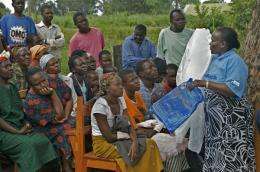
A volunteer in 2008 shows people from the Lurambi District in Western Kenya how to use incecticide-treated bednets to prevent the spread of malaria during the Integrated Prevention Demonstration Campaign sponsored by Vestergaard Frandsen. Photo by Georgina Goodwin courtesy Vestergaard Frandsen

(Medical Xpress) -- The great paradox of global health efforts is that regions of the world most plagued by poverty, poor infrastructure and rampant disease are often the most difficult to support. Now, scientists have demonstrated that confronting several diseases at once can make the most of thinly-stretched donor dollars and national health care budgets, to help to save lives.

A new analysis published this week in the open-access journal PLoS ONE (Feb. 3, 2012) (Link to the paper will be posted when it is available from the journal PLOS One online) focused on a combined in Western Province, Kenya led by the Swiss-based company Vestergaard Frandsen, the Kenyan Ministry of Health and the U.S. (CDC). The analysis looked at the cost effectiveness of simultaneously confronting the problems of HIV/AIDS, malaria, and diarrhea caused by waterborne pathogens.

The researchers used the results of the campaign to build an analysis of the impact such efforts could have if carried out more broadly. The analysis found that for every 1,000 people reached through such campaigns, some $16,015 in would be avoided and more than 16 lives would be saved. As a result, local populations would gain hundreds of years of healthy life. The cost would be $32 per person, but averted costs would be greater, leading to the net savings.

“That's a very attractive deal,” said James G. Kahn, MD, MPH, a professor of health policy, epidemiology and at the University of California, San Francisco (UCSF), who is the senior author on the study and led the economic aspect of the research. “This kind of a campaign is an excellent use of global health dollars."

Bed Nets, Water Filters, Condoms, and Education

Health care workers distributed “CarePacks” at 37 locations in Kenya over seven days in 2008. These packs contained insecticide-treated bed nets to reduce the spread of malaria, water filters for preventing diarrheal diseases, and condoms.

Some 47,000 people ultimately received the packs, which also contained educational information as incentive for local residents to participate in a voluntary HIV testing and counseling program.

By combining efforts to reduce the burdens of malaria, diarrhea, and HIV/AIDS, the program efficiently stretched the impact of its funds, Kahn said, which is important in areas where per capita health expenditures may amount to little more than a few dollars a year. Combining these public health efforts into one program also saved a great deal of time, he added.

"This program was implemented in seven days, reaching 80 percent of the local population," Kahn said. "This rapid implementation means more health benefits were quickly achieved."

Other co-authors of the article, "Integrated HIV Testing, Malaria, and Diarrhea Prevention Campaign in Kenya: Modeled Health Impact and Cost-effectiveness" are N. Muraguri, B. Harris, E. Lugada, T. Clasen, M. Grabowsky, J. Mermin and S. Shariff.

Kahn is based in the UCSF Philip R. Lee Institute for Health Policy Studies, the Department of Epidemiology and Biostatistics, and Global Health Sciences.

In addition to UCSF, authors on this study are affiliated with the Kenyan Ministry of and Sanitation, CHF International, the London School of Hygiene & Tropical Medicine, the ESP/UN Foundation, and the CDC.

The analysis was funded by the U.S. National Institute on Drug Abuse and by the company Vestergard Frandsen, which managed the campaign and manufactured the and bed nets distributed.

UCSF is a leading university dedicated to promoting health worldwide through advanced biomedical research, graduate-level education in the life sciences and health professions, and excellence in patient care.

Provided by University of California, San Francisco search and more info website

not rated yet  

Filter


Move the slider to adjust rank threshold, so that you can hide some of the comments.


Display comments: newest first

dogbert
Feb 06, 2012

Rank: not rated yet
The analysis found that for every 1,000 people reached through such campaigns, some $16,015 in health care costs would be avoided and more than 16 lives would be saved. As a result, local populations would gain hundreds of years of healthy life. The cost would be $32 per person, but averted health care costs would be greater, leading to the net savings.

$32,000 spent saves $16,015 in health care costs? I would have expected a higher savings.

Rank not rated yet
Relevant PhysicsForums posts

More news stories

Keep food safety in mind this memorial day weekend

(HealthDay) -- Picnics, parades and cookouts are as much a part of Memorial Day weekend as tributes to the United States' war veterans.

Health created 4 hours ago | popularity not rated yet | comments 0

Most occupational injury and illness costs are paid by the government and private payers

UC Davis researchers have found that workers' compensation insurance is not used nearly as much as it should be to cover the nation's multi-billion dollar price tag for workplace illnesses and injuries. Instead, almost 80 ...

Health created May 25, 2012 | popularity not rated yet | comments 0

Early physical therapist treatment associated with reduced risk of healthcare utilization and reduced overall healthcare

A new study published in Spine shows that early treatment by a physical therapist for low back pain (LBP), as compared to delayed treatment, was associated with reduced risk of subsequent healthcare utilization and lower ...

Health created May 25, 2012 | popularity not rated yet | comments 0 | with audio podcast

Cancer patients share web info with docs for insight, advice

(HealthDay) -- Cancer patients' primary goal in talking with their doctors about information they've found on the Internet is to get more insight and advice on the online information, new research indicates.

Health created May 25, 2012 | popularity not rated yet | comments 0

P&G to add latches to make detergent packs safer

(AP) -- Procter & Gamble says it will change the design of packaging for its miniature laundry detergent product to deter children from eating the brightly colored packets that look like candy.

Health created May 25, 2012 | popularity not rated yet | comments 0


Travel to high altitudes tied to Crohn's, colitis flare-ups

(HealthDay) -- People with inflammatory bowel disease, which includes Crohn's disease and colitis, may be at increased risk for flare-ups when they fly or travel to high altitudes for skiing or mountain climbing, ...

Family history of Alzheimer's affects functional connectivity

(HealthDay) -- Cognitively normal individuals with a family history of late-onset Alzheimer's disease (AD) may display lower resting state functional connectivity in the default mode network (DMN) of the brain, ...

Transvaginal mesh op restores pelvic organ prolapse at price

(HealthDay) -- Transvaginal mesh (TVM) procedures are effective for anatomical restoration of pelvic organ prolapse (POP), but patients report a worsening of sexual function following surgery, according to ...

Of mice and mental models: Neuroscientific implications of risk-optimized behavior in the mouse

(Medical Xpress) -- Regardless of an organism’s biological complexity, every encephalized animal continuously makes under-informed behavioral choices that can have serious consequences. Despite its ubiquity, ...

Weight struggles? Blame new neurons in your hypothalamus

New nerve cells formed in a select part of the brain could hold considerable sway over how much you eat and consequently weigh, new animal research by Johns Hopkins scientists suggests in a study published in the May issue ...

Color-changing contact lenses to help diabetics (w/ Video)

For the millions of Americans with diabetes, the inconvenient and often painful method of testing blood sugar levels is a way of life. But research and innovative product design by scientists at The University of Akron may ...