Human 'shock absorbers' discovered
February 14, 2012 in Medical research
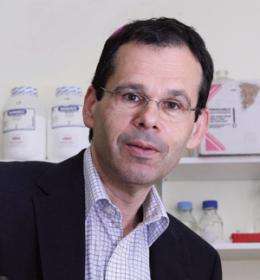
Professor Tony Weiss, from the School of Molecular Bioscience, leads and coordinates the research team who made this groundbreaking discovery
(Medical Xpress) -- An international team of scientists, led by the University of Sydney, has found the molecular structure in the body which functions as our 'shock absorber'.
The discovery of the previously unknown part of the molecule will be applied to the researchers' work on designing improved versions of a human blood vessel and on repairing skin damage, including burns.
The research can be applied to treating cardiovascular disease and emphysema.
The findings are published in today's edition of the Proceedings of the National Academy of Sciences (PNAS).
"This exciting discovery answers the mystery of how our bodies accommodate our living tissue without it being torn to shreds by its interaction with so many moving parts," said Professor Tony Weiss, from the University's School of Molecular Bioscience, who leads and coordinates the research team.
The team dissected a key part of the molecule in elastin, the protein that keeps tissues such as skin, lungs and blood vessels elastic during normal processes such as body movement, breathing and blood circulation.
Using a high-powered combination of synchronised X-ray beams and elastin synthesis tools, the team discovered that human elastin contains a molecular bridge or 'shock absorber'.
"This tiny shock absorber neatly connects specialised molecular parts: one part is dedicated to elasticity and another part dedicated to binding living tissue," Professor Weiss said.
"It performs the same function for humans at a molecular level as shock absorbers do in a car; we can enjoy a smooth ride because they keep the body of the car from being violently rattled by the movement of the wheels."
The team now has sufficient information to change just a billionth of a metre of the molecular bridge, which would result in dramatic changes to the elastin.
The abnormal protein produced an elastin which looks and behaves differently to normal elastin.
"This finding will benefit our work on designing artificial blood vessels that use replicas of human elastin, to repair and replace human blood vessels, with implications for the treatment of cardiovascular disease," Professor Weiss said.
"In the future it may have applications in treating emphysema, which is caused by destruction to lung elastin."
The research was conducted as part of the University's new centre that aims to reduce the personal and social burden of obesity, diabetes and cardiovascular disease worldwide by transforming the way people eat, work and live.
The fact the team is composed of leading researchers from Australia, the United Kingdom and Europe, with access to a variety of exquisite hi-tech tools, means the research can use their collective input.
"An important part of this outstanding work was also done by Giselle Yeo, a superb student in my lab," Professor Weiss said.
More information: http://www.pnas.org/
Provided by University of Sydney
-
Solving the riddle of nature's perfect spring
Mar 01, 2011 |
not rated yet |
0
-
Researchers find unique protein organization in arteries associated with cardiovascular disease
Jan 09, 2012 |
not rated yet |
0
-
Dendritic cells spark smoldering inflammation in smokers' lungs
Oct 28, 2009 |
not rated yet |
0
-
Team grows arteries with most elastic protein reported, big step for living vascular grafts
Jan 31, 2011 |
not rated yet |
0
-
New potential to treat chronic obstructive pulmonary disease
Jan 27, 2010 |
not rated yet |
0
-
Of mice and mental models: Neuroscientific implications of risk-optimized behavior in the mouse
May 25, 2012 |
not rated yet |
0
-
Limits to growth: Scientists identify key metastasis-enabling enzyme
May 22, 2012 |
5 / 5 (4) |
0
-
Seeing is as seeing does: Spatially-structured retinal input in early development of cortical maps
Apr 26, 2012 |
5 / 5 (4) |
1
-
Dreamless nights: Brain activity during nonrapid eye movement sleep
Apr 09, 2012 |
4.4 / 5 (12) |
0
-
Take your time: Neurobiology sheds light on the superiority of spaced vs. massed learning
Mar 28, 2012 |
4.5 / 5 (21) |
3
-
Potential Breakthrough in Seizure Control
19 hours ago
-
Popping/Cracked sternum.
23 hours ago
-
Which Mental Illness Encompasses This Problem?
May 25, 2012
-
A question about drug tolerance
May 23, 2012
-
Poor nutrition leading to overeating?
May 23, 2012
-
Math and dyslexia?
May 21, 2012
- More from Physics Forums - Medical Sciences
More news stories
Implantable pain disk may help those with cancer
An estimated 3.5 million cancer patients around the globe are in severe pain from their disease, but many get no relief.
Medical research
May 25, 2012 |
5 / 5 (1) |
0
|
Energy levels link sleep control mechanisms
Sleep, or lack of it, can determine level of cognitive performance which is linked with accidents as well as increased risk of serious health problems. Links between cell energy levels, gene transcription ...
Medical research
May 25, 2012 |
not rated yet |
0
Researchers identify key brain cell in antidepressant action
(Medical Xpress) -- Antidepressant medications such as Prozac have helped improve mood and lessen anxiety in millions of people with major depression. But scientists know surprisingly little about how these drugs work.
Medical research
May 25, 2012 |
4.7 / 5 (3) |
0
|
Rockefeller scientists pioneer new method to determine mechanisms of drug action
(Medical Xpress) -- Knowing that a drug works is great. Knowing how it works is a luxury. And until now, determining a drugs mechanism of action has been a tedious and difficult process for scientists.
Medical research
May 25, 2012 |
not rated yet |
0
|
Like curry? New biological role identified for compound used in ancient medicine
Scientists have just identified a new reason why some curry dishes, made with spices humans have used for thousands of years, might be good for you.
Medical research
May 25, 2012 |
4.5 / 5 (12) |
2
|
Keep food safety in mind this memorial day weekend
(HealthDay) -- Picnics, parades and cookouts are as much a part of Memorial Day weekend as tributes to the United States' war veterans.
Travel to high altitudes tied to Crohn's, colitis flare-ups
(HealthDay) -- People with inflammatory bowel disease, which includes Crohn's disease and colitis, may be at increased risk for flare-ups when they fly or travel to high altitudes for skiing or mountain climbing, ...
Family history of Alzheimer's affects functional connectivity
(HealthDay) -- Cognitively normal individuals with a family history of late-onset Alzheimer's disease (AD) may display lower resting state functional connectivity in the default mode network (DMN) of the brain, ...
Transvaginal mesh op restores pelvic organ prolapse at price
(HealthDay) -- Transvaginal mesh (TVM) procedures are effective for anatomical restoration of pelvic organ prolapse (POP), but patients report a worsening of sexual function following surgery, according to ...
Of mice and mental models: Neuroscientific implications of risk-optimized behavior in the mouse
(Medical Xpress) -- Regardless of an organism’s biological complexity, every encephalized animal continuously makes under-informed behavioral choices that can have serious consequences. Despite its ubiquity, ...
Weight struggles? Blame new neurons in your hypothalamus
New nerve cells formed in a select part of the brain could hold considerable sway over how much you eat and consequently weigh, new animal research by Johns Hopkins scientists suggests in a study published in the May issue ...
Feb 14, 2012
Rank: not rated yet
Feb 14, 2012
Rank: not rated yet
Feb 22, 2012
Rank: not rated yet