Komen exec quits after Planned Parenthood flap
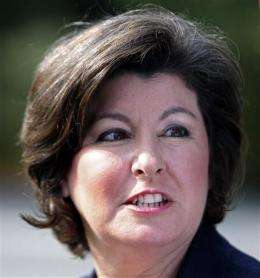
(AP) -- An executive at the Susan G. Komen for the Cure breast cancer charity resigned Tuesday over her support to strip Planned Parenthood of funding, but disputed that she was the driving force behind the decision that created a firestorm of criticism last week.
Karen Handel, the charity's vice president for public policy, said in her resignation later she was "deeply disappointed by the gross mischaracterizations of the strategy, its rationale, and her involvement."
Handel said the discussion to cut funding for Planned Parenthood started before she came to the group last year, and was approved at the highest levels of the charity. However, a person with direct knowledge of decision-making at Komen's headquarters said Handel was a driving force behind the move.
Handel supported a decision Komen announced to exclude Planned Parenthood, which provides a range of women's health care services including abortions, from future grants for breast-cancer screenings because it was under congressional investigation.
"Neither the decision nor the changes themselves were based on anyone's political beliefs or ideology," Handel said in the letter. "Rather, both were based on Komen's mission and how to better serve women, as well as a realization of the need to distance Komen from controversy."
Handel said the now-abandoned policy was fully vetted by the Komen organization. Its board did not raise any objections when it was presented with the proposed policy in November, Handel said.
Komen Founder and CEO Nancy G. Brinker said she accepted Handel's resignation and wished her well.
"We have made mistakes in how we have handled recent decisions and take full accountability for what has resulted, but we cannot take our eye off the ball when it comes to our mission," Brinker said in a statement. "To do this effectively, we must learn from what we've done right, what we've done wrong and achieve our goal for the millions of women who rely on us."
Planned Parenthood spokeswoman Andrea Hagelgans declined to comment on the resignation.
The breast cancer charity cited a probe backed by anti-abortion groups and launched by Rep. Cliff Stearns, R-Fla., to determine if Planned Parenthood improperly spent public money on abortions. Planned Parenthood says taxpayer money is strictly separated.
The breast cancer charity reversed course after its decision created a three-day firestorm of criticism. Members of Congress and Komen affiliates accused the group's national leadership of bending to pressure from anti-abortion activists. Brinker denied the accusation.
Until Tuesday, Handel had publicly kept silent about her role in the dispute.
In her letter, she said the controversy surrounding Planned Parenthood was long a concern to Komen officials.
"Neither the decision nor the changes themselves were based on anyone's political beliefs or ideology," Handel said in the letter. "Rather, both were based on Komen's mission and how to better serve women, as well as a realization of the need to distance Komen from controversy."
A person with direct knowledge of decision-making at Komen's headquarters in Dallas said the grant-making criteria were adopted with the deliberate intention of targeting Planned Parenthood. The criteria's impact on Planned Parenthood and its status as the focus of government investigations were highlighted in a memo distributed to Komen affiliates in December.
According to the person, who spoke on condition of anonymity for fear of repercussions, a driving force behind the move was Handel, who was hired by Komen last year as vice president for public policy after losing a campaign for governor in Georgia in which she stressed her anti-abortion views and frequently denounced Planned Parenthood.
Brinker, in an interview with MSNBC last week, said Handel didn't have a significant role in the policy change.
Handel, a Republican, ran for Georgia governor in 2010, received an endorsement from former vice presidential candidate and Alaska Gov. Sarah Palin. But Handel lost a primary runoff to former Georgia Rep. Nathan Deal, who won the general election.
Throughout the campaign, Deal accused Handel of being soft on abortion.
Deal repeatedly attacked Handel over a 2005 vote she took while serving on a metro Atlanta county commission to give more than $400,000 to Planned Parenthood, though not for abortion services. The Georgia affiliate of Planned Parenthood said the money went to a downtown clinic for services such as cervical cancer screenings, testing for sexually transmitted diseases and birth controls.
A longstanding law bans using federal money to pay for abortions except in cases of rape, incest or to protect the health of the mother.
Anti-abortion activists in Georgia praised Handel's decision.
"I commend her for it," said Daniel Becker, president of the Georgia Right to Life.
He said the organization still had concerns about Handel's belief that women who are raped or victims of incest should be allowed to seek abortions.
©2012 The Associated Press. All rights reserved. This material may not be published, broadcast, rewritten or redistributed.


