Shedding light on memory deficits in schizophrenic patients and healthy aged subjects
February 23, 2012 in Psychology & Psychiatry
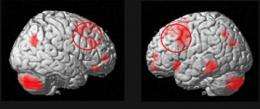
Right and left side views of the brain of healthy elderly subjects compared to schizophrenics. The circled regions show areas of the dorsolateral prefrontal cortex that are less activated in schizophrenic patients than in elderly subjects with identical working memory faculties. Credit: NIMH/US government
Working memory, which consists in the short-term retention and processing of information, depends on specific regions of the brain working correctly. This faculty tends to deteriorate in patients with schizophrenia, as it does in healthy aged subjects.
Jean-Claude Dreher, senior researcher at the Centre de Neurosciences Cognitives, in collaboration with an American team from the National Institute of Mental Health (Bethesda, Maryland), has shown for the first time that working memory deficits in schizophrenics and elderly subjects are accompanied by differences in prefrontal cortex activation, even though the working memory deficits are identical. These results, which shed new light on the brain mechanisms underlying working memory disorders in schizophrenics and elderly subjects, are published online on the 17 February 2012 in the US journal Biological Psychiatry.
What are the brain mechanisms involved in working memory deficits in schizophrenics? How can these cerebral changes be compared to those observed during healthy ageing, which can also lead to similar working memory disorders?
To answer these questions, the research team used medical imaging(1) to compare the cerebral activation of two groups, healthy elderly subjects and medication-free schizophrenic patients.
Previous studies have shown that schizophrenics suffer from working memory deficits accompanied by a malfunction of the dorsolateral prefrontal cortex. In this new study, each schizophrenic patient was paired with a healthy aged subject with virtually identical memory performance. Using this original approach, it is possible to determine whether similar working memory performance impairment in schizophrenic patients is the result or the cause of the prefrontal cortex malfunction. Until now, doubts remained. Indeed, schizophrenic patients were compared with young, healthy control subjects whose working memory performance was better than that of the affected group. Consequently, performance differences between the two groups (schizophrenics and young subjects) could not demonstrate the link between the illness and the prefrontal cortex malfunction.
This new study shows that schizophrenic patients show reduced prefrontal cortex activation, whereas healthy aged subjects over-activate this region while performing working memory tasks (see figure). This finding enables the research team to conclude that reduced activation of the prefrontal cortex in schizophrenics is part of the neurophysiopathology of the illness. The cognitive impairment of patients with schizophrenia is thus the result of a prefrontal cortex malfunction.
The neuronal mechanisms underlying the working memory deficits characterizing the two groups of subjects are thus different. In healthy elderly subjects, the study shows that working memory deficits are not necessarily accompanied by a reduction in prefrontal cortex activation, as observed in schizophrenic patients. In the long run, the efficacy of pharmacological agents in treating cognitive deficits in schizophrenic patients and aged subjects could be improved by targeting more specific regions of the brain.
More information: J-C Dreher, P., et al.. Common and differential pathophysiological features accompany comparable cognitive impairments in medication-free patients with schizophrenia and in healthy aging subjects, Biological Psychiatry, 17 Feb 2012
Journal reference:
Biological Psychiatry
Provided by
CNRS
-
Researchers show how memory is lost -- and found
Jul 27, 2011 |
not rated yet |
0
-
Brain images show schizophrenic's memory usage differs
Mar 14, 2008 |
not rated yet |
0
-
Brain imaging identifies differences in childhood bipolar disorder, ADHD
Oct 12, 2010 |
not rated yet |
0
-
Regulation of attention and concentration in brain unravelled
Aug 11, 2011 |
not rated yet |
0
-
How we remember each other
Apr 03, 2007 |
not rated yet |
0
-
Motion perception revisited: High Phi effect challenges established motion perception assumptions
Apr 23, 2013 |
3 / 5 (2) |
2
-
Anything you can do I can do better: Neuromolecular foundations of the superiority illusion (Update)
Apr 02, 2013 |
4.5 / 5 (11) |
5
-
The visual system as economist: Neural resource allocation in visual adaptation
Mar 30, 2013 |
5 / 5 (2) |
9
-
Separate lives: Neuronal and organismal lifespans decoupled
Mar 27, 2013 |
4.9 / 5 (8) |
0
-
Sizing things up: The evolutionary neurobiology of scale invariance
Feb 28, 2013 |
4.8 / 5 (10) |
14
-
How can there be a term called "intestinal metaplasia" of stomach
7 hours ago
-
Pressure-volume curve: Elastic Recoil Pressure don't make sense
May 18, 2013
-
If you became brain-dead, would you want them to pull the plug?
May 17, 2013
-
MRI bill question
May 15, 2013
-
Ratio of Hydrogen of Oxygen in Dessicated Animal Protein
May 13, 2013
-
Alcohol and acetaminophen
May 13, 2013
- More from Physics Forums - Medical Sciences
More news stories
Teens exposed to schoolmate's death by suicide much more likely to consider or attempt suicide
Youth who had a schoolmate die by suicide are significantly more likely to consider or attempt suicide, according to a study in published in CMAJ (Canadian Medical Association Journal). This effect can last 2 years or mo ...
Psychology & Psychiatry
1 hour ago |
not rated yet |
0
Genetic predictors of postpartum depression uncovered
Johns Hopkins researchers say they have discovered specific chemical alterations in two genes that, when present during pregnancy, reliably predict whether a woman will develop postpartum depression.
Psychology & Psychiatry
9 hours ago |
not rated yet |
0
|
Mediterranean diet seems to boost ageing brain power
A Mediterranean diet with added extra virgin olive oil or mixed nuts seems to improve the brain power of older people better than advising them to follow a low-fat diet, indicates research published online in the Journal of ...
Psychology & Psychiatry
19 hours ago |
2 / 5 (1) |
2
The incidence of eating disorders is increasing in the UK
More people are being diagnosed with eating disorders every year and the most common type is not either of the two most well known—bulimia or anorexia—but eating disorders not otherwise specified (eating disorders that ...
Psychology & Psychiatry
19 hours ago |
not rated yet |
0
Practice makes perfect? Not so much
Turns out, that old "practice makes perfect" adage may be overblown. New research led by Michigan State University's Zach Hambrick finds that a copious amount of practice is not enough to explain why people ...
Psychology & Psychiatry
20 hours ago |
3.3 / 5 (12) |
0
|
B vitamins could delay dementia
(Medical Xpress)—Despite spending billions of dollars on research and development, drug companies have been unable to come up with effective treatments for dementia and Alzheimer's Disease (AD). Now, A. ...
Enrichment therapy effective among children with autism, study finds
Children with autism showed significant improvement after six months of simple sensory exercises at home using everyday items such as scents, spoons and sponges, according to UC Irvine neurobiologists.
Poliovirus vaccine trial shows early promise for recurrent glioblastoma
An attack on glioblastoma brain tumor cells that uses a modified poliovirus is showing encouraging results in an early study to establish the proper dose level, researchers at Duke Cancer Institute report.
'Doctor shopping' by obese patients negatively affects health
Overweight and obese patients are significantly more likely than their normal-weight counterparts to repeatedly switch primary care doctors, a practice that disrupts continuity of care and leads to more emergency room visits, ...
Aggressive behavior linked specifically to secondhand smoke exposure in childhood
Children who are exposed to secondhand smoke in early childhood are more likely to grow up to physically aggressive and antisocial, regardless of whether they were exposed during pregnancy or their parents have a history ...
If you can remember it, you can remember it wrong
(Medical Xpress)—Native peoples in regions where cameras are uncommon sometimes react with caution when their picture is taken. The fear that something must have been stolen from them to create the photo ...