Finding a tumor suppressor's groove
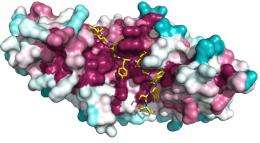
Figure 1: Crystal structure of the complex of the Arm domain of APC and Sam68. The groove on the Arm domain of APC contains highly conserved residues (magenta) that form numerous specific interactions with Sam68 residues (yellow). Credit: Ref. 1 © 2011 Elsevier Ltd
The tumor suppressor protein called adenomatous polyposis coli (APC) is a central genetic risk factor for colorectal cancer. In fact, mutations that potentially alter the structure or function of this protein are found in an estimated 85% of human colorectal tumors, which are currently the third highest-ranked cause of cancer-related death worldwide.
Unfortunately, APC is a very large protein with numerous interacting partners, making it a challenge to determine the direct impact of a given mutation. The mechanisms by which these mutations lead to cancer is still poorly understood, says Shigeyuki Yokoyama, director of the RIKEN Systems and Structural Biology Center in Yokohama.
Structural analysis offers helpful insights into protein function, but obtaining these data can be difficult with such massive target proteins. Yokoyama and colleagues therefore decided to focus on one particular segment of APC, known as the armadillo repeat (Arm) domain. In particular, they were interested in understanding how Arm interacts with and inhibits Sam68, an APC-binding protein that is believed to contribute to the activation of genes involved with tumorigenesis.
The researchers determined that the Arm domain forms a helical structure, with an L-shaped groove for the recognition of binding partners. The Arm-interacting domain of Sam68, on the other hand, appears to be relatively disorganized until it binds this groove, an association stabilized by a number of interactions between specific amino acids on the two proteins (Fig. 1). Yokoyama and colleagues were subsequently able to confirm the contributions of these residues by systematically introducing mutations and determining their impact on these proteins affinity for each other.
With this information in hand, the researchers assessed the potential significance of real-life mutations at these points of interaction. We were able to map cancer-related APC mutations within this domain and analyze their effects on the structure of APC and on the binding of proteins to APC, says Yokoyama. Indeed, some of the amino acid changes introduced by these mutations appeared to be directly detrimental to complex formation between APC and Sam68.
Arm interacts with several other important proteins, and Yokoyamas group plans to perform equally in-depth analyses to characterize the structural bases for these associations. However, he notes that the present findingsin conjunction with data obtained by co-author Tetsu Akiyama at the University of Tokyomay already offer direct clinical utility. We think that targeted disruption of the interaction between mutated APCs and Sam68 might be a good strategy to prevent the development of cancer, says Yokoyama.
More information: Morishita, E.C., et al. Crystal structures of the armadillo repeat domain of adenomatous polyposis coli and its complex with the tyrosine-rich domain of Sam68. Structure 19, 14961508 (2011).
Provided by
RIKEN
-
A new way to treat colon cancer?
Oct 10, 2006 |
not rated yet |
0
-
Tumor suppressor APC could stop cancer through its effect on actin cytoskeleton
Jun 21, 2010 |
not rated yet |
0
-
The APCs of nerve cell function
Jun 16, 2008 |
not rated yet |
0
-
Shedding light on a photosensitive protein
Nov 04, 2011 |
not rated yet |
0
-
Copycat protein finds a perfect match
Nov 19, 2010 |
not rated yet |
0
-
Motion perception revisited: High Phi effect challenges established motion perception assumptions
Apr 23, 2013 |
3 / 5 (2) |
2
-
Anything you can do I can do better: Neuromolecular foundations of the superiority illusion (Update)
Apr 02, 2013 |
4.5 / 5 (11) |
5
-
The visual system as economist: Neural resource allocation in visual adaptation
Mar 30, 2013 |
5 / 5 (2) |
9
-
Separate lives: Neuronal and organismal lifespans decoupled
Mar 27, 2013 |
4.9 / 5 (8) |
0
-
Sizing things up: The evolutionary neurobiology of scale invariance
Feb 28, 2013 |
4.8 / 5 (10) |
14
-
Pressure-volume curve: Elastic Recoil Pressure don't make sense
May 18, 2013
-
If you became brain-dead, would you want them to pull the plug?
May 17, 2013
-
MRI bill question
May 15, 2013
-
Ratio of Hydrogen of Oxygen in Dessicated Animal Protein
May 13, 2013
-
Alcohol and acetaminophen
May 13, 2013
-
Marie Curie's leukemia
May 13, 2013
- More from Physics Forums - Medical Sciences
More news stories
Genetic diversity within tumors predicts outcome in head and neck cancer
A new measure of the heterogeneity – the variety of genetic mutations – of cells within a tumor appears to predict treatment outcomes of patients with the most common type of head and neck cancer. In the May 20 issue ...
Cancer
1 hour ago |
not rated yet |
0
Molecular marker from pancreatic 'juices' helps identify pancreatic cancer
Researchers at Mayo Clinic have developed a promising method to distinguish between pancreatic cancer and chronic pancreatitis—two disorders that are difficult to tell apart. A molecular marker obtained from pancreatic ...
Cancer
1 hour ago |
not rated yet |
0
New smartphone application improves colonoscopy preparation
The use of a smartphone application significantly improves patients' preparation for a colonoscopy, according to new research presented today at Digestive Disease Week (DDW). The preparation process, which begins days in ...
Cancer
May 19, 2013 |
not rated yet |
0
Research examines new methods for managing digestive health
Research presented at Digestive Disease Week (DDW) explores new methods for managing digestive health through diet and lifestyle.
Cancer
May 19, 2013 |
not rated yet |
1
New colonoscope provides ground-breaking view of colon
A ground-breaking advance in colonoscopy technology signals the future of colorectal care, according to research presented today at Digestive Disease Week(DDW). Additional research focuses on optimizing the minimal withdrawal ...
Cancer
May 18, 2013 |
5 / 5 (2) |
0
Treatment of sleep apnea improves glucose levels in prediabetes
Optimal treatment of sleep apnea in patients with prediabetes improves blood sugar (glucose) levels and thus can reduce cardiometabolic risk, according to a study to be presented at the ATS 2013 International Conference in ...
Whole-cell vaccine was more effective than acellular vaccine during CA pertussis outbreak
Whole-cell pertussis vaccines were more effective at protecting against pertussis than acellular pertussis vaccines during a large recent outbreak, according to a new Kaiser Permanente study published in Pediatrics.
Blame your parents for bunion woes
A novel study reports that white men and women of European descent inherit common foot disorders, such as bunions (hallux valgus) and lesser toe deformities, including hammer or claw toe. Findings from the Framingham Foot ...
Commonly used catheters double risk of blood clots in ICU and cancer patients
Touted for safety, ease and patient convenience, peripherally inserted central catheters have become many clinicians' go-to for IV delivery of antibiotics, nutrition, chemotherapy, and other medications.
ER docs are key to reducing health care costs
Emergency physicians are key decisionmakers for nearly half of all hospital admissions, highlighting a critical role they can play in reducing health care costs, according to a new report from the RAND Corporation.
New theory on genesis of osteoarthritis comes with successful therapy in mice
Scientists at Johns Hopkins have turned their view of osteoarthritis (OA) inside out. Literally. Instead of seeing the painful degenerative disease as a problem primarily of the cartilage that cushions joints, ...