Understanding a woman's heart means knowing what to look for
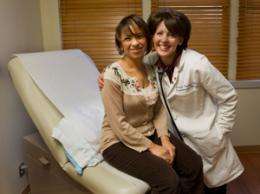
Reyna Robles was always the first one up and the last one to bed: she possessed more than enough steam to come home from her full-time job, prepare a meal for her husband and children, take her dogs for walk and help her kids with homework. Before bedtime, she’d fit in a good work out.
She wasn’t one to complain, either, until the spring day in 2009 when she suddenly felt a pain in her chest as she exercised. It was a cramp-like pain, not anything like the normal muscle aches Robles expected from her body after vigorous activity. “I didn’t think I should be feeling chest pains,” she said. She wasn’t even 40.
She saw her doctor, who ordered an EKG. Everything was fine, Robles was told. Nothing was wrong with her heart. But the pain kept coming back, and that worried her. “Exercise should feel good,” she said. “It shouldn’t hurt.” She went back to her doctor, who ordered more tests. Still nothing, she was told. Soon, she started feeling the pain even when she wasn’t exercising. “I intuitively knew something wasn’t right,” she said. Still, none of the doctors she saw could discern a problem. And she began to doubt herself, “although I knew I wasn’t imagining it. It was real.”
With no answers and no end to the pain, Robles’ whole view of life was gradually permeated by the uncertainty of her health. “I’m normally very positive, very bubbly and cheerful,” she said, “but I felt like a shadow of my former self. All I could think about was my chest pain.” By winter, she’d become desperate for help and went online to find it. She connected with a group of women who had experienced similar symptoms. One of them was a patient of Jennifer Tremmel, MD, assistant professor of cardiovascular medicine and clinical director of the Stanford Hospital Women’s Heart Health program, just celebrating its fifth year in service.
In Tremmel, Robles found someone whose focused interest and knowledge of heart disease in women became the key to solving her medical mystery. “For years, the standard medical treatment for women with heart disease was based on what we know about heart disease in men,” Tremmel said. “That’s really confounded things. In the past 30 years, we’ve learned a lot about how women differ from men, but there’s a lot we still don’t know. Just getting physicians to have a broader concept of symptoms, and what constitutes coronary artery disease in women, is a challenge.”
Robles is a classic example of the challenge, in several ways. Her first EKG, stress test and angiogram were deemed normal. “What we have found is that stress tests, and even angiograms, may not always identify the problem in a woman’s heart”, Tremmel said. “If a lack of blood flow through the entire thickness of the heart muscle is needed to have a positive stress test, those patients with symptoms from a lack of blood flow to only the inner most lining of the heart may not be caught.”
Similarly, Tremmel said, angiograms catch only blockages in large vessels, but patients, particularly women, may have a problem like endothelial dysfunction, which affects small vessels whose failure to work properly can’t be seen on angiography.
Robles came to Stanford as many do, having been told no abnormalities had been found.
“A lot of women come to us with years of having people tell them, ‘There’s nothing there,’” said Tremmel. “They doubt themselves and have really been affected by that. ” The Stanford Women’s Heart Health program includes a psychologist to help its patients address the emotional repercussions of such treatment.
And, of course, the program is committed to finding the cause of the types of symptoms that Robles was reporting. “We decided we’d look harder,” Tremmel said. “We did all this extra testing to see if we might find something that had been missed on her original angiogram.”
Tremmel discovered that Robles had a physical anomaly called a myocardial bridge, where an artery that normally sits on top of the heart actually dives down into the heart muscle. Such bridges are not uncommon, and most people can live their entire lives without symptoms, but if a large portion of the artery is deeply buried, then there’s trouble. Again, however, this physical abnormality often doesn’t show up on an angiogram.
Not only did Robles have a myocardial bridge, but she also had endothelial dysfunction within the bridge. This dysfunction causes an artery to constrict when it should dilate.
“There were a lot of physiologic dynamics going on in that bridge,” Tremmel said. The first approach for Robles’ treatment was standard: use medications to slow the heart rate enough to allow blood to flow through the artery, even though it was squeezed inside the heart muscle. That didn’t work. Nor did Robles’ efforts to minimize stress, another tool to reducing symptoms.
Finally, with no other options left, Tremmel began to consider a surgery to release the artery from the muscle. “The surgery itself isn’t complicated,” she said, “but it is open heart surgery where you open the chest and expose the heart. It’s a big deal. But for patients who have a poor quality of life, and you can’t find any other way, it’s a viable option.”
Before the final decision was made, Tremmel wanted to do one more test. She inserted a wire into Robles’ artery, while stressing her heart with medication, to measure the pressure and flow, on that one particular part of her heart’s anatomy. “The test proved that the bridge was definitely the problem,” Tremmel said. Tremmel’s colleague, cardiovascular surgeon Michael Fischbein, MD, made the repair in November to Robles’ heart.
By the start of the year,, Robles was taking small but steady steps toward a more active life. After so many months of living with fear and uncertainty, Robles’ belief in the strength of her repaired heart has been helped along by Tremmel’s gentle encouragements.
Recently, Robles worried aloud at an exam with Tremmel about some enthusiastic laughing she’d done with one of her daughters — so exuberant that her chest began to hurt. Tremmel pressed her stethoscope against Robles’ chest for a close listen.
“It sounds like a happy heart,” said Tremmel. “You can laugh as much as you want."


