More autism reported, likely from better testing
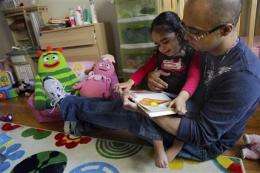
(AP) -- At 18 months, Cristina Astacio spoke only a few words, wouldn't respond to her name and shunned other kids in her day care group. Last October, her worried parents found out why.
She has a mild form of autism, a diagnosis being given to more U.S. children than ever before, largely because of more awareness and better diagnosis.
According to new government statistics, the rate is about 1 in 88. That means autism is nearly twice as common as the government reported just five years ago. The largest increases are in Hispanic kids like Cristina.
The definition of autism has changed over the years, and Cristina might not have been considered autistic two decades ago.
But experts say kids like her are lucky in a way, because her parents recognized early that something was wrong. The Centers for Disease Control and Prevention report issued Thursday found that 40 percent of kids weren't diagnosed until after age 4. Evidence shows that children who are identified early and get help have the best chance for reaching their potential, said CDC Director Dr. Thomas Frieden.
The American Academy of Pediatrics recommends autism screening for all children at age 18 months and 2 years.
Diagnosing the developmental disorder relies on observing behavior. Autism can't be cured, but treatment including intensive behavior therapy can help many kids function better.
The academy's Dr. Susan Hyman said many children who aren't making eye contact and aren't talking "may have autism, but they may have other things." She said it's important for parents to be persistent about their concerns with their doctor so their kids can be evaluated.
Kristy Batesole, of Atascadero, Calif., says she suspected something was wrong with her son, Keegan, even when he was a hard-to-calm overly fussy baby. He learned words, but by age 2 stopped talking, would spend hours opening and closing doors and sometimes bang his head on the ground.
Though he started getting special help in preschool in Nevada, he wasn't formally diagnosed with autism until last year, at age 6, after the family moved to California, where there are more autism specialists.
Cristina Astacio gets two hours of behavior therapy six days a week. Her mom, Charisse, says the little girl now responds to commands and speaks about 50 words. The most special are two words Cristina never said before. "Now she says `mommy' and `daddy,'" Astacio said. "It's wonderful."
Christina's dad, Christopher, is a special-education teacher in the New York City; most of the kids in his class are Hispanic and many have autism.
"I remember back in the past, a few kids here and there had autism, not like the way it is now," Astacio said. "I'm really curious why so many kids are being diagnosed."
Experts, including CDC researchers, think broader screening and better diagnosis have largely contributed to that. But autism's cause remains a mystery, and government researchers are seeking answers.
The latest numbers are based on 2008 data from 14 states and suggest that autism rates have climbed 23 percent since 2006. Rates are highest in boys and white children. But the biggest rate increase was among Hispanics, from 1 in 270 in 2002 to about 1 in 125 in 2008.
That rate increase also is likely due to better awareness. The CDC report says there's no strong evidence of any racial or ethnic difference in risk factors for autism and that it's likely the condition is underdiagnosed in blacks and Hispanics.
Melissa Miller, a St. Petersburg, Fla., mom whose daughter, Chelsea, was diagnosed last year at age 2, said many people still misunderstand the disorder.
"I think many people hear `autism' and think `Rain Man,'" she said, referring to the 1988 movie featuring Dustin Hoffman as the mathematically brilliant but socially impaired autistic savant.
"The autism spectrum is so vast, and all of our children are different. Many of them don't rock back and forth or have savant skills. They are sweet, affectionate, intelligent, goofy - and exhausting - kids," Miller said.
Proposed revisions in the manual that doctors use to diagnose mental illness would streamline autism criteria. Critics contend the suggested changes would be too narrow and exclude children who need educational and behavioral services.
Hyman noted that since the manual's last revision, in 1994, much has been learned about autism. "There's a real possibility the new definition will be better for children," she said Thursday at a CDC news conference.
CDC officials say research into causes of autism will help determine if there's been a true increase or just better diagnosis.
Genetics is believed to play a role. Studies have found no connection with childhood vaccines, but other factors under investigation include mothers' illnesses or medication during pregnancy. First results from the CDC study are expected next year.
Geraldine Dawson, chief science officer for the advocacy group Autism Speaks, said the new figures indicate "a public health emergency that demands immediate attention."
Her group estimates that U.S. autism costs total $126 billion each year, including costs related to diagnosis and treatment. That estimate also includes treatment for severely affected adults and lost wages.
More information:
CDC: http://www.cdc.gov
Autism Speaks: http://www.autismspeaks.org
©2012 The Associated Press. All rights reserved. This material may not be published, broadcast, rewritten or redistributed.


