Holding a gun makes you think others are too, new research shows
March 20, 2012 By Susan Guibert in Psychology & Psychiatry

Holding a gun makes you think others are too, new research shows

Enlarge

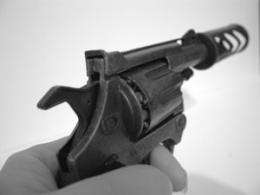
(Medical Xpress) -- Wielding a gun increases a person’s bias to see guns in the hands of others, new research from the University of Notre Dame shows.

Notre Dame Associate Professor of Psychology James Brockmole, who specializes in human cognition and how the visual world guides behavior, together with a colleague from Purdue University, conducted the study, which will appear in an upcoming issue of the Journal of Experimental Psychology: Human Perception and Performance.

In five experiments, subjects were shown multiple images of people on a computer screen and determined whether the person was holding a gun or a neutral object such as a soda can or cell phone. Subjects did this while holding either a toy gun or a neutral object such as a foam ball.

The researchers varied the situation in each experiment — such as having the people in the images sometimes wear ski masks, changing the race of the person in the image or changing the reaction subjects were to have when they perceived the person in the image to hold a gun. Regardless of the situation the observers found themselves in, the study showed that responding with a gun biased observers to report “gun present” more than did responding with a ball. Thus, by virtue of affording the subject the opportunity to use a gun, he or she was more likely to classify objects in a scene as a gun and, as a result, to engage in threat-induced behavior, such as raising a firearm to shoot.

“Beliefs, expectations and emotions can all influence an observer’s ability to detect and to categorize objects as guns,” Brockmole says. “Now we know that a person’s ability to act in certain ways can bias their recognition of objects as well, and in dramatic ways. It seems that people have a hard time separating their thoughts about what they perceive and their thoughts about how they can or should act.”

The researchers showed that the ability to act is a key factor in the effects by showing that simply letting observers see a nearby gun did not influence their behavior; holding and using the gun was important.

“One reason we supposed that wielding a firearm might influence object categorization stems from previous research in this area, which argues that people perceive the spatial properties of their surrounding environment in terms of their ability to perform an intended action,” Brockmole says.

For example, other research has shown that people with broader shoulders tend to perceive doorways to be narrower, and softball players with higher batting averages perceive the ball to be bigger. The blending of perception and action representations could explain, in part, why people holding a would tend to assume others are, too.

“In addition to the theoretical implications for event perception and object identification, these findings have practical implications for law enforcement and public safety,” Brockmole says.

Provided by University of Notre Dame search and more info website

3.7 /5 (3 votes)  

Rank 3.7 /5 (3 votes)
Tags

gun
Relevant PhysicsForums posts

More news stories

Storm chasers: born to be wild?

(HealthDay)—We've all seen them: the surfers who race to the beach when a hurricane hits, the guy who decides to ride out the storm in his overmatched boat, the tornado chasers who fearlessly steer their ...

Psychology & Psychiatry created 14 hours ago | popularity not rated yet | comments 0

Hormone levels may provide key to understanding psychological disorders in women

Women at a particular stage in their monthly menstrual cycle may be more vulnerable to some of the psychological side-effects associated with stressful experiences, according to a study from UCL.

Psychology & Psychiatry created 15 hours ago | popularity 3.7 / 5 (3) | comments 0 | with audio podcast

Are there atheists in foxholes? Study says they're the minority

Ernie Pyle – an iconic war correspondent in World War II – reportedly said "There are no atheists in foxholes." A new joint study between two brothers at Cornell and Virginia Wesleyan found that only ...

Psychology & Psychiatry created 18 hours ago | popularity 2.5 / 5 (4) | comments 1

Breathing exercises help veterans find peace after war, scholar says

(Medical Xpress)—Research by Stanford scholar Emma Seppala at the Center for Compassion and Altruism Research and Education found that post-traumatic stress disorder decreased in veterans who participated ...

Psychology & Psychiatry created 18 hours ago | popularity 5 / 5 (1) | comments 0

Depression raises diabetics' risk of severe low blood sugar episodes

(Medical Xpress)—Patients with diabetes who are depressed are much more likely to develop episodes of dangerously low blood sugars, or hypoglycemia, than are those who are not depressed, a new study has ...

Psychology & Psychiatry created 19 hours ago | popularity not rated yet | comments 0 | with audio podcast


Engineered cytomegalovirus protects monkeys from HIV equivalent

(Medical Xpress)—A new study by researchers in the US has shown that an ancient virus can be modified to help in the fight against the simian immunodeficiency virus SIV, which is the equivalent in monkeys ...

Researchers identify first drug targets in childhood genetic tumor disorder

Two mutations central to the development of infantile myofibromatosis (IM)—a disorder characterized by multiple tumors involving the skin, bone, and soft tissue—may provide new therapeutic targets, according to researchers ...

Going live: Immune cell activation in multiple sclerosis

Biological processes are generally based on events at the molecular and cellular level. To understand what happens in the course of infections, diseases or normal bodily functions, scientists would need to ...

Help at hand for people with schizophrenia

How can healthy people who hear voices help schizophrenics? Finding the answer for this is at the centre of research conducted at the University of Bergen.

Alzheimer's disease, the soft target of the euthanasia debate

(Medical Xpress)—The way Alzheimer's disease is portrayed by advocacy groups and the media is having undue influence on the euthanasia debate, according to a Deakin University nursing ethics professor.

Driving and hands-free talking lead to spike in errors, study shows

Talking on a hands-free device while behind the wheel can lead to a sharp increase in errors that could imperil other drivers on the road, according to new research from the University of Alberta.