The innate ability to learn language
March 26, 2012 By Angela Herring in Neuroscience

The innate ability to learn language

Enlarge

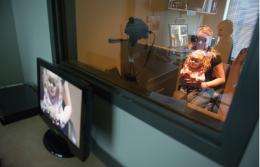
Psychology professor Iris Berent is using behavioral and neuroimaging techniques to investigate whether our ability to learn language is innate. Credit: Mary Knox Merrill

All human languages contain two levels of structure, said Iris Berent, a psychology professor in Northeastern’s College of Science. One is syntax, or the ordering of words in a sentence. The other is phonology, or the sound structure of individual words.

Berent — whose research focuses on the phonological structure of — examines the nature of linguistic competence, its origins and its interaction with reading. While previous studies have all centered on adult language acquisition, she is now working with to address two core questions.

“First,” she said, “do infants have the capacity to encode phonological rules? And, second, are some phonological rules innate?”

To address the first issue, Berent collaborated with neuroscientists Janet Werker, of the University of British Columbia, and Judit Gervain, of the Paris-based Centre National de la Recherche Scientifique.

By utilizing an optical brain imaging technique called near-infrared spectroscopy, or NIRS, the researchers found that newborns have the capacity to learn linguistic rules. This finding — published this month in the Journal of Cognitive Neuroscience — suggests that the neural foundations of language acquisition are present at birth.

Armed with this knowledge, Berent has begun conducting behavioral studies on more than two-dozen infants to explore whether linguistic rules are innate or entirely learned.

“We want to see whether infants prefer certain sound patterns to others even if neither occurs in their language,” Berent explained. “For instance, we know that prefer sequences such as bnog over bdog. Would six-month-old infants show this preference even if their language (English) does not include either sequence?”

For the study, each child is placed in front of a video screen that displays an image pulsing in coordination with rotating sounds, such as “bnog” and “bdog.” Berent hypothesized that infants would look longer at the video screen when they hear sounds to which they are innately biased.

Preliminary results have upheld the hypothesis, but Berent is still accepting new subjects for the study. Her entire research program forms part of a new book called “The Phonological Mind,” which will be published by Cambridge University Press this year.

More information: A symposium on the nature, origins and use of language will take place on March 30 at 12:30 p.m. in the Curry Student Center Ballroom.

Journal reference: Journal of Cognitive Neuroscience search and more info website

Provided by Northeastern University search and more info website

4 /5 (1 vote)  

Rank 4 /5 (1 vote)
Related Stories
Relevant PhysicsForums posts

More news stories

New neuron formation could increase capacity for new learning, at the expense of old memories

New research presented today shows that formation of new neurons in the hippocampus - a brain region known for its importance in learning and remembering - could cause forgetting of old memories by causing a reorganization ...

Neuroscience created 21 hours ago | popularity 4 / 5 (4) | comments 0

Help at hand for people with schizophrenia

How can healthy people who hear voices help schizophrenics? Finding the answer for this is at the centre of research conducted at the University of Bergen.

Neuroscience created 22 hours ago | popularity 4 / 5 (2) | comments 2

Japanese research organizations contribute to Human Brain Project

One of the major frontiers of modern science is a comprehensive understanding of the human brain and its functions to guide the development of new technologies in information and communication. In a major announcement for ...

Neuroscience created 22 hours ago | popularity 3.7 / 5 (3) | comments 0

Controlling mood through the motions of mitochondria

(Medical Xpress)—Regulating the distribution of power in neurons is done by a system that makes the national electric grid look simple by comparison. Each neuron has several thousand mitochondria confined ...

Neuroscience created May 23, 2013 | popularity 4.9 / 5 (9) | comments 0 | with audio podcast report

Brain uses internal 'average voice' prototype to identify who is talking

(Medical Xpress)—The human brain is able to identify individuals' voices by comparing them against an internal 'average voice' prototype, according to neuroscientists.

Neuroscience created May 23, 2013 | popularity 3.7 / 5 (3) | comments 3 | with audio podcast


Heart failure accelerates male 'menopause'

Heart failure accelerates the aging process and brings on early andropausal syndrome (AS), according to research presented today at the Heart Failure Congress 2013. AS, also referred to as male 'menopause', was four times ...

First drug to improve heart failure mortality in over a decade

Coenzyme Q10 decreases all cause mortality by half, according to the results of a multicentre randomised double blind trial presented today at Heart Failure 2013 congress. It is the first drug to improve heart failure mortality ...

Feds fight morning-after pill age ruling in NY

(AP)—Department of Justice lawyers have again asked a federal appeals court in New York to delay lifting age restrictions and prescription requirements on an emergency contraceptive popularly known as the morning-after ...

Death highest in heart failure patients admitted in January, on Friday, and overnight

Mortality and length of stay are highest in heart failure patients admitted in January, on Friday, and overnight, according to research presented today at the Heart Failure Congress 2013. The analysis of nearly 1 million ...

Engineered cytomegalovirus protects monkeys from HIV equivalent

(Medical Xpress)—A new study by researchers in the US has shown that an ancient virus can be modified to help in the fight against the simian immunodeficiency virus SIV, which is the equivalent in monkeys ...

Researchers identify first drug targets in childhood genetic tumor disorder

Two mutations central to the development of infantile myofibromatosis (IM)—a disorder characterized by multiple tumors involving the skin, bone, and soft tissue—may provide new therapeutic targets, according to researchers ...