Plague in Kazakhstan

Researchers are exploring the dynamics of plague in the wild in Kazakhstan to understand where it is and what is happening when it seems to disappear. The aim is to develop a cost-effective and accurate early warning system for when human outbreaks might be imminent.
In the West, we tend to associate the 'black death' with images from medieval Europe: an eerie quiet in once-busy streets broken only by the jingling of a plague cart's bell…red crosses daubed on the doors of stricken houses…and fires burning night and day to 'purify' the air.
Since the discovery of the Yersinia pestis bacterium in 1894 and the discovery of its transmission via fleas (the vector) in 1898 - and, crucially, the advent of antibiotics in the 1940s - plague is no longer the dreaded spectre it was. Provided it's caught in time, the disease is quite easy to treat.
If treatment is delayed, however, things can get serious. The infection can spread from the lymph nodes (where it proliferates after the original bite) through the bloodstream to the lungs and other organs. "Once patients get respiratory symptoms, indicating the infection has reached their lungs, they have a 95 to 100 per cent chance of dying if they aren't treated within 28 to 24 hours," says Dr. Anne Laudisoit from the University of Liverpool. With Wellcome Trust funding, she is studying the behavior of Y. pestis in the wild in Kazakhstan.
The severity of disease it causes in people if left untreated (and the high likelihood it might be because cases are so rare today in the West) was demonstrated in 2002 when a couple from New Mexico holidaying in New York went to a doctor with flu-like symptoms. In fact, they had caught bubonic plague from infected rodents on their farm, something that simply hadn't occurred to them as a possibility. By the time plague was diagnosed, the man was in a coma and had to have both legs amputated below the knee.
England saw several cases of human plague as recently as the start of the last century. Seven people from a village near Ipswich became ill with it between December 1906 and January 1907, only one of whom recovered.
The disease then seemed to die out, only to resurface three years later, infecting another seven people in late 1909 and early 1910. This time, three people recovered. Then, once again, as swiftly and mysteriously as it had arrived, plague disappeared, and to date there have been no further reported human cases in England.
The Ipswich cases highlight some of the perplexing questions plague poses for biologists. In the pre-antibiotics era, what are the differences in immunity that enabled some people to recover and not others? Why did both outbreaks occur at the same time of year (winter)?
Where did the disease come from in the first place? Researchers assume it was brought by infected rats from a ship docking at the nearby port, but no one knows for sure. And, crucially, where did it go in the three years between the two outbreaks? Did it die out completely and get re-imported? Or did it persist in a host reservoir somewhere nearby?
With Wellcome Trust funding, Anne, along with Professor Mike Begon at the University of Liverpool and colleagues, hopes to clarify some of these conundrums by studying plague in one of its natural habitats: the vast steppes of Central Asia.
Giant gerbils
Plague is still endemic in the desert plains of Kazakhstan, extending to parts of Uzbekistan and western China and Mongolia. Many researchers believe that it was carried to the West by fleas hitching rides on the Mongols centuries ago.
Y. pestis obviously has a better chance of surviving in a host reservoir it doesn't kill. Humans and cats are highly sensitive to infection and frequently die without antibiotics to eliminate it from their bodies, whereas camels, goats, dogs and many rodents have relatively few symptoms in comparison.
In Kazakhstan, outbreaks of plague in people have been caused by eating camel meat infected with plague. Generally, though, people get plague when they are bitten by fleas that have fed on infected wild rodents. Of these, the main rodent hosts in much of Central Asia are great gerbils, growing up to 20 cm in length and living in large, easily visible systems of burrows.
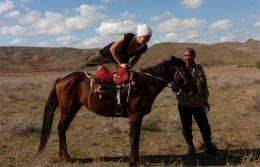
The risk of catching plague is real, and workers in gas and oil stations (which have proliferated in Kazakhstan since the 1960s) are vaccinated against it. When outbreaks occur in nearby villages, the entire village population is also vaccinated.
It used to be a far more serious problem before the 1940s (and antibiotics). The disease killed scores of people every year in Kazakhstan, wiping out whole villages. The former Soviet Union, which controlled the region at the time, cracked down on the disease. Beginning in 1949, it sent teams into the steppes to collect gerbils and fleas to continue to study the causes of plague, determine the extent of the outbreaks - and treat plague outbreaks when necessary.
That information was compiled in a vast archive of handwritten ledgers, forming a goldmine of data on plague for scientists. After the Iron Curtain was lifted in 1992, Professor Herwig Leirs, an ecologist at the University of Antwerp in Belgium, discovered the archive.
Professor Leirs teamed up with Mike Begon, Dr. Stephen Davis and others to take advantage of this rich resource. Analysing the data, they determined that when the gerbil population exceeded a certain threshold (measured by the proportion of burrows occupied), plague outbreaks occur two years later. In a paper published in Science in 2004, they suggested that detecting this 'threshold abundance' can act as an early warning system for the appearance of plague.
Subsequent trialling of the model revealed some flaws, however. "The model is pretty good at saying you really can't expect plague here and getting that right," says Mike. "But it would often tell you you're going to get plague and then you don't. Then the public health people end up wasting time and money controlling it when they don't have to. So as far as they're concerned, they get the wrong answer too often with it."
Jumping rats
With Wellcome Trust funding, Mike, Anne, Stephen and colleagues aim to improve and develop that system. They hope to be able to identify the reasons for these 'false positives' so that they can eliminate them, by collecting new data.
"The 2004 paper was based on analysis of old data. We're now in the business of collecting new data to try to improve the model's predictive power," says Mike.
They will be collecting the new data in two ways: the intensive trapping of gerbils and fleas in the field and, with Dr. Elisabeth Addink and her team at the University of Utrecht, by monitoring burrow occupancy via remote sensing. The vast territory is divided into 36 sectors. Some of these are 'quiet' (identified as such in the 2004 paper) - with little or no plague even when there are enough rodents to warrant an outbreak - but others are active plague sites.
The remote sensing work is partly a proof-of-concept study to ascertain how much data can be collected from satellite imagery. It aims to count not only the number of burrows but also their occupancy status - whether they are occupied, or empty, or visited by individual gerbils. If it proves useful and accurate, it would be an extremely cost-effective method of monitoring burrows and identifying impending high-risk outbreaks.
To collect the new biological data, Anne spent much of last year in Kazakhstan armed with insect repellent and emergency antibiotics, and she will be spending further time there over the next two years, trapping rodents and fleas from both active and 'quiet' sites. Her sites are close to but not overlapping with the satellite sectors, to prevent their physical presence interfering with the remote sensing.
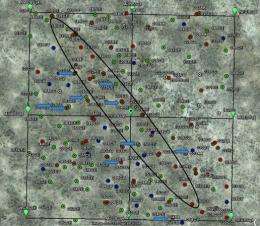
The team will study the new data from the biological field work and remote sensing to identify differences between active and quiet plague sites and ascertain the status of plague at a particular point in time, in a particular place. This will help them get a better handle on its dynamics in the wild.
"Where is plague when we can't see it? That's the essential question we're addressing," says Mike. "We're trying to understand where plague is when it's not obvious, so that we can anticipate it emerging and control it before there's an outbreak."
What are the factors that allow Y. pestis to survive in the environment? Does it completely disappear to be later reintroduced from a distant location? Does it remain present in host reservoirs, within the rat-flea-rat transmission cycle, but at levels too low to be detected?
Does it persist without any reliance on this cycle - perhaps in the soil? If the gerbils come into constant contact with the organism in the soil of their burrows and consequently develop immunity to it, it may explain their greater resistance to the organism. "We don't know the answers to any of these questions," says Anne.
As well as trapping great gerbils, Anne will be collecting other rodents to see whether they are also plague reservoirs. Some - including another giant, a jumping rat aptly nicknamed the 'jumpin' great jerboa' - are almost impossible to trap.
"The Russians focused on the great gerbils. They did collect other rodents, but we want to collect and study them more systematically, to see if they are a repository for plague," she says. "And we're collecting every species of fleas and ticks, because they're all potential vectors, to try and see if we can culture plague out of those as well."
Her team will also be testing the organs of gerbils and other rodents for other infections in the area. "Co-infection can influence the immune status of individuals. So we want to look at other pathogens and how they influence the appearance or dynamics of plague."
Infections they have found to date include the typhoid and Lyme disease bacteria, and they expect to find leishmania. "There is leishmania in the west of the country, but we've got no data on leishmania in that particular part of the country."
As well as shedding more light on the precise factors that reactivate human outbreaks - thereby improving the reliability of the early warning system - they also hope to develop a more cost-effective control system, which would involve focusing control only where it is needed.
"In principle you could control plague by going there and fumigating every burrow in Kazakhstan," says Mike. "But even widespread control is very expensive and uses a huge amount of manpower. It makes more sense to just fumigate the burrows you need to, where occupancy is above the threshold and other conditions are favourable for plague. It's all about using inevitably scarce resources sensibly."
More information: Davis S et al. Predictive thresholds for plague in Kazakhstan. Science 2004;304(5671):736-738.


