Blood cell breakthrough could help treat heart disease
April 27, 2012 in Cardiology

Blood cell breakthrough could help treat heart disease

Enlarge

(Phys.org) -- Scientists at the University of Reading have made a groundbreaking discovery into the way blood clots are formed, potentially leading to the development of new drugs to treat one of the world's biggest killer illnesses.

Cardiovascular disease, which causes heart attacks and strokes, accounts for one in three of all deaths in the UK, often brought about by clots blocking major , preventing critical to the heart or brain.

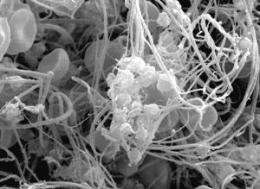
Now researchers at the Institute for Cardiovascular and Metabolic Research (ICMR) at the University of Reading have uncovered, for the first time, the mechanism by which platelets, the that cause clots, ‘communicate' with each other and the inner walls of blood vessels when clotting.

The clotting process helps the body to repair itself and stops wounds from bleeding. But inappropriate activation of platelets leads to the formation of clots in the bloodstream (thrombosis), which can lead to a potentially fatal or stroke.

Currently, doctors treating heart disease can administer drugs which reduce the tendency of the blood to clot, and therefore decrease the risk of thrombosis.  However, such anti-thrombotic drugs are not effective for some patients, and can cause dangerous side-effects.

Professor Jonathan Gibbins and Dr. Sakthivel Vaiyapuri have headed up an international team of researchers that have discovered how platelets use specialised pore-like structures, called gap junctions, allowing direct communication between the cells. These structures have  been studied previously in other cells that are in constant contact with each other, but the researchers said their role in platelets was a ‘big surprise'.

The scientists, whose findings are published online in the journal Circulation, conclude that the discovery could lead to the creation of innovative to prevent or treat thrombosis.

Professor Gibbins said: "This appears to be a very important communication mechanism for blood clotting and thrombosis.  Since we have found that molecules that block these channels reduce thrombosis this may pave the way for potential new avenues for the development of more effective anti-thrombotic therapies to prevent heart attacks and strokes."

Dr. Vaiyapuri said: "Although this area of platelet research is still in its early stages, this is an exciting discovery.  The pore proteins have important functions in a range of cell types in the body, and therefore in the future it will be important to consider how to modulate the opening and closing of the pores specifically in platelets. "

Provided by University of Reading search and more info website

5 /5 (1 vote)  

Rank 5 /5 (1 vote)
Related Stories
Relevant PhysicsForums posts

More news stories

Dual-source cardiac CT IDs CAD in hard-to-image patients

(HealthDay)—In patients who have previously been considered difficult to image, dual-source cardiac (DSC) computed tomography (CT) can identify clinically significant coronary artery disease, according ...

Cardiology created 13 hours ago | popularity not rated yet | comments 0

Death rates decline for advanced heart failure patients, but outcomes are still not ideal

UCLA researchers examining outcomes for advanced heart-failure patients over the past two decades have found that, coinciding with the increased availability and use of new therapies, overall mortality has decreased and sudden ...

Cardiology created 15 hours ago | popularity not rated yet | comments 0

Second-generation TAVI device—Lotus Valve—shows good performance in REPRISE II

22 May 2013, Paris, France: The Lotus Valve, a second-generation transcatheter aortic valve implantation (TAVI) device, was successfully implanted in all of the first 60 patients in results from REPRISE II reported at EuroPCR ...

Cardiology created 20 hours ago | popularity not rated yet | comments 0

Costs to treat stroke in America may double by 2030

Costs to treat stroke are projected to more than double and the number of people having strokes may increase 20 percent by 2030, according to the American Heart Association/American Stroke Association.

Cardiology created May 22, 2013 | popularity not rated yet | comments 0

New blood-thinner measures may cut medication errors

Blood thinners are the preferred treatment option to prevent heart attacks, blood clots and stroke, but they are not without risk, and not just because of their side effects. These high-risk drugs, known as anticoagulants, ...

Cardiology created May 22, 2013 | popularity not rated yet | comments 0


WHO voices deep concern over spread of SARS-like virus

The World Health Organization voiced deep concern Thursday over the SARS-like virus that has killed 22 people in less than a year, saying it might potentially spread more widely between humans.

Study: No higher cancer rate at Conn. Pratt plant

(AP)—Researchers examining the incidence of brain cancer at jet engine manufacturer Pratt & Whitney in Connecticut say they have found no statistically significant elevations in the rate of cancer among workers.

Controlling mood through the motions of mitochondria

(Medical Xpress)—Regulating the distribution of power in neurons is done by a system that makes the national electric grid look simple by comparison. Each neuron has several thousand mitochondria confined ...

Obesity weighs down on top soda guzzler Mexico

Artemio Martinez balanced his corpulent frame on a stool in a Mexico City street taco stand, downing a sweet soda and eating a final pork-filled corn tortilla.

Hormone replacement therapy—clarity at last

The British Menopause Society and Women's Health Concern have today released updated guidelines on Hormone Replacement Therapy (HRT) to provide clarity around the role of HRT, the benefits and the risks. The new guidelines ...

Motion quotient: IQ predicted by ability to filter motion (w/ video)

A brief visual task can predict IQ, according to a new study. This surprisingly simple exercise measures the brain's unconscious ability to filter out visual movement. The study shows that individuals whose ...