Health care debate: high stakes for those with HIV
(AP) -- For many HIV-positive Americans, and those who advocate on their behalf, these are days of anxious waiting as the Supreme Court ponders President Barack Obama's health care overhaul.
This loose-knit community - made up of activists, health professionals and an estimated 1.2 million people living with HIV - has invested high hopes in the Affordable Care Act, anticipating that it could dramatically improve access to lifesaving care and treatment. The act is now in limbo as the high court deliberates on its constitutionality, notably its requirement that most Americans obtain health insurance. A ruling could come in June.
"The HIV treatment community sees the act as a critical step in our fight against the AIDS epidemic," said Scott Schoettes of Lambda Legal, a national gay-rights advocacy group. "People have been counting on it, making plans based on its implementation, so for it to be pulled out from under their feet at this point would be a tremendous loss."
Among its many provisions, the health care law has two major benefits for HIV-positive people: It expands Medicaid so that those with low incomes can get earlier access to treatment, and it eliminates limits on pre-existing conditions that have prevented many people with HIV from obtaining private insurance.
Under current policies, low-income HIV-positive people often do not qualify for Medicaid if they are not yet sick enough to be classified as disabled.
In the view of advocacy groups, this creates a cruel Catch 22 - at a stage when they are still active and productive, these people can't afford the antiretroviral treatments that could help them stay that way. Only when their condition worsens are they able to qualify for Medicaid and get treatment that might have prevented the deterioration.
The health care act would remove the disability requirement and makes Medicaid available to a broader range of low-income adults.
"It will prolong life potentially by decades for literally hundreds of thousands of persons," said the National Minority AIDS Council in its Supreme Court brief. "Individuals can continue to work and go about their daily lives as productive members of society."
According to the Department of Health and Human Services, only about 13 percent of people with HIV have private health insurance and about 24 percent have no coverage at all. As a group, HHS says, these people "have been particularly vulnerable to insurance industry abuses" and face barriers to obtaining care from qualified providers.
Under the new law, insurers cannot rescind existing coverage to adults unless there's evidence of fraud. As if 2014, when the law is scheduled for full implementation, insurers will not be allowed to deny coverage to anyone with HIV/AIDS or impose annual limits on coverage.
Schoettes, who is Lambda Legal's HIV Project director and is HIV-positive himself, says this part of the law would curtail harmful insurance practices.
"Most private insurers have refused to provide affordable coverage to those with HIV," he and other Lambda Legal lawyers wrote in a brief submitted to the Supreme Court in March.
"This market failure has caused serious consequences both for individuals with HIV - who suffer unnecessary illness and premature death - and for society generally in higher overall health care costs and lost productivity," the lawyers wrote. "Virtually all this suffering is avoidable: medical care is available that can turn HIV into a chronic, manageable condition."
America's Health Insurance Plans, which represents major private health insurers, opposed Obama's health care law. The trade group says it supports expanding coverage to most Americans but believes key provisions in the law are poorly designed and will raise costs and cause disruptions.
The organization's spokesman, Robert Zirkelbach, acknowledged that under the current system, individuals with HIV or AIDS do find it hard to obtain private coverage if they already had the disease. "If people wait until after they're sick, they're often not able to get it," he said.
However, he said health plans were active in trying to improve treatment and care for HIV-positive Americans, both their own clients and others. He said insurers did sometimes rescind coverage on grounds that a patient had not fully disclosed required information, but that such instances were rare.
Among HIV-positive people without private insurance, many rely on public programs such as Medicaid and Medicare, but others are not eligible. As a last resort, if they meet the low-income criteria, they can seek financial assistance through the federal Ryan White Care Act.
However, advocates say the result is often patchwork health care - or no care at all. Many uninsured people don't get tested, don't know their HIV status and unwittingly transmit the infection to others.
Antiretroviral treatment is expensive - often more than $18,000 per year. But advocacy groups say treatment is cost-effective, enabling more people to be self-sufficient and reducing later spending on acute care and stays at hospices.
Advocacy groups also contend that the positive effects of the federal health care act can be foretold by the experience of Massachusetts, which adopted similar legislation in 2006. According to a study last year by Harvard Law School's Center for Health Law and Policy Innovation, new HIV infections dropped by 37 percent in Massachusetts from 2005 to 2008, while rising by 8 percent in the rest of U.S.
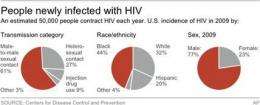
By federal estimate, about 50,000 new cases of HIV infection occur annually in the United States. The Centers for Disease Control's latest figures show that gay and bisexual men account for about 60 percent of the new infections; blacks also are affected disproportionately, accounting for about 13 percent of the population and about 44 percent of new HIV infections.
The CDC also says the HIV infection rate in poor urban areas is far higher than for the rest of the U.S. - and is on par with the rate in such AIDS-devastated countries as Haiti and Angola.
"HIV is a disease of poverty," said Dr. Michael Saag, an HIV physician and researcher at the University of Alabama at Birmingham. "That's why the health care law is critically important."
In Alabama, he said, funding to provide HIV treatment for low-income people has not risen to meet growing demand, and clinics lack adequate staff and resources.
"Once on treatment, transmission of HIV is cut to almost zero - but where do these people get treatment?" Saag asked. "The question to people who are against the Affordable Care Act is, `What are we going to do instead?'"
Saag is a past chairman of the HIV Medicine Association, representing more than 4,800 health care professionals and researchers. The current chair, Dr. Judith Aberg of the New York University School of Medicine, recently pleaded for the health care law to be upheld.
"For the first time in 30 years, thanks to advances in HIV prevention and treatment research, we can realistically envision the end of the greatest pandemic of our time," she said. "To reach this goal, we cannot afford to take any steps backward."
In Illinois, state Rep. Greg Harris, who is HIV-positive, has joined with colleagues in fighting to minimize funding cuts for the AIDS Drug Assistance Program, a joint state-federal initiative providing HIV medications to low-income people.
Harris believes the Affordable Care Act can be a huge help in providing more HIV-positive people with health insurance. Were it to be rejected by the Supreme Court, he said, "It would take away a lot of hope for a lot of people."
More information: Health and Human Services fact sheet: http://1.usa.gov/snPcYA
Lambda Legal's Supreme Court brief: http://bit.ly/zOyeER
©2012 The Associated Press. All rights reserved. This material may not be published, broadcast, rewritten or redistributed.


