Modest alcohol consumption lowers risk and severity of liver disease
April 19, 2012 in Addiction

Modest alcohol consumption lowers risk and severity of liver disease

Enlarge

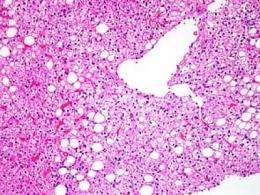
Two forms of nonalcoholic fatty liver disease (NAFLD) are depicted in these images of liver biopsies from adults, taken from this study. The first shows nonalcoholic fatty liver only. Credit: Elizabeth Brunt, M.D., of Washington University in Saint Louis.

People with nonalcoholic fatty liver disease (NALFD) who consume alcohol in modest amounts – no more than one or two servings per day – are half as likely to develop hepatitis as non-drinkers with the same condition, reports a national team of scientists led by researchers at the University of California, San Diego School of Medicine.

NALFD is the most common liver disease in the United States, affecting up to one third of American adults. It's characterized by abnormal fat accumulation in the liver. The specific cause or causes is not known, though obesity and diabetes are risk factors. Most patients with NAFLD have few or no symptoms, but in its most progressive form, known as nonalcoholic steatohepatitis or NASH, there is a significantly heightened risk of cirrhosis, liver cancer and liver-related death.

NALFD is also a known risk factor for cardiovascular disease (CVD). Patients with NAFLD are approximately two times more likely to die from coronary heart disease than from liver disease. The study's authors wanted to know if the well-documented heart-healthy benefits of modest consumption outweighed alcohol's negative effects.
Modest alcohol consumption lowers risk and severity of liver disease
Enlarge

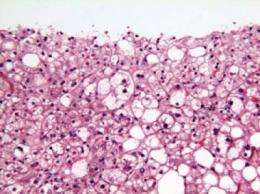
The second shows nonalcoholic steatohepatitis (NASH), a more serious condition with potential to progress to cirrhosis. Credit: Elizabeth Brunt, M.D., of Washington University in Saint Louis.

"We know a 50-year-old patient with NAFLD has a higher risk of CVD," said Jeffrey Schwimmer, MD, associate professor of clinical pediatrics at UC San Diego, director of the Fatty Liver Clinic at Rady Children's Hospital-San Diego and senior author. "Data would suggest modest alcohol consumption would be beneficial (in reducing the patient's CVD risk) if you don't take liver disease into account. When you do take liver disease into account, however, the usual medical recommendation is no alcohol whatsoever."

Schwimmer and colleagues discovered that the benefits of modest alcohol consumption were compelling, at least in terms of reducing the odds of patients with NAFLD from developing more severe forms of the disease. Patients with NASH are 10 times more likely to progress to cirrhosis, the final phase of chronic liver disease. Cirrhosis is the 12th leading cause of death in the U.S., killing an estimated 27,000 Americans annually.

"Our study showed that those people with modest alcohol intake – two drinks or less daily – had half the odds of developing NASH than people who drank no alcohol," said Schwimmer. "The reasons aren't entirely clear. It's known that alcohol can have beneficial effects on lipid levels, that it increases 'good' cholesterol, which tends to be low in NAFLD patients. Alcohol may improve insulin sensitivity, which has a role in NAFLD. And depending upon the type of alcohol, it may have anti-inflammatory effects."

The study also found that in patients with NAFLD, modest drinkers experienced less severe liver scarring than did lifelong non-drinkers.

The study did not evaluate the effects of different types of alcohol, such as beer or spirits. Schwimmer said to do so would require a much larger study. Also, the study's findings do not apply to children. All of the participants in the study were age 21 and older.

The current paper is based on analyses of 600 liver biopsies of patient's with NAFLD by a national panel of pathologists who had no identifying clinical information about the samples. The study excluded anyone who averaged more than two alcoholic drinks per day or who reported consuming five or more drinks in a day (binge-drinking) at least once a month. All of the patients were at least 21 years of age.

Schwimmer said the findings indicate patients with liver disease should be treated individually, with nuance.

"For a patient with cirrhosis or viral hepatitis, the data says even small amounts of alcohol can be bad. But that may not be applicable to all forms of . Forty million Americans have NAFLD. Physicians need to look at their patient's overall health, their CVD risk, their liver status, whether they're already drinking modestly or not. They need to put all of these things into a framework to determine risk. I suspect modest will be an appropriate recommendation for many patients, but clearly not all."

The findings are published in the April 19, 2012 online issue of The Journal of Hepatology.

Provided by University of California - San Diego search and more info website

not rated yet  

Rank not rated yet
Relevant PhysicsForums posts

More news stories

Beer-industry advertising guidelines: Rating panels may help industry assess itself

In order to avoid exposing vulnerable groups such as children and young adults to alcohol advertising, industry groups have developed their own self-regulation guidelines. However, these guidelines have been criticized for ...

Addiction created May 17, 2013 | popularity not rated yet | comments 0

College women exceed NIAAA drinking guidelines more frequently than college men

In order to avoid harms associated with alcohol consumption, in 2009 the National Institute on Alcohol Abuse and Alcoholism issued guidelines that define low-risk drinking. These guidelines differ for men and women: no more ...

Addiction created May 17, 2013 | popularity not rated yet | comments 0 | with audio podcast

Individuals who drink heavily and smoke may show 'early aging' of the brain

Treatment for alcohol use disorders works best if the patient actively understands and incorporates the interventions provided in the clinic. Multiple factors can influence both the type and degree of neurocognitive abnormalities ...

Addiction created May 17, 2013 | popularity not rated yet | comments 0 | with audio podcast

Researchers analyze how Spanish smoking relapse booklets are distributed

Researchers from Moffitt Cancer Center and the University of South Florida have evaluated how Florida health care and social service agencies distribute "Libres para Siempre", a Spanish smoking relapse prevention booklet ...

Addiction created May 17, 2013 | popularity not rated yet | comments 0

No significant change seen in overall smokeless tobacco use among US youths

Tobacco use remains the leading preventable cause of death and disease in the United States. Declines in smoking among youths were observed from the late 1990s. "However, limited information exists on trends in smokeless ...

Addiction created May 14, 2013 | popularity not rated yet | comments 0


First long-term study reveals link between childhood ADHD and obesity

A new study conducted by researchers at the Child Study Center at NYU Langone Medical Center found men diagnosed as children with attention-deficit/hyperactivity disorder (ADHD) were twice as likely to be obese in a 33-year ...

Computer model predicts when viruses become infectious

A new computer model could help scientists predict when a particular strain of avian influenza might become infectious from bird to human, according to a report to be published in the International Journal Data Mining an ...

Atherosclerotic disease heredity mapped in nationwide study

Researchers at Lund University in Sweden have mapped the significance of heredity for common forms of atherosclerotic disease. No studies have previously examined whether different forms of the disease share heredity.

Germ-fighting vaccine system makes great strides in delivery

A novel vaccine study from South Dakota State University (SDSU) will headline the groundbreaking research that will be unveiled at the American Association of Pharmaceutical Scientists' (AAPS) National Biotechnology Conference ...

Diabetes drug tested in Parkinson's disease patients

Parkinson's disease (PD) is a degenerative neurological disorder marked by a progressive loss of motor control. Despite intensive research, there are currently no approved therapies that have been demonstrated to alter the ...

Impossible to predict outcome in China's bird flu outbreak, WHO says

It is impossible to predict the evolution of China's human H7N9 bird flu outbreak as researchers are still trying to understand the source of human transmission, the head of the World Health Organisation said Monday.