Preventing problems after cancer
April 12, 2012 By Raquel Maurier in Cancer
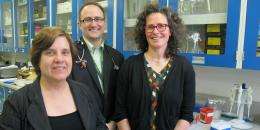
(from left) U of A medical researchers Lesley Mitchell and Maury Pinsk with Lisa McDermott, whose daughter went through cancer treatment and had blood-clot complications
Medical researchers at the University of Alberta are part of a national team that has one common visionto prevent long-term complications from childhood cancer treatment.
The researchers will initially test blood samples of those who survived childhood cancer to see which genetic biomarkers made the survivors more susceptible to developing common post-cancer complications, such as blood clots, hearing loss, kidney failure or bone marrow transplant rejection. In the fifth and final year of funding of the $4.3-million grant, researchers will start a pilot study in which children deemed to be at risk of these complications will be given medications to prevent the noted health problems. Ultimately, the researchers hope to screen all children with cancer before their treatment starts, in hopes of preventing the complications in the first place.
Each team across the country is recruiting patients for each arm of the study. And each site has a principal investigator who is the national lead in charge of one specific aspect of the research. In Edmonton, principal investigator Lesley Mitchell is in charge of the research arm zeroing in on blood clots. She is a researcher and an associate professor in the Department of Pediatrics with the Faculty of Medicine & Dentistry and an adjunct associate professor with the School of Public Health. She notes that children who have had cancer are one of the largest groups of children to suffer from blood clots, a side-effect of the cancer and the treatment.
Twenty to 30 years ago children didnt survive cancer, says Mitchell, who has spent more than 20 years researching the issue of blood clots in children who have this disease. Thanks to advances in pediatric medicine and research, children are surviving cancer, but they are living with long-term complications of treatment for the disease. We want to help these children and prevent these complications from happening in the first place.
This video is not supported by your browser at this time.
Lesley Mitchell and Maury Pinsk describe their research
Some children who suffer from blood clots can have symptoms such as swelling or passing out. Others dont exhibit any symptoms at all, such as one child whose multiple veins to his heart had been completely blocked by blood clots, so the body created numerous additional veins to the heart to keep blood flowing. But the problem, says Mitchell, is that these newly created veins dont work as well as the original ones. Blood clots can lead to complications later in life such as being at risk for developing multiple clots and rupturing of the newly created veins.
Pediatric oncologist Maria Spavor, an Edmonton co-investigator and assistant clinical professor with the Department of Pediatrics, will be involved in enrolling child and adult patients for all arms of the study through her role as medical director of the Kids With Cancer Society Survivor Program, a multidisciplinary Edmonton clinic that follows survivors of childhood cancer. The clinic provides lifelong screening and support for survivors, assisting them with the long-term medical and psychosocial complications of cancer treatment.
"Late complications of cancer treatment are a reality for so many survivors of childhood cancer, says Spavor. Our hope is that we will reduce the significant impact these complications cause in their lives, ultimately giving every survivor the quality of life they so deserve."
Maury Pinsk, another Edmonton co-investigator, is based in pediatric nephrology and is an associate professor in the Department of Pediatrics. He will lead the kidney-failure part of the study in Edmonton.
Kidney injury from the medicines used to treat cancer is not well recognized in pediatric cancer unless children end up with complete kidney failure on dialysis, he says.
The $4.3-million grant was jointly funded by the Canadian Institutes of Health Research (CIHR), the C17 Research Network in Edmonton, the Canadian Cancer Society, the Hospital for Sick Children in Toronto, and the Pediatric Oncology Group of Ontario.
Overall, CIHR and other funding organizations have invested $12 million to support the work of four different research teams across Canada.
Provided by
University of Alberta
-
Childhood cancer survivors at higher risk for future GI complications
May 20, 2011 |
not rated yet |
0
-
Preventive use of blood thinners by cancer patients could save lives, cut costs
Dec 13, 2011 |
not rated yet |
0
-
Kids born with HIV growing up well
Apr 21, 2011 |
not rated yet |
0
-
Childhood cancer survivors face long-term risk of GI complications, study finds
Oct 22, 2010 |
not rated yet |
0
-
Most cancer-related blood clots occur in outpatients
Dec 13, 2011 |
not rated yet |
0
-
Motion perception revisited: High Phi effect challenges established motion perception assumptions
Apr 23, 2013 |
3 / 5 (2) |
2
-
Anything you can do I can do better: Neuromolecular foundations of the superiority illusion (Update)
Apr 02, 2013 |
4.5 / 5 (11) |
5
-
The visual system as economist: Neural resource allocation in visual adaptation
Mar 30, 2013 |
5 / 5 (2) |
9
-
Separate lives: Neuronal and organismal lifespans decoupled
Mar 27, 2013 |
4.9 / 5 (8) |
0
-
Sizing things up: The evolutionary neurobiology of scale invariance
Feb 28, 2013 |
4.8 / 5 (10) |
14
-
Why is zone 1 in liver more prone to ischemic injury?
May 23, 2013
-
How can there be villous adenoma in colon, if there are no villi there
May 22, 2013
-
How can there be a term called "intestinal metaplasia" of stomach
May 21, 2013
-
Pressure-volume curve: Elastic Recoil Pressure don't make sense
May 18, 2013
-
If you became brain-dead, would you want them to pull the plug?
May 17, 2013
-
MRI bill question
May 15, 2013
- More from Physics Forums - Medical Sciences
More news stories
Scientists put bowel cancer under the microscope
Researchers from London's Kingston University have begun a two-year study which could help prolong the lives of people with colorectal tumours.
Cancer
1 hour ago |
5 / 5 (1) |
0
Researcher identifies breast cancer fighting hormone
Transformative research from Western University has identified new hormones in the body which may suppress breast cancer and stimulate the regression of breast tumors.
Cancer
2 hours ago |
5 / 5 (1) |
0
Ground breaking cancer research finds immune system link
(Medical Xpress)—Curtin University researchers have found evidence that targeting specific cells in the body can reverse the effects of cancer on the immune system.
Cancer
2 hours ago |
5 / 5 (2) |
0
How the EU could help more children survive cancer
A leading expert in childhood cancer at The University of Nottingham is spearheading a Europe-wide lobby of the European Parliament to try to make it easier for doctors to develop and test new treatments on children and young ...
Cancer
3 hours ago |
not rated yet |
0
Study: No higher cancer rate at Conn. Pratt plant
(AP)—Researchers examining the incidence of brain cancer at jet engine manufacturer Pratt & Whitney in Connecticut say they have found no statistically significant elevations in the rate of cancer among workers.
Cancer
4 hours ago |
not rated yet |
0
Saudi to send animal samples to US in coronavirus probe
Saudi Arabia said Friday it would send samples taken from animals possibly infected with a deadly SARS-like virus to the United States for testing in a bid to find the source of disease.
Engineered cytomegalovirus protects monkeys from HIV equivalent
(Medical Xpress)—A new study by researchers in the US has shown that an ancient virus can be modified to help in the fight against the simian immunodeficiency virus SIV, which is the equivalent in monkeys ...
New neuron formation could increase capacity for new learning, at the expense of old memories
New research presented today shows that formation of new neurons in the hippocampus - a brain region known for its importance in learning and remembering - could cause forgetting of old memories by causing a reorganization ...
Are there atheists in foxholes? Study says they're the minority
Ernie Pyle – an iconic war correspondent in World War II – reportedly said "There are no atheists in foxholes." A new joint study between two brothers at Cornell and Virginia Wesleyan found that only ...
Help at hand for people with schizophrenia
How can healthy people who hear voices help schizophrenics? Finding the answer for this is at the centre of research conducted at the University of Bergen.
Do doctors understand the individualisation of treatments?
The individualisation of drug treatments to support patients to self-manage their conditions is a concept that sits at the heart of policy, but a recent study in BMJ Open shows that there is no concrete defini ...