You, revealed: 'X-Rays of the Soul' examines history, influence of Rorschach test
April 3, 2012 By Peter Reuell in Psychology & Psychiatry
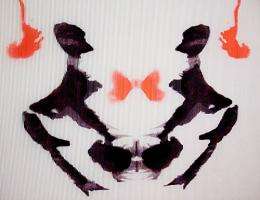
The Rorschach test (pictured), and the Thematic Apperception Test, developed at Harvard in 1935, present subjects with ambiguous images or situations, and analyze their responses for clues to hidden emotions and mental states.
With the creation, in 1921, of the Rorschach inkblot test, psychologists and researchers had at their disposal a tool that might offer access to the inner life or secret self of a subject: the projective test.
A new exhibition at Harvards Collection of Historical Scientific Instruments, X-Rays of the Soul: Rorschach and the Projective Test, tells the story of the triumphal rise, and periodic setbacks, of the projective test movement, and portrays the heady confidence that science could be used to extract and access the most human parts of human beings.
As opposed to objective tests, which compare a subjects responses with an accepted set of correct answers, the Rorschach test, and the Thematic Apperception Test (TAT), developed at Harvard in 1935, present subjects with ambiguous images or situations, and analyze their responses for clues to hidden emotions and mental states.
Visitors to the exhibition are immediately confronted with a projection of a Rorschach inkblot and analysis of subjects responses to the image. Other displays include examples of responses from people who are depressed, suicidal, or victims of trauma.
The rest of the exhibition is separated into two sections one devoted to the Rorschach test, which includes examples of other inkblot analyses and how the Rorschach test has been portrayed in popular culture; the other devoted to storytelling tests like the TAT.
At the back of the exhibition space, a projective theater will play excerpts of the 1946 film The Dark Mirror, about twin sisters who take the Rorschach test in an effort to determine which committed a murder. Clips of researchers discussing the TAT test will also be shown.
Telling stories based on inkblots started as a parlor game in the 19th century, said Jean-Francois Gauvin, lecturer on the history of science and director of administration at the Collection of Historical Scientific Instruments. It was Rorschach who saw their potential and made them into an instrument that might capture, as the exhibition title says, an X-ray of the soul.
The exhibition will be on display in the Special Exhibitions Gallery, Room 251 of the Science Center, through June 30.
More information: www.fas.harvard.ed… i_xrays.html
Provided by
Harvard University
This story is published courtesy of the Harvard Gazette, Harvard University's official newspaper. For additional university news, visit Harvard.edu.
-
Invisible ink? What Rorschach tests really tell us
Jul 30, 2009 |
not rated yet |
0
-
Responses shift when changing languages
Nov 03, 2010 |
not rated yet |
0
-
To 'think outside the box', think outside the box
Jan 19, 2012 |
not rated yet |
0
-
Is there a hidden bias against creativity?
Nov 18, 2011 |
not rated yet |
0
-
Are we bad at forecasting our emotions? It depends on how you measure accuracy
Jan 26, 2012 |
not rated yet |
0
-
Motion perception revisited: High Phi effect challenges established motion perception assumptions
Apr 23, 2013 |
3 / 5 (2) |
2
-
Anything you can do I can do better: Neuromolecular foundations of the superiority illusion (Update)
Apr 02, 2013 |
4.5 / 5 (11) |
5
-
The visual system as economist: Neural resource allocation in visual adaptation
Mar 30, 2013 |
5 / 5 (2) |
9
-
Separate lives: Neuronal and organismal lifespans decoupled
Mar 27, 2013 |
4.9 / 5 (8) |
0
-
Sizing things up: The evolutionary neurobiology of scale invariance
Feb 28, 2013 |
4.8 / 5 (10) |
14
-
Why is zone 1 in liver more prone to ischemic injury?
May 23, 2013
-
How can there be villous adenoma in colon, if there are no villi there
May 22, 2013
-
How can there be a term called "intestinal metaplasia" of stomach
May 21, 2013
-
Pressure-volume curve: Elastic Recoil Pressure don't make sense
May 18, 2013
-
If you became brain-dead, would you want them to pull the plug?
May 17, 2013
-
MRI bill question
May 15, 2013
- More from Physics Forums - Medical Sciences
More news stories
Storm chasers: born to be wild?
(HealthDay)—We've all seen them: the surfers who race to the beach when a hurricane hits, the guy who decides to ride out the storm in his overmatched boat, the tornado chasers who fearlessly steer their ...
Psychology & Psychiatry
10 hours ago |
not rated yet |
0
Hormone levels may provide key to understanding psychological disorders in women
Women at a particular stage in their monthly menstrual cycle may be more vulnerable to some of the psychological side-effects associated with stressful experiences, according to a study from UCL.
Psychology & Psychiatry
11 hours ago |
5 / 5 (2) |
0
|
Are there atheists in foxholes? Study says they're the minority
Ernie Pyle – an iconic war correspondent in World War II – reportedly said "There are no atheists in foxholes." A new joint study between two brothers at Cornell and Virginia Wesleyan found that only ...
Psychology & Psychiatry
13 hours ago |
2.5 / 5 (4) |
1
Breathing exercises help veterans find peace after war, scholar says
(Medical Xpress)—Research by Stanford scholar Emma Seppala at the Center for Compassion and Altruism Research and Education found that post-traumatic stress disorder decreased in veterans who participated ...
Psychology & Psychiatry
14 hours ago |
5 / 5 (1) |
0
Depression raises diabetics' risk of severe low blood sugar episodes
(Medical Xpress)—Patients with diabetes who are depressed are much more likely to develop episodes of dangerously low blood sugars, or hypoglycemia, than are those who are not depressed, a new study has ...
Psychology & Psychiatry
15 hours ago |
not rated yet |
0
|
Engineered cytomegalovirus protects monkeys from HIV equivalent
(Medical Xpress)—A new study by researchers in the US has shown that an ancient virus can be modified to help in the fight against the simian immunodeficiency virus SIV, which is the equivalent in monkeys ...
Researchers identify first drug targets in childhood genetic tumor disorder
Two mutations central to the development of infantile myofibromatosis (IM)—a disorder characterized by multiple tumors involving the skin, bone, and soft tissue—may provide new therapeutic targets, according to researchers ...
Going live: Immune cell activation in multiple sclerosis
Biological processes are generally based on events at the molecular and cellular level. To understand what happens in the course of infections, diseases or normal bodily functions, scientists would need to ...
Driving and hands-free talking lead to spike in errors, study shows
Talking on a hands-free device while behind the wheel can lead to a sharp increase in errors that could imperil other drivers on the road, according to new research from the University of Alberta.
Help at hand for people with schizophrenia
How can healthy people who hear voices help schizophrenics? Finding the answer for this is at the centre of research conducted at the University of Bergen.
Comorbidities common with alopecia areata
(HealthDay)—Comorbid conditions often accompany alopecia areata, according to a study published online May 22 in JAMA Dermatology.