Hope for Romania baby born with stunted intestines
April 5, 2012 By ALISON MUTLER , Associated Press in Other
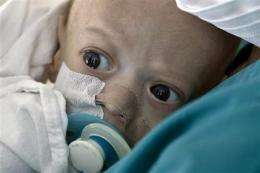
This March 27, 2012 file photo shows Baby Andrei, eight-month-old, the son of Roma under-age parents, in the arms of a nurse in the intensive care unit of the Marie Curie children's hospital Bucharest, Romania. Baby Andrei was born with almost no intestines, and has confounded medical opinion by still being alive, and even kicking, 8 months later. Now there's hope for another miracle. The Romanian infant has received offers for a complicated intestine transplant, an operation not performed on babies in Europe, from Harvard and Boston, said the Romanian pediatrician who is in charge of caring for Andrei. (AP Photo/Vadim Ghirda)
(AP) -- Baby Andrei has confounded doctors just by being alive: The tiny boy with twig-thin limbs was given just days to live when he was born with almost no intestines - eight months ago.
Now there's hope for another miracle.
Harvard University and hospitals in Boston have offered to help Andrei get a complicated intestine transplant that isn't performed on babies in Europe, the Romanian pediatrician in charge of the baby's care said Thursday.
The offers came after an Associated Press story last week chronicled how Dr. Catalin Cirstoveanu, head of the neonatal unit at Bucharest's Marie Curie children's hospital, flies babies abroad for lifesaving surgery to get around a culture of corruption in which many doctors won't operate unless they're bribed.
AP photographs of Andrei in his incubator generated sympathy around the world, and the doctor said people in Europe and the U.S. have reached out with offers to help fund the expensive surgery.
"Offers of help have come in, particularly from abroad, from a non-governmental organization, and from Boston and Harvard," Cirstoveanu said. "We need to get ID papers, contact his parents, and send faxes and see what is our best option."
The cost of the surgery goes into the hundreds of thousands of dollars, way out of the reach of Andrei's underage Gypsy parents, who live in a poor part of eastern Romania. Romania's average monthly salary is (EURO)350 ($460).
The bribery culture in Romanian hospitals is so ingrained that nurses expect bribes just to change sheets. Surgeons can get hundreds of euros (dollars) and upward for an operation, while anesthetists get roughly a third of that.
Cirstoveanu runs the cardio unit at Marie Curie. But its state-of-the-art machinery has lain idle because he has banned staff from taking bribes. So he flies sick babies to western Europe on budget flights so they can get treatment from doctors who won't expect kickbacks.
Andrei, who still weighs less than an average newborn, has just 10 centimeters (4 inches) of intestine, compared to about three meters (yards) for other babies his age. Like them, he has started teething.
He has captured the hearts of his nurses, some of whom played the lottery to try to raise the money needed for surgery in the U.S., which Cirstoveanu hopes the infant will now get for free.
Andrei's parents, who live hundreds of kilometers (miles) away, rarely visit. Nurses take turns cuddling the bony baby, who loves human contact and screws up his face and wails when put back in his incubator.
Andrei's alert gaze and keen interest in the world around him appear at odds with his frail, shrunken frame of just 2.8 kilograms (6.16 pounds). He has grown less than one kilogram (2.2 pounds) since he was born premature on July 27 in the small town of Tecuci.
"He has no muscles or fat on him, but gets annoyed when no attention is paid to him," said Cirstoveanu, who personally oversees the sick baby's development.
Without surgery, he said, Andrei could expect to live for "one, two, three months."
Andrei's parents all but despaired of saving their son when they approached Cirstoveanu for help.
Now, it seems possible.
"He should have been dead by now, but he has another chance," Cirstoveanu said. "But he needs this operation soon. It is very urgent."
©2012 The Associated Press. All rights reserved. This material may not be published, broadcast, rewritten or redistributed.
-
LA hospital prepares to send tiny baby home
Jan 20, 2012 |
not rated yet |
0
-
Romania, Bulgaria have EU's sickest health systems
Aug 23, 2010 |
not rated yet |
0
-
Tiny baby leaves Los Angeles hospital amid fanfare
Jan 21, 2012 |
not rated yet |
0
-
Palm-sized baby among the world's smallest
Dec 15, 2011 |
not rated yet |
0
-
Formula-fed preemies at higher risk for dangerous GI condition than babies who get donor milk
May 01, 2011 |
not rated yet |
0
-
Motion perception revisited: High Phi effect challenges established motion perception assumptions
Apr 23, 2013 |
3 / 5 (2) |
2
-
Anything you can do I can do better: Neuromolecular foundations of the superiority illusion (Update)
Apr 02, 2013 |
4.5 / 5 (11) |
5
-
The visual system as economist: Neural resource allocation in visual adaptation
Mar 30, 2013 |
5 / 5 (2) |
9
-
Separate lives: Neuronal and organismal lifespans decoupled
Mar 27, 2013 |
4.9 / 5 (8) |
0
-
Sizing things up: The evolutionary neurobiology of scale invariance
Feb 28, 2013 |
4.8 / 5 (10) |
14
-
Classical and Quantum Mechanics via Lie algebras
Apr 15, 2011
- More from Physics Forums - Independent Research
More news stories
ACP issues recommendations for management of high blood glucose in hospitalized patients
High blood glucose is associated with poor outcomes in hospitalized patients, and use of intensive insulin therapy (IIT) to control hyperglycemia is a common practice in hospitals. But the recent evidence does not show a ...
Other
8 hours ago |
not rated yet |
0
Future doctors unaware of their obesity bias
Two out of five medical students have an unconscious bias against obese people, according to a new study by researchers at Wake Forest Baptist Medical Center. The study is published online ahead of print in the Journal of ...
Other
14 hours ago |
not rated yet |
0
Plastic realistic: Medical students to use plastinated human bodies for anatomy learning
Nanyang Technological University's (NTU) new medical school will be pioneering the use of plastinated bodies for medical education in Singapore.
Other
23 hours ago |
not rated yet |
0
Survey points out deficiencies in addictions training for medical residents
A 2012 survey of internal medicine residents at Massachusetts General Hospital (MGH) – one of the nation's leading teaching hospitals – found that more than half rated the training they had received in addiction and other ...
Other
May 22, 2013 |
5 / 5 (1) |
0
Early use of tracheostomy for mechanically ventilated patients not associated with improved survival
For critically ill patients receiving mechanical ventilation, early tracheostomy (within the first 4 days after admission) was not associated with an improvement in the risk of death within 30 days compared to patients who ...
Other
May 21, 2013 |
not rated yet |
0
Alzheimer's disease, the soft target of the euthanasia debate
(Medical Xpress)—The way Alzheimer's disease is portrayed by advocacy groups and the media is having undue influence on the euthanasia debate, according to a Deakin University nursing ethics professor.
Depression raises diabetics' risk of severe low blood sugar episodes
(Medical Xpress)—Patients with diabetes who are depressed are much more likely to develop episodes of dangerously low blood sugars, or hypoglycemia, than are those who are not depressed, a new study has ...
Patenting the human genome
Can human genes be patented? That was the question posed by Alan J. Snyder, vice president and associate provost for research and graduate studies at Lehigh, and Lee Kaplan, scientific director of cellular and molecular genetics ...
Cardiac study used as source for new guidelines on treating people undergoing coronary artery bypass surgery
Cardiac research from the University of Alberta had serious impact as a source for the American College of Cardiology and the American Heart Association's new guidelines on how to treat patients undergoing coronary artery ...
How the EU could help more children survive cancer
A leading expert in childhood cancer at The University of Nottingham is spearheading a Europe-wide lobby of the European Parliament to try to make it easier for doctors to develop and test new treatments on children and young ...
Controlling mood through the motions of mitochondria
(Medical Xpress)—Regulating the distribution of power in neurons is done by a system that makes the national electric grid look simple by comparison. Each neuron has several thousand mitochondria confined ...