Scientists discover a ‘handbrake’ for MS
April 26, 2012 in Neuroscience

Scientists discover a ‘handbrake’ for MS

Enlarge

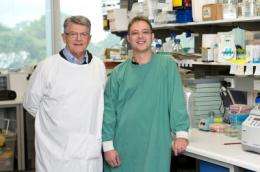
Professor Claude Bernard and Dr Steven Petratos

(Medical Xpress) -- The progression of the debilitating disease Multiple Sclerosis (MS) could be slowed or even halted by blocking a protein that contributes to nerve damage, according to a new study.

In research published today in the journal Brain, scientists from the Monash and Stem Cell Laboratories (MISCL), the University of Toronto, Yale and the University of Western Australia, have demonstrated the key role played by the collapsin response mediator protein 2 (CRMP-2) in the development of .

Led by MISCL’s Dr Steven Petratos, also of RMIT University, and Professor Claude Bernard, the research team found that a modified version of CRMP-2 is present in active MS lesions, which indicate damage to the nervous system, in a laboratory model of MS.

The modified CRMP-2 interacts with another protein to cause nerve fibre damage that can result in numbness, blindness, difficulties with speech and motor skills, and cognitive impairments in sufferers.

When either the modified CRMP-2 or the interaction between the two proteins was blocked, using a method already approved in both the US and Australia, the progression of the disease was halted.

Director of MISCL, Professor Richard Boyd said the discovery could lead to new treatments for MS.

“Blocking the same protein in people with MS could provide a ‘handbrake’ to the progression of the disease,” Professor Boyd said.

Dr Petratos said the method used to block the was approved for the treatment of other disease conditions by both the US Food and Drug Administration and Australia’s Therapeutic Goods Administration.

“This should mean that clinical trials – once they start – will be fast tracked as the form of administration has already been approved,” Dr Petratos said.

MS Australia estimates that the disease affects more than 20,000 people in Australia, and up to 2.5 million worldwide. The disease tends to strike early in adulthood, with women three times more likely than men to be diagnosed. The total cost to the Australian community of the disease is estimated at $1 billion annually.

The research received major funding from the National Society of the United States of America and partial funding from MS Research Australia.

Provided by Monash University search and more info website

4.9 /5 (9 votes)  

Rank 4.9 /5 (9 votes)
Related Stories
Relevant PhysicsForums posts

More news stories

For combat veterans suffering from post-traumatic stress disorder, 'fear circuitry' in the brain never rests

Chronic trauma can inflict lasting damage to brain regions associated with fear and anxiety. Previous imaging studies of people with post-traumatic stress disorder, or PTSD, have shown that these brain regions can over-or ...

Neuroscience created May 18, 2013 | popularity 5 / 5 (1) | comments 0 | with audio podcast

Temporal processing in the olfactory system

The neural machinery underlying our olfactory sense continues to be an enigma for neuroscience. A recent review in Neuron seeks to expand traditional ideas about how neurons in the olfactory bulb might encode information about ...

Neuroscience created May 17, 2013 | popularity 4 / 5 (1) | comments 0 | with audio podcast report

Melon focus headband turns to Kickstarter for rollout plans

(Medical Xpress)—What if the quality of your work depends more on your focus on the piano keys or canvas or laptop than your musical or painting or computing skills? If target users can be convinced, they ...

Neuroscience created May 17, 2013 | popularity 3.7 / 5 (3) | comments 0 | with audio podcast weblog

Deep brain stimulation: A fix when the drugs don't work

Neurological disorders can have a devastating impact on the lives of sufferers and their families.

Neuroscience created May 17, 2013 | popularity 5 / 5 (1) | comments 0 | with audio podcast

Brain makes call on which ear is used for cell phone

If you're a left-brain thinker, chances are you use your right hand to hold your cell phone up to your right ear, according to a newly published study from Henry Ford Hospital in Detroit.

Neuroscience created May 16, 2013 | popularity 2 / 5 (2) | comments 0 | with audio podcast


Researchers identify a potential new risk for sleep apnea: Asthma

Researchers at the University of Wisconsin have identified a potential new risk factor for obstructive sleep apnea: asthma. Using data from the National Institutes of Health (Heart, Lung, and Blood Institute)-funded Wisconsin ...

Computational tool translates complex data into simplified 2-dimensional images

In their quest to learn more about the variability of cells between and within tissues, biomedical scientists have devised tools capable of simultaneously measuring dozens of characteristics of individual ...

Study finds that sleep apnea and Alzheimer's are linked

A new study looking at sleep-disordered breathing (SDB) and markers for Alzheimer's disease (AD) risk in cerebrospinal fluid (CSF) and neuroimaging adds to the growing body of research linking the two.

New theory on genesis of osteoarthritis comes with successful therapy in mice

Scientists at Johns Hopkins have turned their view of osteoarthritis (OA) inside out. Literally. Instead of seeing the painful degenerative disease as a problem primarily of the cartilage that cushions joints, ...

'Gap' for HIV vaccine efforts after latest setback

The hunt for an HIV vaccine has gobbled up $8 billion in the past decade, and the failure of the most recent efficacy trial has delivered yet another setback to 26 years of efforts.

Ginger compounds may be effective in treating asthma symptoms

Gourmands and foodies everywhere have long recognized ginger as a great way to add a little peppery zing to both sweet and savory dishes; now, a study from researchers at Columbia University shows purified components of the ...